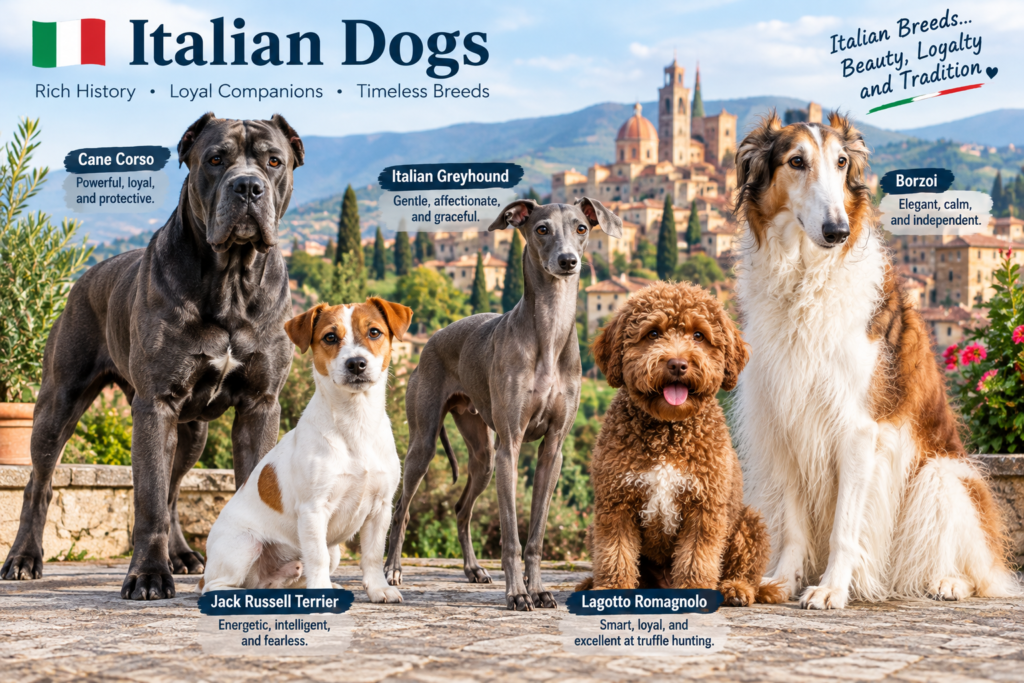
Italy is famous for its history, art, food, and culture, but the country also has a remarkable tradition of dog breeding. Italian dogs come in many different shapes and sizes, from powerful guardian breeds to elegant companion dogs and highly skilled hunting breeds.
Some Italian breeds are internationally famous, such as the Cane Corso, while others are less commonly seen outside Italy. The country has developed breeds for guarding property, protecting livestock, hunting, retrieving, tracking, companionship, and other specialized work.
Italian breeds recognized by major kennel organizations include the Cane Corso, Lagotto Romagnolo, Spinone Italiano, Italian Greyhound, Bracco Italiano, Bergamasco Sheepdog, Cirneco dell’Etna, Neapolitan Mastiff, Bolognese, and Volpino Italiano. Research into Italian dog populations also documents several regional and locally maintained breeds. For more insight here rarest dogs on earth
What Are Italian Dogs?
Italian dogs are breeds that originated in Italy or have a long-established historical connection with particular Italian regions.
They are extremely diverse. Some were bred to work with hunters, while others protected homes, farms, or livestock. Smaller breeds were often developed as companion dogs.
This variety means there is no single “Italian dog personality.” A Cane Corso has very different needs from an Italian Greyhound, while a Lagotto Romagnolo has a completely different working background from a Bolognese.
Most Popular Italian Dog Breeds
Here are some of the best-known Italian dog breeds.
1. Cane Corso
The Cane Corso is one of the most recognizable Italian dogs. It is a large, muscular mastiff-type breed with a history of working as a guardian and utility dog.
The Fédération Cynologique Internationale (FCI) lists the breed as Cane Corso Italiano, with Italy as its country of origin. It belongs to the Molossian type and Mastiff subsection.
Cane Corsos are powerful and athletic dogs. They require early socialization, consistent training, appropriate exercise, and responsible handling.
Their size and strength mean they are generally better suited to owners who understand large working breeds.
2. Italian Greyhound
The Italian Greyhound is almost the opposite of the Cane Corso in size and appearance.
It is a tiny, elegant sighthound with a slender body, long legs, and a graceful appearance. The AKC describes it as a miniature Greyhound with an affectionate and playful companion nature, while also noting its instinct to pursue moving objects.
Italian Greyhounds can make excellent companions for people who want a small dog with an athletic side.
Despite their delicate appearance, they still benefit from regular exercise and safe opportunities to run and play.
3. Lagotto Romagnolo
The Lagotto Romagnolo is a curly-coated Italian breed famous for its exceptional scenting ability.
Historically associated with water work, the breed later became highly specialized in truffle hunting. The FCI recognizes the Lagotto Romagnolo as an Italian breed in the water-dog group.
The Italian kennel organization ENCI describes the Lagotto as a specialized truffle-searching dog with an excellent sense of smell. It is also described as affectionate, attentive, trainable, and strongly attached to its owner.
Its curly coat requires regular maintenance, and its intelligent working mind benefits from training and activities.
4. Spinone Italiano
The Spinone Italiano is an old Italian hunting breed known for its distinctive rough coat, strong body, and gentle expression.
The AKC describes the Spinone as sociable, patient, and versatile, with an ancient Italian lineage.
The FCI classifies it as an Italian pointing dog in the continental pointing-dog group.
Spinoni are active dogs that generally benefit from outdoor exercise and activities that allow them to use their natural abilities.
5. Neapolitan Mastiff
The Neapolitan Mastiff, or Mastino Napoletano, is a massive Italian mastiff recognized for its heavy build and loose, wrinkled skin.
It has historically been associated with guarding and protection. Its enormous size means that training, socialization, nutrition, and veterinary care are particularly important.
This breed is very different from smaller Italian companions and should be considered by owners who are prepared for the responsibilities of living with an extremely large dog.
6. Bracco Italiano
The Bracco Italiano is an elegant Italian pointing breed with a long history as a hunting dog.
It has a distinctive appearance, including long ears, a noble head, and a strong athletic body.
Bracco Italianos are active working dogs and generally need regular exercise, training, and mental stimulation.
The breed is recognized by the AKC among pointing breeds.
7. Bergamasco Sheepdog
The Bergamasco Sheepdog is famous for its unusual coat, which develops into long, textured mats or “flocks.”
It originated in the Italian Alps and was developed as a herding and working dog.
Its coat is one of its most recognizable features, but prospective owners should learn proper coat care before choosing the breed.
8. Cirneco dell’Etna
The Cirneco dell’Etna is a graceful Italian sighthound from Sicily.
It has a slim athletic body, large upright ears, and a short coat. Historically, it was used for hunting in the difficult terrain around Mount Etna.
The breed is relatively small compared with large Italian working dogs and can be an energetic companion for an active owner.
9. Bolognese
The Bolognese is a small companion dog associated with the Italian city of Bologna.
It has a fluffy white coat and a compact body. Unlike large Italian working breeds, the Bolognese was developed primarily as a companion.
Its smaller size can make it suitable for people who prefer a compact dog, although grooming and socialization remain important.
10. Volpino Italiano
The Volpino Italiano is a small, fluffy Italian companion breed with a fox-like appearance.
It has a lively personality and distinctive pointed ears and curled tail.
Although small, the Volpino is not simply a decorative dog. It can be alert, active, and vocal, so training and socialization are useful from an early age.
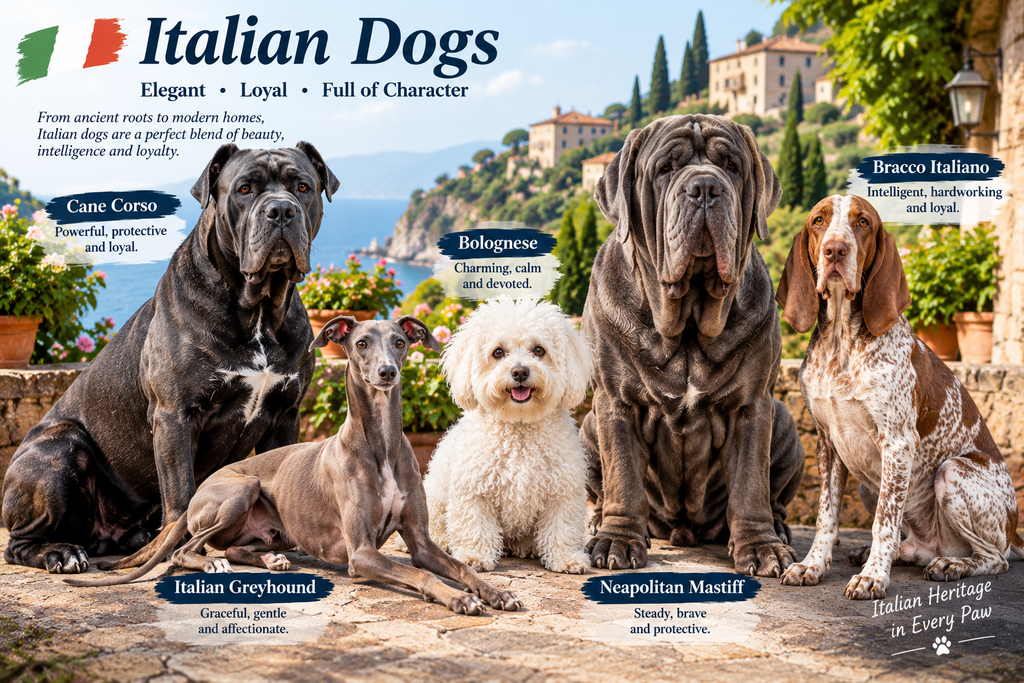
Italian Dogs by Size
Italian breeds cover almost the entire size range.
| Size | Examples |
|---|---|
| Small | Italian Greyhound, Bolognese, Volpino Italiano |
| Small–Medium | Cirneco dell’Etna, Lagotto Romagnolo |
| Medium–Large | Spinone Italiano, Bracco Italiano, Bergamasco Sheepdog |
| Large | Cane Corso |
| Giant | Neapolitan Mastiff |
This variety makes Italian breeds suitable for very different types of households, although individual breed needs should always be considered.
Italian Dogs by Purpose
Guard Dogs
The Cane Corso and Neapolitan Mastiff are well-known Italian breeds associated with guarding and protection.
They require experienced, responsible ownership because their size and strength make appropriate training particularly important.
Hunting Dogs
Italy has produced several accomplished hunting breeds, including the Bracco Italiano, Spinone Italiano, Cirneco dell’Etna, and Segugio Italiano.
Their exercise requirements can be significant because their instincts were shaped by generations of working.
Truffle Dogs
The Lagotto Romagnolo has become especially famous for truffle hunting.
Its excellent nose and trainability make it particularly suited to scent-based work.
Companion Dogs
The Italian Greyhound, Bolognese, and Volpino Italiano are examples of smaller Italian breeds that can be kept primarily as companions.
However, small size does not mean zero exercise. These dogs still need appropriate physical activity, training, and social interaction.
Are Italian Dogs Good Family Pets?
Some Italian breeds can be excellent family companions, but there is no single answer for every Italian breed.
A Bolognese has very different needs from a Cane Corso. A Lagotto Romagnolo may want plenty of mental stimulation, while an Italian Greyhound may prefer a combination of play, exercise, and comfortable indoor living.
Families should consider:
- Dog size
- Energy level
- Temperament
- Training requirements
- Grooming needs
- Exercise requirements
- Experience with dogs
- Compatibility with children and other pets
Do Italian Dogs Need a Lot of Exercise?
It depends on the breed.
Working and hunting breeds such as the Cane Corso, Bracco Italiano, Spinone Italiano, and Lagotto Romagnolo generally need regular physical and mental activity.
Smaller companion breeds may require less exercise, but they still need daily movement and interaction.
Mental stimulation is also important. Training, scent games, puzzle toys, and appropriate activities can help prevent boredom.
Grooming Italian Dog Breeds
Italian breeds have very different coats.
The Italian Greyhound has a short coat and generally requires relatively simple grooming.
The Lagotto Romagnolo has a dense curly coat that needs regular maintenance.
The Bergamasco Sheepdog has an unusual flocked coat requiring specialized care.
The Spinone Italiano has a rough coat that also benefits from regular grooming.
Before choosing an Italian dog, owners should research the specific coat rather than assuming all Italian breeds have similar grooming requirements.
Training Italian Dogs
Training should begin early, especially with intelligent or powerful working breeds.
Positive, consistent training can help establish good manners and communication between dog and owner.
Socialization is particularly important for dogs that may naturally be cautious, independent, protective, or highly alert.
For large breeds such as the Cane Corso and Neapolitan Mastiff, basic obedience and responsible handling are especially important because even ordinary behavioral problems become more difficult to manage when the dog is very large.
Italian Dogs and Apartment Living
Some Italian dogs can adapt to apartment life, but breed size alone should not determine suitability.
An Italian Greyhound may be much easier to accommodate in a smaller home than a Cane Corso or Neapolitan Mastiff.
However, an apartment dog still needs appropriate daily exercise and mental stimulation. Owners should also consider barking, access to outdoor areas, stairs, temperature, and the dog’s individual temperament.
Are Italian Dogs Rare?
Some Italian breeds are much less commonly encountered than others.
The number of dogs varies according to the breed and country. Some Italian breeds have established international populations, while others remain strongly associated with Italy or particular regions.
Research on Italian dog populations has identified numerous breeds and regional dog populations, including established breeds as well as locally maintained populations.
How to Choose the Right Italian Dog
The best approach is to choose based on lifestyle rather than appearance.
Ask yourself:
- How much exercise can I provide every day?
- Do I have experience with large or powerful dogs?
- How much grooming can I manage?
- Do I want a companion, hunting dog, or working dog?
- How much training and mental stimulation can I provide?
- Do I live in an apartment or a house?
- Will the dog live with children or other animals?
Answering these questions can help narrow down the Italian breeds that fit your circumstances.
Frequently Asked Questions
What is the most famous Italian dog breed?
The Cane Corso is one of the most internationally recognized Italian dog breeds. The FCI officially lists it as Cane Corso Italiano and identifies Italy as its country of origin.
What is the smallest Italian dog?
The Italian Greyhound is one of Italy’s smallest recognized breeds and is a miniature sighthound.
Which Italian dog is famous for finding truffles?
The Lagotto Romagnolo is famous for truffle hunting and has an excellent sense of smell.
What Italian dog has a curly coat?
The Lagotto Romagnolo is particularly well known for its dense, curly coat.
Are Italian dogs good pets?
Many Italian breeds can be wonderful pets, but each breed has different exercise, training, grooming, and temperament requirements.
What are some Italian hunting dogs?
Italian hunting breeds include the Bracco Italiano, Spinone Italiano, Cirneco dell’Etna, Lagotto Romagnolo, and Segugio Italiano.
Conclusion
Italian dogs represent an impressive range of canine history and working ability. From the powerful Cane Corso and Neapolitan Mastiff to the elegant Italian Greyhound, talented Lagotto Romagnolo, and versatile Spinone Italiano, Italy has produced breeds for almost every purpose.
Their differences are just as important as their shared Italian heritage. Some are guardians, some are hunters, some are scent specialists, and others are devoted companion dogs.
If you are considering an Italian dog, focus on the individual breed’s temperament, exercise requirements, grooming, training needs, and size. Choosing a dog based on lifestyle and long-term compatibility is more important than choosing one simply because it looks distinctive.
[…] Several Italian breeds are formally recognized by the Fédération Cynologique Internationale (FCI), including the Cane Corso Italiano, Bracco Italiano, Spinone Italiano, and Lagotto Romagnolo. For more insight here italian dogs […]