
Large fluffy dogs are hard to miss. Their thick coats, impressive size, and often gentle personalities make breeds such as the Newfoundland, Bernese Mountain Dog, Great Pyrenees, and Leonberger especially appealing to dog lovers. But that beautiful fluff also comes with real grooming, exercise, training, and space requirements.
The best large fluffy dog for your household depends on more than appearance. Consider the breed’s temperament, coat maintenance, activity level, independence, and ability to fit into your everyday routine. For more insight here best medium sized dog breeds
What Makes a Dog a Large Fluffy Breed?
A large fluffy dog generally combines a substantial body size with a long, dense, thick, or abundant coat. Many were developed for demanding jobs in cold environments, including livestock guarding, water rescue, pulling, and farm work.
The American Kennel Club notes that many giant breeds have working backgrounds and require careful consideration of housing, training, development, and ongoing care.
Common characteristics include:
- Thick or double coats
- Significant seasonal shedding in many breeds
- Strong working instincts
- Considerable adult size
- Regular grooming requirements
- Need for appropriate exercise
- Early socialization and training
Fluffy does not automatically mean low-energy. Some large coated dogs are athletic working breeds that need substantial physical and mental activity.
15 Large Fluffy Dog Breeds
1. Newfoundland
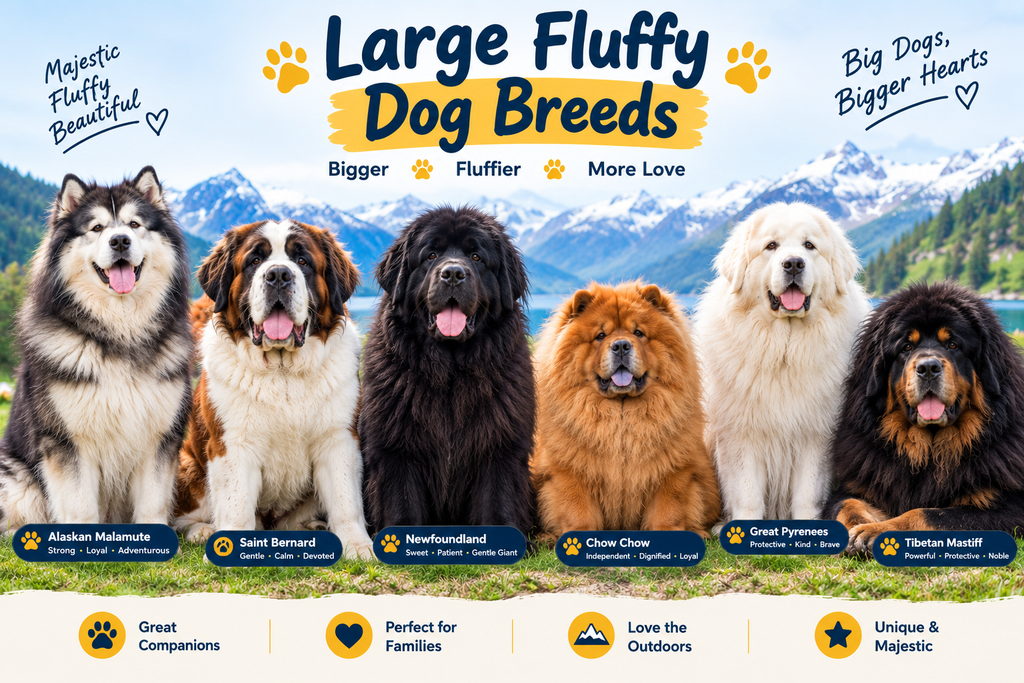
The Newfoundland is one of the most recognizable large fluffy breeds. Originally associated with Canadian fishermen, Newfoundlands were developed as powerful working dogs capable of performing demanding tasks in and around water.
Their heavy, water-resistant coat helped protect them in cold conditions. Today, they are known for their gentle nature and strong attachment to their families.
What to know:
- Gentle and people-oriented
- Large and powerful
- Thick, water-resistant coat
- Regular grooming required
- Enjoys appropriate daily activity
A Newfoundland can be an impressive family companion, but owners need to be prepared for the realities of living with a very large, heavy dog.
2. Bernese Mountain Dog
The Bernese Mountain Dog combines a striking tri-colored coat with a friendly and good-natured personality. Originally developed as a farm dog in Switzerland, it was used for jobs including drafting and carting.
Its long, silky double coat contributes heavily to its fluffy appearance and requires regular brushing. The breed generally does well in cooler weather.
Best suited to:
- Families
- Cooler climates
- Owners who enjoy outdoor walks
- Homes able to accommodate a large dog
One practical consideration is shedding: that beautiful coat will leave hair around the home.
3. Great Pyrenees
The Great Pyrenees has a majestic white coat that gives it an especially fluffy appearance. Historically developed as a livestock guardian, the breed retains independent protective instincts.
The AKC describes the breed as patient, independent, and fearless. Its thick, weather-resistant coat needs regular brushing.
Best suited to:
- Experienced owners
- Homes with adequate space
- Families wanting a guardian-type dog
- People comfortable with an independent temperament
A common misconception is that a fluffy appearance means the dog is always eager to follow commands. Great Pyrenees can be independent thinkers, so consistent training matters.
4. Leonberger
The Leonberger is a giant German breed famous for its lion-like appearance and abundant coat. The AKC describes it as a lush-coated giant with a gentle nature.
Leonbergers were developed as versatile working and companion dogs and can be strikingly calm and affectionate when properly socialized.
What to expect:
- Very large body
- Profuse coat
- Regular grooming
- Strong family attachment
- Need for daily activity
Their combination of size and coat means they require owners who are prepared for significant grooming and general care.
5. Saint Bernard
The Saint Bernard is a classic giant breed associated with rescue work in the Swiss Alps. Its substantial body, thick coat, and distinctive expression make it one of the world’s most recognizable large dogs.
The breed was historically developed to locate and rescue travelers in difficult alpine conditions.
Potential advantages:
- Friendly appearance
- Family-oriented personality
- Impressive size
- Strong historical working background
Potential owners should also prepare for shedding, grooming, drool, and the practical challenges of managing a giant dog.
6. Old English Sheepdog
The Old English Sheepdog is perhaps one of the first breeds people picture when they hear “large fluffy dog.” Its abundant coat can completely transform its silhouette and gives the breed its famous shaggy appearance.
The AKC describes it as the archetypical shaggy dog, known for its profuse coat.
Grooming is a major consideration.
Owners should be prepared for:
- Frequent brushing
- Coat maintenance
- Regular checks for mats
- Keeping the coat clean and dry
- Professional grooming when needed
This breed is particularly appealing to people who genuinely enjoy maintaining a long, thick coat.
7. Tibetan Mastiff
The Tibetan Mastiff is an imposing guardian breed with an enormous double coat. Historically used to guard monasteries and livestock, it is known for independence and strong protective instincts.
This is not simply a giant fluffy companion dog.
Important characteristics include:
- Independent temperament
- Strong guarding instincts
- Substantial coat
- Powerful build
- Need for experienced handling
The breed can be a poor match for someone who wants an easygoing dog that immediately follows every command.
8. Alaskan Malamute
The Alaskan Malamute is a powerful Arctic working dog with a dense double coat designed for harsh conditions. Its appearance combines a muscular frame with thick fur and a distinctive northern-dog look.
The AKC includes the Alaskan Malamute among its Working Group breeds.
Best for:
- Active owners
- Cold-weather environments
- Experienced dog households
- People who enjoy outdoor activities
Malamutes need appropriate exercise and engagement. Their impressive coat also means owners should expect regular grooming and significant shedding.
9. Samoyed
The Samoyed is famous for its brilliant white coat, fluffy appearance, and characteristic friendly expression. Although generally smaller than some giant breeds on this list, it is still a substantial, heavily coated working dog.
The AKC places the Samoyed in the Working Group.
Samoyeds typically appeal to people who want:
- A highly fluffy coat
- An active companion
- An interactive family dog
- A distinctive northern-breed appearance
Their beautiful coat requires consistent care, and owners should be prepared for shedding.
10. Kuvasz
The Kuvasz is a large Hungarian livestock guardian recognized for its white coat and independent working nature. Its thick coat provides the fluffy appearance many large-dog enthusiasts love.
Because of its guardian background, it may be more independent than a typical companion breed.
Important considerations:
- Strong protective instincts
- Independent personality
- Substantial size
- Regular coat care
- Early socialization and training
It can be a better match for someone who understands guardian breeds rather than a first-time owner looking for an uncomplicated pet.
11. Komondor
The Komondor is one of the most unusual fluffy-looking dogs in the world. Rather than having a conventional fluffy coat, its distinctive coat develops into long cords.
The AKC describes the Komondor as a large Hungarian flock guardian covered in profuse white cords.
Its coat requires specialized care and should not be treated like the coat of an ordinary long-haired dog.
Best suited to:
- Experienced owners
- People interested in unusual breeds
- Households prepared for specialized coat care
- Owners who understand guardian-dog behavior
12. Briard
The Briard is a large French herding breed with a long, slightly wavy coat. The AKC describes the breed as loyal, loving, and spirited.
Its combination of intelligence, working heritage, and substantial coat makes it an interesting choice for experienced dog owners.
A Briard needs more than brushing. It also benefits from regular training and activities that engage its mind.
13. Estrela Mountain Dog
The Estrela Mountain Dog is a large guardian breed originating from Portugal. It has a substantial coat and was developed for work in mountainous environments.
The AKC includes the Estrela Mountain Dog among its large, long-coated breeds.
Its guardian background means prospective owners should understand that large fluffy breeds can have serious working instincts beneath their cuddly appearance.
14. Anatolian Shepherd Dog
The Anatolian Shepherd Dog is a large livestock guardian with a strong, rugged build. It may not have the same extremely long coat as a Leonberger or Old English Sheepdog, but its dense coat and impressive size can give it a substantial appearance.
The AKC describes the breed as protective, intelligent, loyal, and territorial.
Best for:
- Experienced owners
- Rural or spacious environments
- People familiar with guardian breeds
- Households able to provide appropriate training
This is a working guardian rather than simply a decorative fluffy dog.
15. Greater Swiss Mountain Dog
The Greater Swiss Mountain Dog is a powerful Swiss working breed with a dense coat and substantial build. It belongs to the same broad Swiss mountain-dog family as the Bernese Mountain Dog.
The AKC lists the Greater Swiss Mountain Dog among its Working Group breeds.
Its short-to-medium coat is not as dramatically fluffy as the Leonberger or Old English Sheepdog, but its large frame and dense coat still give it a substantial appearance.
Which Large Fluffy Dogs Are Good Family Dogs?
Several large coated breeds can make wonderful family companions, but breed selection should always consider the individual dog’s temperament, training, socialization, and the family’s ability to manage its size.
Breeds often associated with family companionship include:
- Newfoundland
- Bernese Mountain Dog
- Leonberger
- Saint Bernard
- Old English Sheepdog
The AKC specifically notes that several giant breeds, including Bernese Mountain Dogs and Newfoundlands, can be excellent family companions.
However, even a gentle giant needs basic manners.
A 100-pound dog jumping on guests may be dangerous even if the behavior is friendly. Early training is therefore especially valuable with large breeds.
Are Large Fluffy Dogs Hard to Groom?
Some are, yes.
The amount of grooming depends heavily on the individual breed’s coat.
Higher-maintenance coats may include:
- Old English Sheepdog
- Leonberger
- Bernese Mountain Dog
- Newfoundland
- Tibetan Mastiff
Specialized coat care:
- Komondor
Regular grooming can help remove loose hair, prevent or identify mats, and keep the coat in better condition.
For example, the AKC notes that Leonbergers have profuse coats and need frequent brushing, while Bernese Mountain Dogs have long double coats requiring regular brushing.
Do Large Fluffy Dogs Shed a Lot?
Many do, but the amount varies by breed and individual dog.
Owners should be prepared for:
- Hair on floors
- Fur on furniture
- Seasonal increases in shedding for some breeds
- Regular brushing
- Frequent vacuuming
- Extra coat care during shedding periods
A thick coat can look beautiful in photographs but requires real maintenance in everyday life.
Are Large Fluffy Dogs Good for Apartments?
Size alone does not determine whether a dog can live comfortably in an apartment.
The AKC notes that some large dogs can adapt to smaller living spaces when they receive suitable exercise and enrichment.
However, practical issues become more important with giant fluffy dogs.
Consider:
- Elevator access
- Hallway space
- Exercise opportunities
- Temperature control
- Grooming space
- Dog-friendly flooring
- Building weight restrictions
- Access to veterinary care
A giant breed can physically occupy a lot of space even if it is relatively relaxed indoors.
How Much Exercise Do Large Fluffy Dogs Need?
Exercise needs vary enormously.
A Newfoundland and an Alaskan Malamute may both be large, thick-coated working dogs, but their lifestyles and individual energy levels can differ.
Daily activities can include:
- Walks
- Training sessions
- Controlled outdoor play
- Hiking where appropriate
- Scent games
- Retrieving games
- Obedience work
Puppies of giant breeds need particularly thoughtful management because they mature slowly. The AKC notes that giant breeds can remain puppy-like for a long developmental period and require careful management as they grow.
Common Mistake: Choosing a Fluffy Dog Only for Its Appearance
One of the biggest mistakes is choosing a breed because it looks like a giant teddy bear.
A fluffy dog may have:
- Strong guarding instincts
- High exercise requirements
- Heavy shedding
- Independent behavior
- Extensive grooming needs
- Significant training requirements
For example, a Great Pyrenees may look soft and cuddly but was developed as a livestock guardian and can be independent. A Tibetan Mastiff has an even stronger guardian background.
Before choosing a breed, ask yourself:
- Can I manage its adult size?
- Can I afford large-dog supplies and veterinary care?
- Am I prepared for shedding?
- Do I have time for grooming?
- Can I provide daily exercise?
- Am I comfortable training a powerful dog?
- Does its temperament fit my household?
Large Fluffy Dogs vs. Giant Dogs
Not every fluffy dog is technically a giant breed.
For example, a Samoyed can look extremely fluffy without reaching the enormous size of a Newfoundland or Saint Bernard.
The difference matters because body size affects:
- Food requirements
- Transportation
- Crate size
- Beds and equipment
- Veterinary care
- Home space
- Physical handling
The AKC emphasizes that a giant dog’s size can affect housing, transportation, supplies, veterinary care, and overall ownership costs.
How to Choose the Right Large Fluffy Dog
Start with lifestyle rather than appearance.
If you want a gentle family companion:
Look into:
- Newfoundland
- Bernese Mountain Dog
- Leonberger
- Saint Bernard
If you want a livestock guardian:
Consider:
- Great Pyrenees
- Anatolian Shepherd
- Kuvasz
- Tibetan Mastiff
If you want an active northern breed:
Consider:
- Alaskan Malamute
- Samoyed
If you want an unusual coat:
Consider:
- Komondor
- Old English Sheepdog
Remember that these categories describe breed tendencies, not guarantees about individual dogs.
Frequently Asked Questions
What is the fluffiest large dog breed?
There is no single official “fluffiest” breed. Old English Sheepdogs, Leonbergers, Newfoundlands, Bernese Mountain Dogs, Great Pyrenees, and other long- or heavily coated breeds are all notably fluffy.
What is the best large fluffy dog for a family?
Newfoundlands, Bernese Mountain Dogs, Leonbergers, and some Saint Bernards can be family companions when their exercise, training, grooming, and space requirements are met. Individual temperament matters as much as breed.
What large fluffy dog is easiest to groom?
There is no truly low-maintenance large fluffy breed. Dogs with shorter or less abundant coats generally require less coat maintenance than breeds with very long or profuse hair.
Do large fluffy dogs need a big house?
Not necessarily. Some large dogs can adapt to smaller homes when their exercise and enrichment needs are met. However, the dog’s adult size, activity level, and ability to move comfortably indoors should be considered.
Are large fluffy dogs expensive to maintain?
They can be. Larger dogs generally require larger beds, crates, collars, food portions, transportation arrangements, and other supplies. Veterinary and medication costs can also be affected by body size.
Which large fluffy dogs are good in cold weather?
Many thick-coated breeds were developed for cold environments. Examples include the Bernese Mountain Dog, Newfoundland, Great Pyrenees, Alaskan Malamute, and Saint Bernard. Their coats provide insulation, but individual dogs still need appropriate protection and care based on weather conditions.
The Bottom Line
Large fluffy dogs can be extraordinary companions, but their beautiful appearance comes with real responsibilities. Grooming, shedding, exercise, training, space, and the practical challenges of living with a large dog should all be considered before choosing a breed.
From the gentle Newfoundland and affectionate Bernese Mountain Dog to the independent Great Pyrenees and powerful Tibetan Mastiff, these dogs represent very different personalities despite their shared fluffy appearance. The American Kennel Club’s breed information also highlights how many large dogs were originally developed for serious working roles such as guarding, water rescue, and drafting.
The right large fluffy dog is the one whose size, temperament, grooming needs, exercise level, and working instincts fit your actual lifestyle—not simply the one with the most impressive coat.
[…] If you love the look of a giant white dog, it is worth learning about the breed behind the fluffy coat. Some are calm and watchful, while others are energetic, highly independent, or require specialized grooming. For more insight here large fluffy dog breeds […]