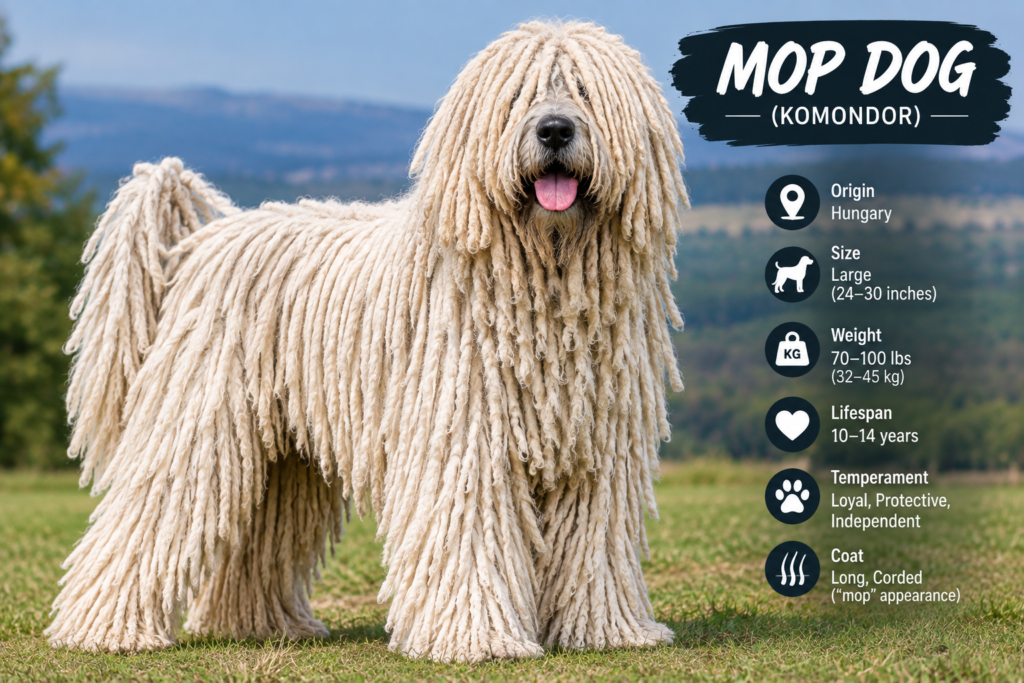
When people search for the mop dog breed, they are usually talking about the Komondor, a large Hungarian livestock guardian famous for its long, white, corded coat. Its unusual appearance makes it look remarkably similar to a traditional floor mop, which is why “Mop Dog” became a popular nickname.
The Komondor is much more than its unusual coat. It is an intelligent, courageous, independent, and highly protective working dog. For centuries, it was used to guard livestock, particularly sheep, from predators and other threats.
Today, the Komondor can be a devoted family companion, but it is not a breed for every household. Its size, guardian instincts, independent personality, and demanding coat require an owner who understands the breed. For more insight here italian mastiff vs cane corso
Quick Facts About the Mop Dog
| Feature | Komondor |
|---|---|
| Common Name | Komondor |
| Nicknames | Mop Dog, Hungarian Sheepdog |
| Origin | Hungary |
| Size | Large |
| Coat | Long, white, naturally corded |
| Original Purpose | Livestock guardian |
| Personality | Loyal, protective, independent |
| Energy | Moderate to active |
| Training | Requires consistency |
| Grooming | High maintenance |
| Best For | Experienced dog owners |
Mop Dog BreedWhy Is the Komondor Called a Mop Dog?
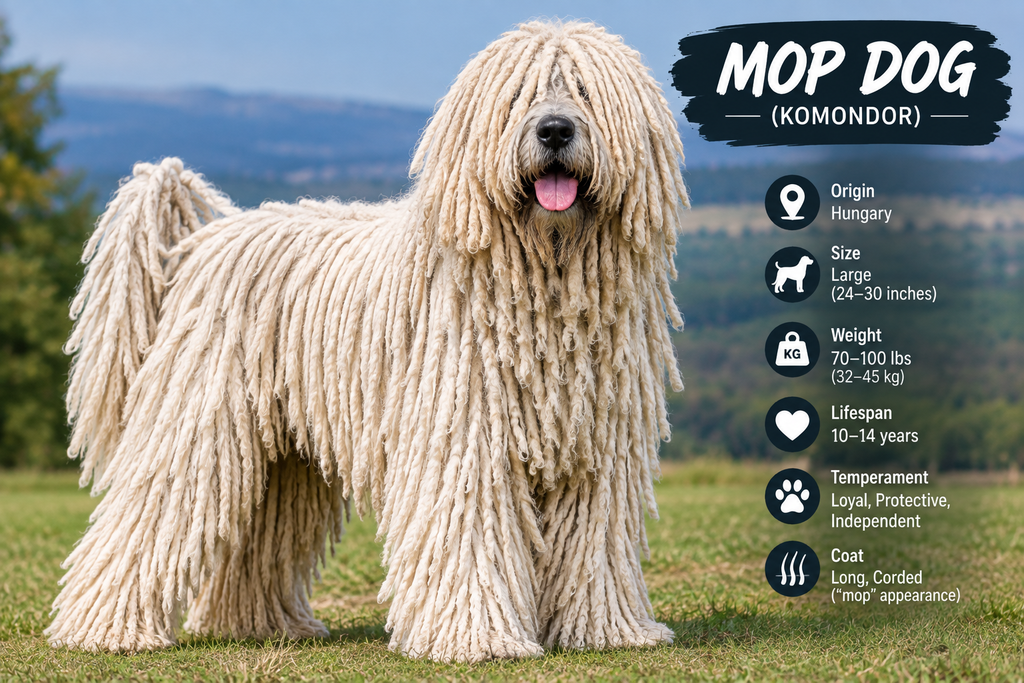
The Komondor’s most recognizable feature is its long, white corded coat. As the dog matures, the soft undercoat and coarser outer coat combine to form distinctive rope-like cords. These cords create the mop-like appearance associated with the breed.
The coat is not simply decorative. It developed as protection against harsh weather and helped shield the dog from attacks while working around livestock. The cords can also provide insulation against cold and other environmental conditions.
A young Komondor does not immediately look like the classic mop dog. Puppies have a softer, fluffy coat, while the characteristic cords develop as they mature.
Mop Dog Breed Komondor History
The Komondor has a long history connected to Hungary and the pastoral cultures of Central Europe. The breed is associated with the Cumans, and its name has been linked to the Cuman people. Historical references to the breed date back centuries.
The Komondor was developed primarily as a livestock guardian. Rather than constantly herding sheep, its job was to stay with the flock and protect it from predators.
This history explains many of the breed’s modern characteristics. A Komondor had to be able to make decisions independently, recognize potential threats, and react without waiting for constant instructions from a human.
Mop Dog Appearance
The Komondor is a large, muscular dog with a powerful body hidden beneath its distinctive coat.
Key physical characteristics include:
- Large and strongly built body
- Long, white corded coat
- Broad head
- Dark nose
- Strong muzzle
- Muscular legs
- Large bone structure
- Long, hanging cords
- Confident posture
Male Komondors have a minimum height of about 27.5 inches, while females have a minimum height of about 25.5 inches. The breed has no upper height limit in the commonly cited standard.
Their size, combined with their unusual coat, gives them an imposing appearance.
Mop Dog Breed Komondor Temperament
The Komondor is generally loyal, courageous, alert, protective, and independent.
Because it was bred to guard livestock without constant human direction, it does not always behave like a dog that wants to follow every command immediately. It can evaluate situations independently, which is useful for a guardian but can be challenging for an inexperienced owner.
Komondors often form strong bonds with their families. At the same time, they can be reserved or suspicious around unfamiliar people.
Early socialization is therefore extremely important.
Is the Mop Dog Aggressive?
The Komondor is naturally protective, but protective behavior should not automatically be confused with uncontrolled aggression.
Its original job required it to recognize potential threats and defend livestock. As a result, the breed can be territorial and serious about protecting its home and family.
Responsible socialization and training can help a Komondor learn how to behave appropriately around visitors, other animals, and unfamiliar environments.
Because of its size and strength, poor socialization can become difficult to manage.
Mop Dog Breed Training a Komondor
Training a Komondor requires patience, consistency, and confidence.
This is an intelligent breed, but it was specifically developed to work independently. That means owners should not expect the dog to behave like a highly obedient breed that automatically follows every command.
Important training areas include:
- Basic obedience
- Leash manners
- Recall
- Impulse control
- Visitor manners
- Puppy socialization
- Handling and grooming tolerance
- Appropriate behavior around other animals
Short, consistent training sessions can be more effective than repetitive sessions that become boring.
Mop Dog Breed Exercise Requirements
Despite its large size and impressive coat, the Komondor needs regular physical activity.
Daily walks and opportunities to move around safely are important. The breed can also benefit from having an appropriate area where it can patrol and observe its surroundings.
However, the Komondor is not necessarily a nonstop high-energy dog. Its activity level can vary with age, health, environment, and individual personality.
Mental stimulation is also valuable because guardian breeds need opportunities to use their intelligence.
Mop Dog Breed Komondor Grooming
This is one of the biggest considerations for anyone thinking about owning a mop dog.
The Komondor’s coat is naturally corded, and those cords require careful maintenance. Owners need to keep the individual cords separated so that they do not form one giant, unhealthy mat.
Grooming involves:
- Separating cords
- Checking the skin regularly
- Keeping the coat clean
- Carefully drying the coat after bathing
- Regular nail trimming
- Ear care
- Dental care
Bathing can be particularly challenging because the dense cords can take a long time to dry.
For many owners, professional grooming advice is extremely useful.
Does a Mop Dog Shed?
The Komondor’s coat behaves differently from the coat of many common dog breeds.
Instead of leaving large amounts of loose hair around the house, much of the hair becomes incorporated into the developing cords. Fully developed cords can therefore give the impression of relatively low shedding.
However, low visible shedding does not mean low maintenance. The coat still requires considerable care.
Mop Dog Breed Komondor With Children
A well-socialized Komondor can become devoted to its family, but its large size and protective instincts mean children should always be supervised around the dog.
Parents should teach children:
- Not to pull the dog’s coat
- Not to disturb the dog while eating
- Not to climb on the dog
- Not to tease the dog
- How to respect the dog’s personal space
The individual dog’s temperament also matters greatly.
Mop Dog Breed Komondor With Other Pets
Because the Komondor was developed as a livestock guardian, it can have strong instincts around other animals.
Some individuals can live successfully with other household pets, particularly when properly socialized from an early age. However, owners should not assume that every Komondor will automatically accept unfamiliar animals.
Careful introductions and supervision are important.
Mop Dog Breed Common Health Considerations
Like many large breeds, Komondors can be affected by certain orthopedic and other health problems. Sources list conditions including hip dysplasia, elbow dysplasia, and gastric dilatation-volvulus (GDV) among concerns associated with the breed.
Responsible owners should maintain regular veterinary care and pay attention to:
- Healthy body weight
- Joint health
- Mobility
- Digestive problems
- Skin condition
- Dental health
- General fitness
Anyone purchasing a puppy should look for a responsible breeder who performs appropriate health screening and prioritizes sound temperament.
Mop Dog Breed Is the Mop Dog a Good Family Pet?
The Komondor can be a wonderful companion for the right family, but it is not an easy breed.
It may be a good choice if you:
- Have experience with large guardian breeds
- Can provide consistent training
- Understand protective behavior
- Have enough space
- Can commit to extensive coat care
- Want a loyal and watchful companion
It may not be ideal if you:
- Want a very easy-to-groom dog
- Have little experience with large dogs
- Want a dog that welcomes every stranger
- Cannot provide regular training
- Do not have time for coat maintenance
Mop Dog Breed Komondor vs Puli
The Puli is another Hungarian breed with a distinctive corded coat, and it is sometimes also called a mop dog. However, it is much smaller and was traditionally associated more strongly with herding, while the Komondor is a large livestock guardian.
The difference is easy to remember:
Komondor = large guardian
Puli = smaller, agile herding dog
Both have remarkable coats, but they are distinctly different breeds.
Mop Dog Breed Frequently Asked Questions
What breed is the mop dog?
The dog most commonly called the mop dog is the Komondor, a large Hungarian livestock guardian with a long, white corded coat.
Mop Dog Breed Are mop dogs real dogs?
Yes. The mop-like appearance is produced by the Komondor’s naturally developing corded coat.
Mop Dog Breed Are Komondors good house dogs?
They can live as family companions, but they need appropriate exercise, training, socialization, and substantial coat care.
Mop Dog Breed Are Komondors easy to groom?
No. Their corded coat requires significant maintenance, particularly keeping the cords separated and ensuring the dense coat is properly cleaned and dried.
How big does a Komondor get?
Male Komondors have a minimum height of approximately 27.5 inches, while females have a minimum of approximately 25.5 inches at the shoulder.
Is a Komondor a sheepdog?
Yes. It is also known as the Hungarian Sheepdog and was historically used to guard livestock.
Conclusion
The mop dog breed, most commonly referring to the Komondor, is one of the most recognizable dogs in the world. Its long white cords make it look like a walking mop, but its unusual appearance is the result of a functional coat developed for life as a livestock guardian.
Behind that remarkable coat is a courageous, intelligent, loyal, and independent dog. The Komondor can make a devoted family companion, but its protective nature, large size, and demanding grooming requirements mean it is best suited to knowledgeable and committed owners.
If you want a dog that combines a unique appearance, powerful guardian instincts, and a fascinating Hungarian history, the Komondor is certainly one of the most interesting breeds to consider.
[…] These coats are more than a fashion statement. In several of these breeds, the unusual coat developed alongside a working role, helping protect the dog from weather and, in some cases, predators. Foe more insigh here mop dog breed […]