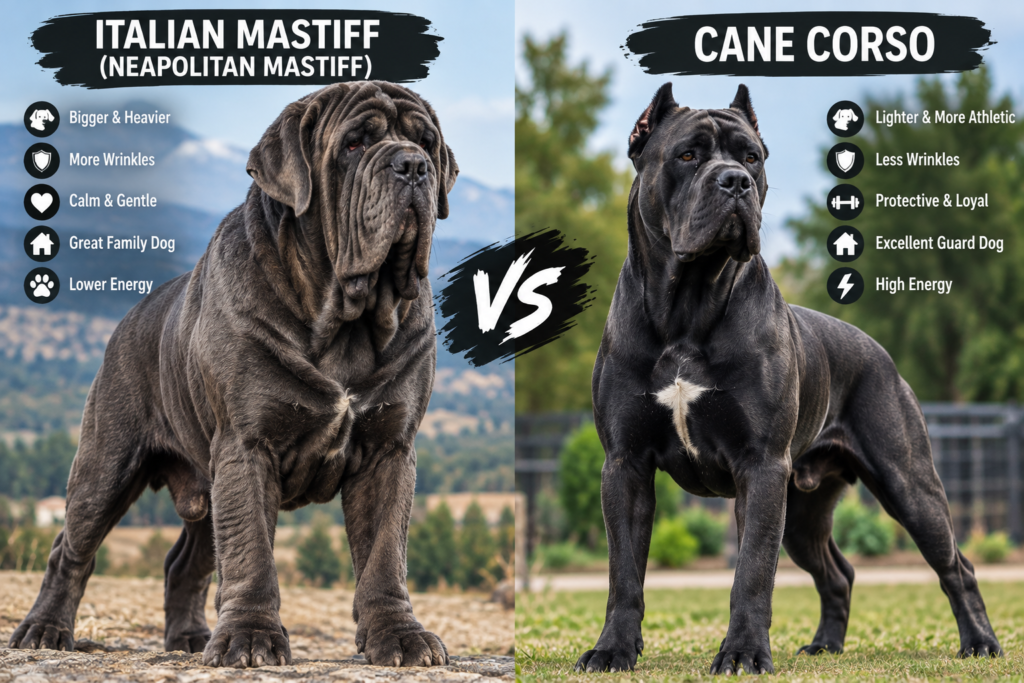
If you are searching for Italian Mastiff vs Cane Corso, there is an important detail to understand first: Italian Mastiff is commonly used as another name for the Cane Corso. In other words, an Italian Mastiff and a Cane Corso generally refer to the same breed, not two separate breeds. Breed references also list names such as Cane Corso Italiano and Italian Mastiff.
The Cane Corso is an ancient Italian mastiff-type working dog known for its muscular body, intelligence, loyalty, and strong guarding instincts. The American Kennel Club describes it as a smart, trainable and confident protector.
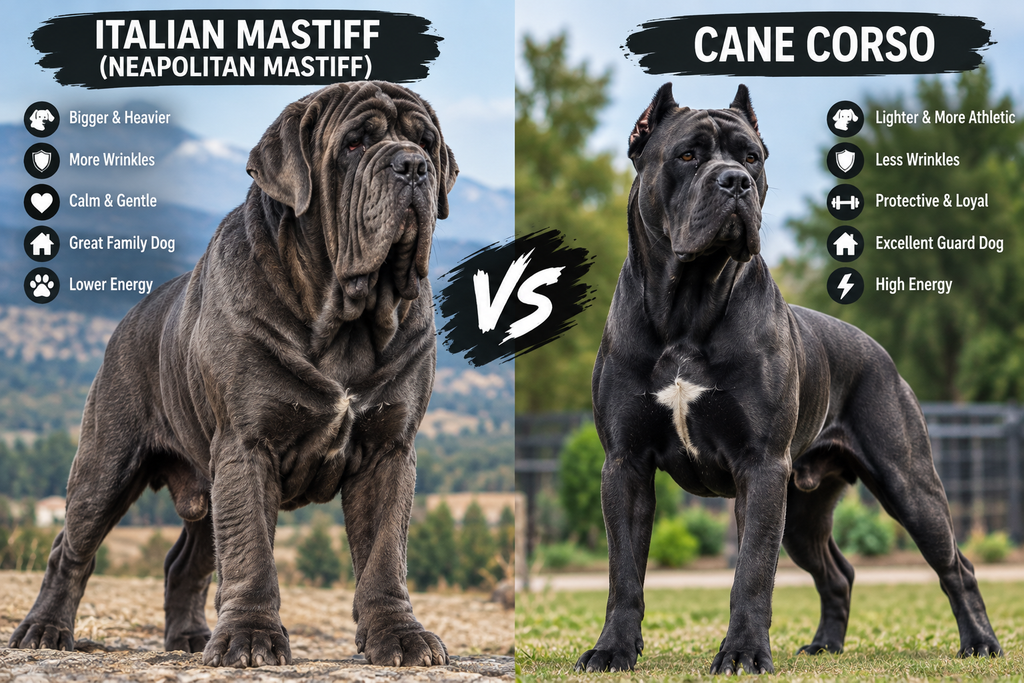
However, some people asking this question may actually mean Cane Corso vs Neapolitan Mastiff. These are two different Italian breeds. The Neapolitan Mastiff is considerably heavier and has the loose skin, deep wrinkles, and massive appearance that distinguish it from the more athletic Cane Corso. For more insigh here cane corso vs mastiff
Quick Comparison
| Feature | Italian Mastiff | Cane Corso |
|---|---|---|
| Breed identity | Another name for Cane Corso | Cane Corso |
| Origin | Italy | Italy |
| Type | Mastiff-type working dog | Mastiff-type working dog |
| Build | Muscular and athletic | Muscular and athletic |
| Temperament | Protective and loyal | Protective and loyal |
| Training | Needs early training | Needs early training |
| Exercise | Regular activity required | Regular activity required |
| Coat | Short and dense | Short and dense |
| Best for | Experienced owners | Experienced owners |
Bottom line: There is no real breed-vs-breed comparison between an Italian Mastiff and a Cane Corso because they are essentially the same breed.
What Is an Italian Mastiff?
The name Italian Mastiff is commonly used for the Cane Corso Italiano. The breed originated in Italy and historically served as a versatile working dog, including roles involving property protection, livestock, and hunting.
The Cane Corso has a powerful but athletic structure. Unlike some extremely heavy mastiff breeds, it is built to move efficiently and perform demanding work.
According to the AKC breed standard, male Cane Corsos stand approximately 25 to 27.5 inches at the shoulder, while females stand approximately 23.5 to 26 inches. Weight should remain proportionate to the dog’s height and structure.
Italian Mastiff vs Cane Corso What Is a Cane Corso?
The Cane Corso is an Italian mastiff-type breed and a member of the AKC Working Group. Its name is associated with the idea of a bodyguard or protector, which fits its historical role as a guardian.
The breed is known for:
- Strong protective instincts
- Intelligence
- Loyalty to its family
- Athletic strength
- Trainability
- A confident and serious personality
Although Cane Corsos can be affectionate with their families, they are generally reserved around unfamiliar people. Proper socialization is therefore extremely important.
Italian Mastiff vs Cane Corso Appearance
Because these names refer to the same breed, there is no meaningful appearance difference.
A typical Cane Corso has:
- A large, powerful head
- A broad and deep muzzle
- A muscular neck
- A deep chest
- A strong, athletic body
- A short, dense coat
- A confident posture
The AKC standard describes the breed as muscular and athletic, with movement that should remain powerful but relatively easy and elegant.
Italian Mastiff vs Cane Corso Temperament
Again, the temperament is essentially the same because they are the same breed.
Cane Corsos are generally protective, intelligent, confident, and devoted to their owners. They can be affectionate with family members while remaining cautious around strangers.
They are not usually the ideal choice for someone looking for a carefree, highly social dog that welcomes everyone.
Their guardian instincts mean owners should take training and socialization seriously from puppyhood.
Training Requirements
A Cane Corso is intelligent and capable of learning quickly, but its size and strength make proper training especially important.
Start with:
- Basic obedience
- Leash training
- Recall training
- Impulse control
- Puppy socialization
- Calm behavior around visitors
- Positive exposure to different environments
The AKC recommends early training and socialization because the breed’s size, strength, and protective nature can become difficult to manage without proper guidance.
Harsh or inconsistent handling is not a good training strategy. Clear rules, consistency, appropriate rewards, and experienced guidance are much better approaches.
Italian Mastiff vs Cane Corso Exercise Needs
Despite its heavy appearance, the Cane Corso is an athletic working dog.
It needs regular:
- Walks
- Controlled outdoor activity
- Obedience work
- Mental stimulation
- Interactive games
- Age-appropriate exercise
The AKC notes that Cane Corsos benefit from frequent physical and mental activity.
Puppies should not be pushed into excessive high-impact exercise while their bones and joints are developing.
Italian Mastiff vs Cane Corso Grooming and Shedding
Cane Corsos have a short, stiff, double-layered coat. Their grooming requirements are relatively moderate compared with long-haired breeds. Weekly brushing is generally useful, with more brushing during heavier seasonal shedding.
Owners should also pay attention to:
- Nails
- Teeth
- Ears
- Skin
- Overall body condition
Regular grooming also gives owners an opportunity to notice unusual changes in the dog’s skin or body.
Is a Cane Corso Good for Families?
A well-trained and properly socialized Cane Corso can form a very strong bond with its family.
However, this is a large and powerful working breed, so it is not automatically suitable for every household. The AKC particularly notes that experienced owners may be a better fit because of the breed’s size, strength, and training requirements.
Families should consider the dog’s temperament, the ages of children, supervision requirements, available space, and the owner’s ability to provide consistent training.
Italian Mastiff vs Neapolitan Mastiff: The Comparison You May Mean
If you actually wanted to compare the Italian Mastiff/Cane Corso with the Neapolitan Mastiff, the differences are much clearer.
The Neapolitan Mastiff is another Italian guardian breed, but it has a much heavier and more massive appearance.
The AKC standard describes the Neapolitan Mastiff as a massive, heavy-boned dog with abundant loose skin and prominent wrinkles. Male Neapolitan Mastiffs are listed at 26–31 inches, with an average mature male weight of about 150 pounds.
Cane Corso
- More athletic
- Muscular and streamlined
- Generally more agile
- Strong working ability
- Protective and trainable
- Less loose skin
Neapolitan Mastiff
- Much heavier appearance
- Massive bone structure
- Extensive wrinkles
- Large dewlap
- Slower, rolling movement
- Powerful guardian
The Neapolitan Mastiff is also described by the AKC as wary of strangers but steady and affectionate with its loved ones.
Italian Mastiff vs Cane Corso Which One Is Better?
If the question is Italian Mastiff vs Cane Corso, there is no winner because they are names for the same breed.
If you mean Cane Corso vs Neapolitan Mastiff, the better choice depends on your lifestyle.
Choose a Cane Corso if you want:
- An athletic guardian
- A highly trainable working dog
- A powerful but relatively agile dog
- A dog that can participate in active outdoor activities
- A loyal family protector
Consider a Neapolitan Mastiff if you want:
- A truly massive mastiff
- A calmer, heavier guardian type
- The distinctive wrinkled Mastino appearance
- A dog with a slower, more imposing presence
Neither breed should be chosen simply because it looks intimidating. Both require responsible ownership, appropriate socialization, training, and careful management.
Italian Mastiff vs Cane Corso Health and Responsible Ownership
Large breeds require thoughtful care throughout their lives. Maintaining a healthy body condition, providing appropriate exercise, feeding a balanced diet, and arranging regular veterinary care are all important.
When choosing a Cane Corso puppy, look for a responsible breeder who prioritizes health, stable temperament, appropriate socialization, and sound structure.
Avoid choosing a puppy solely because it is unusually large or aggressive-looking. A stable temperament and healthy development are much more important.
Italian Mastiff vs Cane Corso Frequently Asked Questions
Is an Italian Mastiff the same as a Cane Corso?
Yes. Italian Mastiff is commonly used as another name for the Cane Corso or Cane Corso Italiano.
Is the Cane Corso an Italian Mastiff?
Yes. The Cane Corso is an Italian mastiff-type working breed.
Is a Cane Corso bigger than a Neapolitan Mastiff?
Generally, the Neapolitan Mastiff is heavier and more massive. Its breed standard calls for substantial bone and mass, with average mature male weight around 150 pounds.
Italian Mastiff vs Cane Corso Is a Cane Corso good for first-time owners?
It is generally better suited to experienced owners because of its size, strength, protective instincts, and need for consistent training.
Italian Mastiff vs Cane Corso Are Cane Corsos aggressive?
Cane Corsos are naturally protective, but responsible breeding, early socialization, training, and appropriate management are important for developing a stable adult dog. The AKC describes them as protective and affectionate with their families.
Conclusion
The Italian Mastiff vs Cane Corso comparison can be confusing because Italian Mastiff is commonly another name for the Cane Corso. They are not two separate dog breeds.
The Cane Corso is a powerful Italian working dog with an athletic build, strong guarding instincts, intelligence, and deep loyalty to its family. It can be an excellent companion for the right experienced owner, but its strength and protective nature make proper training and socialization essential.
If you were actually looking for a comparison between the Cane Corso and Neapolitan Mastiff, that is a true breed comparison. The Cane Corso is generally more athletic and streamlined, while the Neapolitan Mastiff is substantially heavier, more wrinkled, and more massive.
[…] Today, the Komondor can be a devoted family companion, but it is not a breed for every household. Its size, guardian instincts, independent personality, and demanding coat require an owner who understands the breed. For more insight here italian mastiff vs cane corso […]