
Dogs come in an amazing variety of shapes and sizes, and one of the most noticeable differences between breeds is the shape and length of their muzzle. Dogs with long snouts have an especially distinctive appearance, with elongated noses and narrow or extended facial structures that can give them an elegant, athletic, or unusual look.
Many long-snouted dogs belong to breeds developed for hunting, running, herding, or other working purposes. Some are famous for their incredible speed, while others are valued for intelligence, companionship, or their striking appearance.
In this guide, we’ll explore some of the most recognizable long-nosed dog breeds, why they have long snouts, their personalities, exercise needs, grooming requirements, and what owners should know before bringing one home. For more insight here weird dog species
What Are Dogs With Long Snouts?
A dog’s snout, also called its muzzle, is the portion of the face extending from the eyes and forehead toward the nose. Dogs with noticeably elongated muzzles are often described as having long snouts or long noses.
In canine anatomy, many long-headed breeds are described as dolichocephalic, meaning they have relatively long and narrow skulls compared with their width.
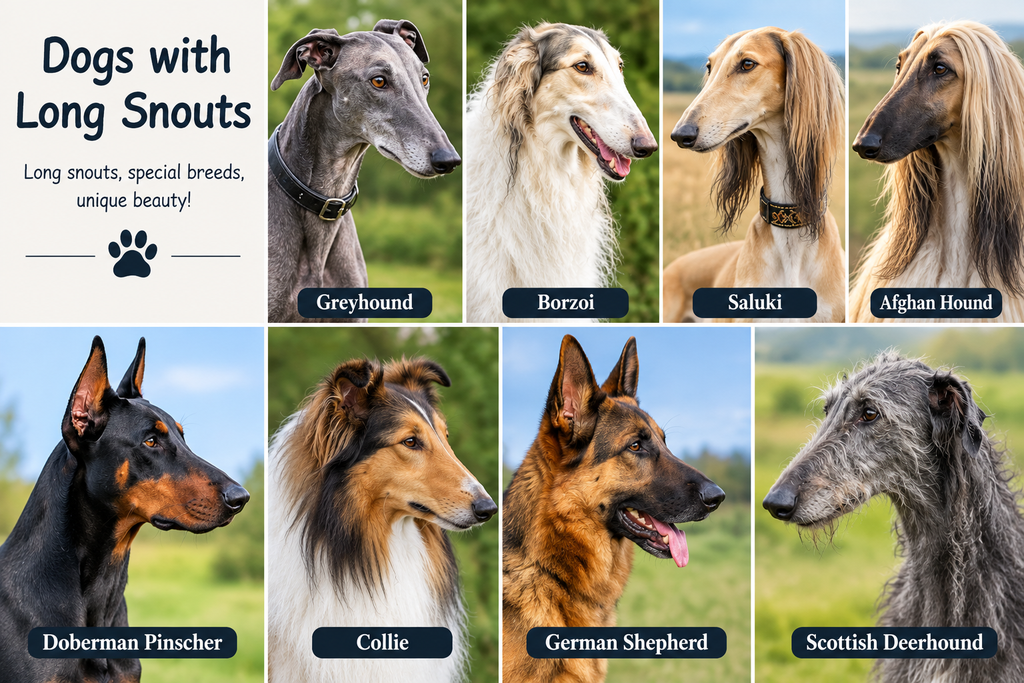
Some of the most recognizable examples include: Dogs With Long Snouts
- Greyhound
- Borzoi
- Afghan Hound
- Saluki
- Whippet
- Collie
- Shetland Sheepdog
- Italian Greyhound
- Dachshund
- German Shepherd
However, having a long snout does not automatically mean two breeds are closely related. Dogs can develop similar physical characteristics because they were selectively bred for different jobs.
1. Dogs With Long Snouts Greyhound
The Greyhound is one of the most famous dogs with a long snout. Its narrow head, long legs, deep chest, and streamlined body give it an unmistakable appearance.
Greyhounds were historically developed for coursing and are famous for their speed. Their long muzzle is one component of their overall athletic structure.
Despite their reputation as racing dogs, Greyhounds can be surprisingly calm and affectionate at home. Many enjoy relaxing for long periods after receiving appropriate exercise.
Dogs With Long Snouts Greyhound characteristics
- Long, narrow muzzle
- Tall, athletic body
- Short coat
- Excellent running ability
- Generally gentle temperament
Their short coat also means grooming is relatively straightforward compared with long-haired breeds.
2. Dogs With Long Snouts Borzoi
The Borzoi, historically known as the Russian Wolfhound, is particularly famous for its exceptionally long and narrow head.
Its elongated muzzle gives the breed an elegant appearance, while its tall body and flowing coat add to its distinctive silhouette.
Borzois were historically used for coursing and hunting. They can be independent dogs, so consistent and patient training is important.
Their long coat requires regular grooming, particularly when the dog is shedding.
3. Dogs With Long Snouts Afghan Hound
The Afghan Hound is another striking example of a long-snouted dog. It has a long, narrow head and a luxurious coat that can make the breed immediately recognizable.
Historically associated with hunting in mountainous regions, Afghan Hounds are athletic and independent.
Their beautiful coat requires considerable grooming. Owners should be prepared for regular brushing and proper coat maintenance.
Dogs With Long Snouts Afghan Hound traits
- Long, narrow muzzle
- Long flowing coat
- Elegant appearance
- Independent personality
- Strong hunting instincts
4. Dogs With Long Snouts Saluki
The Saluki is an ancient sighthound known for its slender body, long legs, and elongated head.
Salukis were developed as hunting dogs and can possess a strong instinct to chase moving animals. They are athletic and often benefit from opportunities to run safely.
They can also be sensitive and independent, making patient training and appropriate socialization important.
5. Dogs With Long Snouts Whippet
The Whippet is a smaller sighthound with a long muzzle and streamlined body.
Although not as large as a Greyhound, the Whippet has many of the same physical characteristics, including long legs, a narrow head, and an athletic build.
Whippets can be energetic when outdoors but often enjoy relaxing at home. Their short coat requires relatively little grooming.
6. Dogs With Long Snouts Collie
Collies are well known for their long, wedge-shaped heads and elongated muzzles.
The Rough Collie, in particular, has a recognizable facial structure that is emphasized by its thick coat. Collies were developed as herding dogs and are known for their intelligence and responsiveness.
They generally benefit from regular physical activity as well as mental stimulation.
Dogs With Long Snouts Collie characteristics
- Long wedge-shaped head
- Elongated muzzle
- Intelligent and trainable
- Herding background
- Regular grooming needs
7. Dogs With Long Snouts Shetland Sheepdog
The Shetland Sheepdog, commonly called the Sheltie, is a smaller herding breed with a relatively long and narrow muzzle.
Shelties were developed for working purposes and tend to be alert, energetic, and intelligent. Their small size can make them appealing to people looking for a compact dog with an active personality.
Their thick double coat requires regular brushing.
8. Dogs With Long Snouts Italian Greyhound
If you’re searching for a small dog with a long snout, the Italian Greyhound is one of the most recognizable choices.
This miniature sighthound has a slender body, long legs, narrow head, and elongated muzzle. Despite its delicate appearance, it has an athletic background.
Italian Greyhounds are often affectionate companion dogs. Because of their fine build and short coat, owners should take care during cold weather and with activities that could result in injury.
9. Dogs With Long Snouts Dachshund
Dachshunds are another recognizable breed with an elongated muzzle, although their overall body shape is very different from that of sighthounds.
Their long nose and low, elongated body are part of the breed’s distinctive appearance. Dachshunds were developed for hunting, including work involving animals in underground burrows.
They are often curious, determined, and lively.
Because of their unusually long backs, owners should pay attention to safe handling and maintaining a healthy body weight.
10. German Shepherd
German Shepherds typically have a noticeably elongated muzzle combined with a strong, wedge-shaped head.
Unlike sighthounds, they have a more muscular working-dog build. The breed was developed for herding and has also become widely used in various working roles.
German Shepherds are generally active dogs that benefit from training, exercise, socialization, and mental stimulation.
Why Do Some Dogs Have Long Snouts?
The shape of a dog’s muzzle is largely determined by genetics and selective breeding.
Throughout the history of domesticated dogs, people selected animals for particular jobs. Over many generations, physical characteristics associated with those jobs became established within individual breeds.
Long-snouted dogs can be found among breeds developed for:
- Hunting
- Coursing
- Running
- Tracking
- Herding
- Scent work
- General working purposes
For example, many sighthounds have long, narrow heads as part of their specialized athletic structure.
Are Long-Snouted Dogs Healthier?
It is too broad to say that dogs with long snouts are automatically healthier than dogs with short snouts.
Every breed has its own potential health concerns. Long-muzzled dogs can experience dental, eye, orthopedic, or inherited conditions depending on their breed and genetics.
A dog’s overall health depends on many factors, including:
- Genetics
- Responsible breeding
- Nutrition
- Exercise
- Weight
- Veterinary care
- Environment
- Age
Therefore, muzzle length should not be used as the only measure of a dog’s health.
Long Snout vs. Short Snout
The difference between long- and short-snouted dogs is particularly noticeable when comparing breeds with very different skull shapes.
Breeds with shortened muzzles, often called brachycephalic breeds, have facial structures that differ significantly from those of Greyhounds, Borzois, and other long-headed breeds.
Long-snouted dogs generally have more extended facial structures, but this does not mean every individual long-snouted dog has identical anatomy or health characteristics.
Do Dogs With Long Snouts Need Special Care?
Most long-snouted dogs can be cared for like other dogs, but their breed-specific characteristics should always be considered.
Dental Care
Regular dental care is important for every dog. Brushing your dog’s teeth and having its mouth checked by a veterinarian can help identify dental problems early.
Exercise
Many long-snouted breeds have working or hunting backgrounds. Sighthounds such as Greyhounds, Salukis, and Whippets may have a strong desire to run.
Exercise should always be adjusted according to the individual dog’s age, health, fitness, and breed.
Grooming
Grooming requirements vary considerably.
A Greyhound has a short coat that requires relatively little maintenance, while an Afghan Hound needs significantly more grooming because of its long coat.
Safe Outdoor Activities
Some long-snouted breeds have strong prey-drive or chasing instincts. Owners should consider secure areas when allowing dogs to run, particularly when the breed is known for pursuing moving animals.
What Is the Smallest Long-Snouted Dog?
The Italian Greyhound is one of the best-known small dogs with a long, narrow muzzle.
Dachshunds can also have relatively long noses, but their head and body proportions are quite different from those of Italian Greyhounds.
What Dog Has the Longest Snout?
There isn’t a single universally accepted answer because “longest snout” can be measured in different ways, and individual dogs can vary significantly.
The Borzoi is frequently recognized for an exceptionally long and narrow head, while Greyhounds, Afghan Hounds, and other sighthounds are also famous for elongated muzzles.
How Can You Identify a Dog With a Long Snout?
If you see a dog with a long nose and want to determine its breed, don’t rely on the muzzle alone.
Look at several characteristics together:
Head Shape
Determine whether the skull is narrow, wedge-shaped, broad, or rounded.
Ears
Ear position and shape can provide useful clues. Some long-snouted breeds have folded ears, while others have erect or feathered ears.
Body Shape
A tall, narrow body may suggest a sighthound, while a muscular body could point toward a working breed.
Coat
Look at whether the coat is short, long, wiry, curly, or double-coated.
Size
Consider the dog’s height and overall build.
Behavior
Herding, hunting, scenting, and chasing behaviors can sometimes provide additional clues.
However, appearance alone cannot always provide a reliable breed identification, especially for mixed-breed dogs.
Long-Snouted Mixed-Breed Dogs
Mixed-breed dogs can also have very long snouts. Their facial appearance depends on the combination of genes inherited from their parents.
For example, a dog with sighthound ancestry may inherit a narrow head and elongated muzzle. A mixed dog with Collie or Shepherd ancestry may also develop a noticeable long nose.
If you are trying to identify a mixed-breed dog, photographs, known parentage, veterinary assessment, and DNA testing may provide additional information.
Long-Snouted Dog Breeds at a Glance
| Breed | Size | Coat | Notable Feature |
|---|---|---|---|
| Greyhound | Large | Short | Exceptional speed |
| Borzoi | Large | Long | Extremely elongated head |
| Afghan Hound | Large | Long | Elegant flowing coat |
| Saluki | Medium-Large | Short/feathered | Ancient sighthound |
| Whippet | Medium | Short | Smaller athletic sighthound |
| Collie | Medium-Large | Long/short varieties | Herding background |
| Shetland Sheepdog | Small-Medium | Long | Intelligent herding breed |
| Italian Greyhound | Small | Short | Small, slender sighthound |
| Dachshund | Small | Various | Long body and elongated muzzle |
| German Shepherd | Large | Double coat | Versatile working breed |
Frequently Asked Questions
What dog breeds have long snouts?
Some well-known long-snouted breeds include Greyhounds, Borzois, Afghan Hounds, Salukis, Whippets, Collies, Shetland Sheepdogs, Italian Greyhounds, Dachshunds, and German Shepherds.
What small dog has a long snout?
The Italian Greyhound is one of the most recognizable small breeds with a long, narrow snout. Dachshunds also have noticeably elongated noses.
Why does my dog have such a long nose?
A dog’s nose and muzzle length are primarily influenced by genetics and ancestry. Your dog may have inherited a long-muzzle structure from its breed or mixed-breed parents.
Are dogs with long snouts rare?
No. Long-snouted dogs are found among many common and well-established breeds. Some, such as Greyhounds and German Shepherds, are widely recognized around the world.
Which dog has an extremely long face?
The Borzoi is particularly famous for its exceptionally elongated and narrow head. Several other sighthounds also have very long facial structures.
Final Thoughts
Dogs with long snouts are among the most distinctive-looking dogs in the world. From the incredibly fast Greyhound and elegant Borzoi to the small Italian Greyhound and intelligent Collie, long-nosed breeds can be found in many different sizes and working groups.
Their elongated muzzles are largely the result of genetics and selective breeding, often connected to historical roles such as hunting, coursing, herding, and running. However, a dog’s snout length is only one part of its overall appearance and health.
If you’re considering a long-snouted dog, look beyond its appearance. Research the breed’s temperament, exercise requirements, grooming needs, training, and potential health concerns to find a dog whose characteristics fit your lifestyle.
[…] If you’re searching for pretty dogs, you may be wondering which breeds are considered especially attractive, which ones are good family companions, and how much grooming or exercise they need. From the glamorous Afghan Hound and fluffy Samoyed to the spotted Dalmatian and graceful Irish Setter, this guide covers 15 beautiful breeds and what life with each one is actually like. For more insight here dogs with long snouts […]