When people search for weird dog species, they are usually looking for dogs with unusual appearances, strange physical features, rare histories, or characteristics that make them look completely different from familiar breeds.
Technically, domestic dogs are not different species from one another. They are different breeds of the same species, Canis lupus familiaris. But the variety among dog breeds is extraordinary. Some dogs have almost no hair, some have naturally occurring cords, some have extremely loose skin, and one famous breed has six fully functioning toes on each foot.
The American Kennel Club has highlighted several breeds with particularly unusual physical characteristics, including the Norwegian Lundehund, Chinese Shar-Pei, Xoloitzcuintli, Bergamasco Sheepdog, Neapolitan Mastiff, Komondor, and Chinese Crested. For more insight here what breed is this
What Makes a Dog Look Weird?
A dog’s appearance may seem unusual because of a natural breed characteristic.
Some of the features that make certain dogs stand out include: weird dog species
- Hairless skin
- Extremely wrinkled skin
- Six toes
- Blue-black tongues
- Naturally corded coats
- Very long ears
- Unusual body proportions
- Distinctive facial structures
- Mohawk-like hair
- Extremely flexible joints
- Unusual coat textures
These traits are not necessarily abnormalities. In many cases, they developed through selective breeding and served a particular purpose.
1. Norwegian Lundehund
The Norwegian Lundehund is one of the most unusual dog breeds in the world.
Its strangest feature is its feet. The breed has six fully functioning toes on each foot, along with extra paw pads. It also has remarkable flexibility in its neck and shoulders. Its ears can fold shut, helping protect them from debris.
These characteristics developed because the Lundehund was bred in Norway to hunt puffins on steep cliffs.
The breed is also extremely rare. According to the AKC’s 2025 registration statistics, the Norwegian Lundehund was the rarest AKC-recognized breed in the United States that year.
What Makes It Weird?
- Six toes on each foot
- Highly flexible neck
- Flexible shoulders
- Ears that can fold shut
- Distinctive movement
Despite its unusual appearance, it is a real working breed with a fascinating history.
2. Chinese Shar-Pei
The Chinese Shar-Pei is famous for its loose, wrinkled skin and unusual head.
Young Shar-Peis can have particularly pronounced wrinkles around the face and body. The breed also has a distinctive blue-black tongue and a short, harsh coat.
Its broad muzzle is sometimes described as resembling a hippopotamus, adding to its unusual appearance. The AKC identifies the Shar-Pei’s wrinkles, small ears, blue-black tongue, and distinctive coat as features that set the breed apart.
What Makes It Weird?
- Heavy facial wrinkles
- Loose skin
- Blue-black tongue
- Unusual muzzle
- Small triangular ears
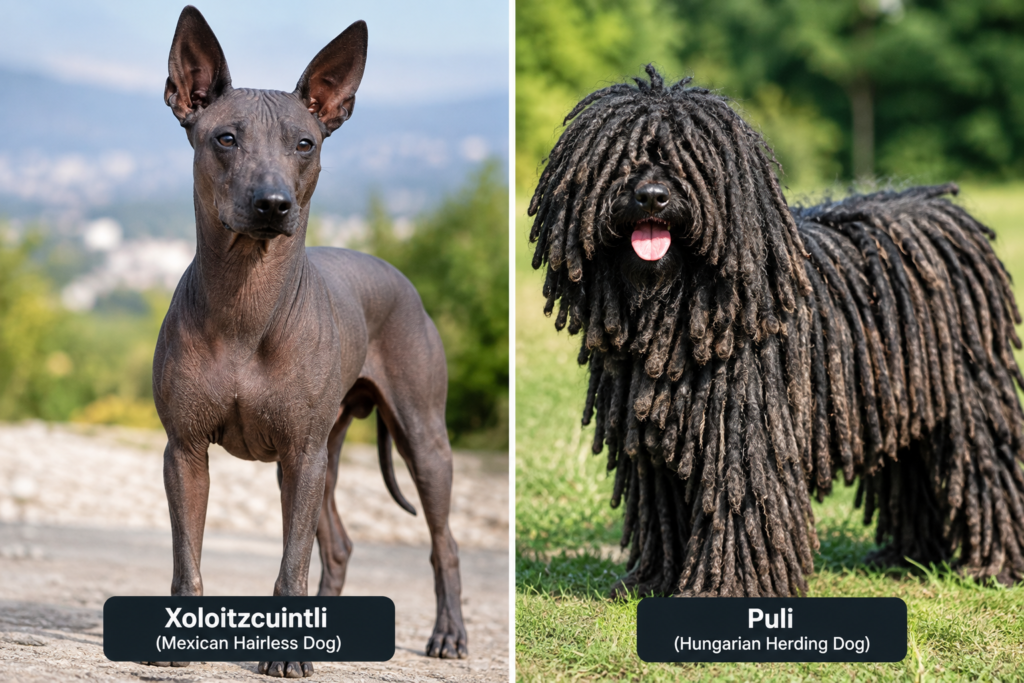
3. Xoloitzcuintli
The Xoloitzcuintli, often called the Xolo, is Mexico’s famous hairless dog.
The hairless variety has smooth, exposed skin with little body hair, although some hair may appear on the head, feet, or tail. A coated variety also exists.
The Xolo has an ancient history and is one of the most recognizable hairless breeds.
What Makes It Weird?
- Mostly hairless body
- Distinctive head hair
- Ancient history
- Three size varieties
- Unusual skin appearance
The AKC has described the Xoloitzcuintli as one of its particularly unique breeds.
4. Chinese Crested
The Chinese Crested is another dog that can look almost otherworldly.
The hairless variety has mostly bare skin but usually has long hair on its head, feet, and tail. This creates the breed’s famous “crested” appearance.
There is also a fully coated variety called the Powderpuff.
What Makes It Weird?
- Hairless body
- Long crest on the head
- Furry feet
- Feathery tail
- Two coat varieties
The hairless Chinese Crested is one of the most visually distinctive small dogs.
5. Komondor
The Komondor looks as though someone covered a large dog in long white ropes.
Its coat develops into naturally occurring cords, creating a distinctive appearance often compared with a mop. The coat helped protect this Hungarian livestock guardian from weather and threats while working with flocks.
The AKC specifically identifies the Komondor’s naturally occurring white cords as one of its defining characteristics.
What Makes It Weird?
- Long white cords
- Extremely unusual coat
- Large body hidden beneath the coat
- Powerful livestock-guardian background
Despite its strange appearance, the Komondor is a serious working dog.
6. Bergamasco Sheepdog
The Bergamasco Sheepdog has one of the strangest coats in the dog world.
Its coat contains three different textures that can form naturally occurring flocks—layers of felted hair that cover much of the body.
This gives the dog an appearance that can resemble hanging mats or dreadlocks.
What Makes It Weird?
- Three coat textures
- Naturally forming flocks
- Long, matted-looking coat
- Distinctive silhouette
The unusual coat is one of the defining characteristics of the breed.
7. Neapolitan Mastiff
The Neapolitan Mastiff is an enormous Italian guardian breed famous for its loose skin and dramatic wrinkles.
Its face features heavy folds, pendulous lips, and a massive head.
Unlike some unusual-looking breeds, the Neapolitan Mastiff’s strange appearance comes primarily from its combination of enormous size, loose skin, wrinkles, and facial structure.
What Makes It Weird?
- Huge head
- Heavy facial wrinkles
- Loose skin
- Pendulous lips
- Massive body
The breed is one of the most recognizable mastiff-type dogs.
8. Chow Chow
The Chow Chow has several characteristics that make it look unlike many other dogs.
Its thick coat can create a lion-like mane around the head and neck. It is also famous for its blue-black tongue and distinctive expression.
The breed’s stiff-legged gait adds another unusual feature to its appearance.
What Makes It Weird?
- Lion-like mane
- Blue-black tongue
- Dense coat
- Distinctive facial expression
- Stiff-legged movement
The AKC specifically lists the Chow Chow among breeds with particularly unique characteristics.
9. American Hairless Terrier
The American Hairless Terrier is unusual because it is a naturally hairless terrier.
Unlike some hairless breeds with ancient histories, this breed developed in the United States from Rat Terrier lines.
Its lack of a normal coat makes it immediately recognizable.
What Makes It Weird?
- Hairless body
- Terrier build
- Exposed skin
- Small-to-medium size
The AKC identifies it as the only hairless breed in the Terrier Group.
10. Dogue de Bordeaux
The Dogue de Bordeaux is another breed with an unmistakable appearance.
It has an enormous head, broad muzzle, muscular body, and expressive facial features.
The breed’s head is particularly striking relative to its body. The AKC has described its massive head as proportionally exceptional among dogs.
What Makes It Weird?
- Extremely large head
- Broad muzzle
- Powerful build
- Heavy facial features
Its appearance is very different from that of slender sporting or companion breeds.
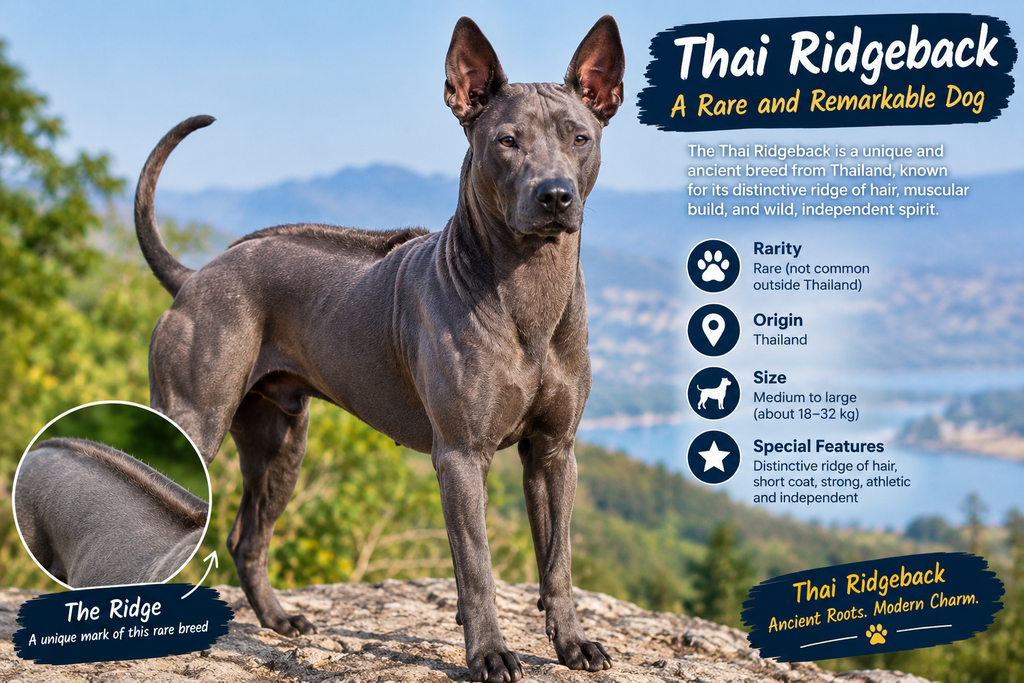
11. Rhodesian Ridgeback
The Rhodesian Ridgeback has one feature that almost immediately identifies it: the ridge of hair running along its back.
The hair in this strip grows in the opposite direction from the surrounding coat.
This is a relatively unusual physical characteristic among dogs and is the feature from which the breed gets its name.
What Makes It Weird?
- Back ridge
- Reverse-growing hair
- Athletic body
- Distinctive silhouette
12. Puli
The Puli is a smaller Hungarian herding breed with a naturally corded coat.
Its cords can cover much of the body and make it difficult to see the dog’s underlying shape.
The result is a dog that can look like a walking collection of ropes.
What Makes It Weird?
- Corded coat
- Long hanging strands
- Unusual silhouette
- Herding-dog history
The Puli is also among the less commonly encountered breeds in the United States. The AKC included it in its 2025 rare-breed statistics.
13. Pharaoh Hound
The Pharaoh Hound has a very different kind of unusual appearance.
It has a slim athletic body, enormous upright ears, and a long narrow head.
One of its most interesting features is that its nose and ears can appear to become more intensely colored when the dog is excited.
The Pharaoh Hound is also among the less commonly registered breeds in the United States.
14. Affenpinscher
The Affenpinscher is a small toy breed with a shaggy coat and distinctive facial appearance.
Its name is associated with its monkey-like expression, and its wiry coat and beard-like facial hair give it an unusual look.
The breed is small but has a confident terrier-like personality.
The AKC included the Affenpinscher among its less frequently registered breeds in its 2025 statistics.
15. Azawakh
The Azawakh looks unusual because of its extremely slender body.
It has long legs, a narrow waist, a deep chest, and a lean athletic frame. Its appearance is very different from heavier breeds such as Mastiffs or Bulldogs.
The breed originated in West Africa and is associated with the sighthound group.
It was also among the 10 rarest AKC breeds in the United States in 2025.
Why Do Weird-Looking Dog Breeds Exist?
Most unusual physical characteristics developed for a reason.
Dogs were selectively bred for specific jobs, including: weird dog species
- Hunting
- Herding
- Guarding
- Pulling
- Retrieving
- Vermin control
- Companionship
For example, the Norwegian Lundehund’s flexible body helped it work around steep cliffs while hunting puffins. The Komondor’s corded coat developed in a breed used for livestock guarding, while the Ridgeback’s characteristic ridge became a defining physical trait.
Are Weird Dog Breeds Rare?
Not necessarily.
A dog can have an unusual appearance without being extremely rare.
For example, the Chinese Shar-Pei and Chinese Crested are recognizable unusual-looking breeds, while the Norwegian Lundehund is both unusual and rare in the United States.
The AKC’s rarity statistics are based on registration numbers, not a worldwide census of every dog. Some breeds may be rare in the United States but more common in other parts of the world.
Are Weird-Looking Dogs Good Pets?
An unusual appearance does not tell you whether a dog will be suitable for your home.
Before choosing a breed, consider: weird dog species
Temperament
Research the breed’s typical temperament and understand that individual dogs can vary.
Exercise
Some unusual breeds are energetic working dogs and need substantial daily activity.
Grooming
Corded and heavily coated breeds can require specialized coat care.
Climate
Hairless dogs can require additional protection from sun and cold.
Training
Working and hunting breeds may have strong instincts that require consistent training.
Health
Learn about breed-associated health concerns and ask responsible breeders about appropriate health screening.
Weird Dog Species vs. Weird Dog Breeds
The phrase “weird dog species” is commonly used in online searches, but technically these are not different dog species.
Domestic dogs belong to the same species, while breeds represent distinct populations developed through selective breeding.
So the more accurate terms are: weird dog species
- Weird dog breeds
- Unusual dog breeds
- Strange-looking dog breeds
- Rare dog breeds
- Unique dog breeds
These phrases can all describe dogs with unusual physical characteristics without incorrectly suggesting that every breed is a separate species.
weird dog species Frequently Asked Questions
What is the weirdest-looking dog breed?
There is no scientific ranking of the “weirdest” dog breed. Breeds such as the Norwegian Lundehund, Chinese Shar-Pei, Komondor, Xoloitzcuintli, Bergamasco Sheepdog, and Chinese Crested have particularly unusual physical characteristics.
What dog has six toes?
The Norwegian Lundehund is known for having six fully functioning toes on each foot.
What dog looks like a mop?
The Komondor is commonly recognized for its long, naturally corded white coat, which gives it a mop-like appearance.
What dog has a blue-black tongue?
The Chow Chow is famous for its blue-black tongue. The Chinese Shar-Pei also has a blue-black tongue.
What is the weirdest hairless dog?
The Xoloitzcuintli and Chinese Crested are two of the best-known unusual hairless breeds. The American Hairless Terrier and Peruvian Inca Orchid are also recognized hairless breeds.
Are unusual dog breeds rare?
Some are rare, but unusual appearance does not automatically mean rarity. The AKC’s 2025 U.S. registration statistics, for example, identify the Norwegian Lundehund as the rarest AKC-recognized breed in the United States.
Conclusion
The world of weird dog species, more accurately called unusual dog breeds, is full of fascinating examples. From the six-toed Norwegian Lundehund and hairless Xoloitzcuintli to the wrinkled Shar-Pei, corded Komondor, and uniquely shaped Azawakh, these dogs demonstrate just how diverse domestic dogs can be.
Their unusual appearances are often connected to their history and original jobs. Some were hunters, some guarded livestock, and others were developed primarily as companions.
Rather than judging a dog simply by how strange it looks, learning about its history, temperament, exercise needs, grooming requirements, and health considerations gives a much better understanding of what makes each breed special.
[…] In this guide, we’ll explore some of the most recognizable long-nosed dog breeds, why they have long snouts, their personalities, exercise needs, grooming requirements, and what owners should know before bringing one home. For more insight here weird dog species […]