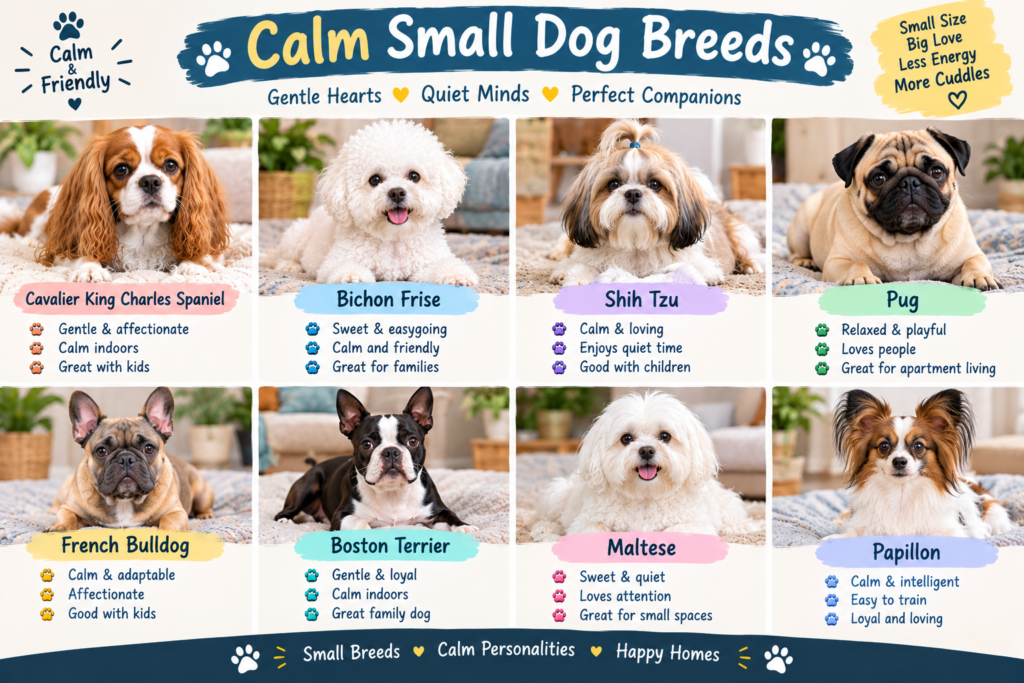
Calm small dog breeds can be a great match for people who want a compact companion with a more relaxed personality. Breeds such as the Cavalier King Charles Spaniel, Shih Tzu, Pug, Havanese, and Japanese Chin are known for companion-oriented temperaments, but no breed is calm all the time. Individual personality, training, age, socialization, and daily routine all influence how a dog behaves at home. For more insight here small breed of dogs with short hair
What Makes a Small Dog Calm?
A calm dog is not necessarily a dog that sleeps all day. A well-balanced companion can enjoy walks and playtime but also settle comfortably when the household becomes quiet.
The American Kennel Club explains that breed temperament is influenced by characteristics developed through selective breeding, while individual dogs still have their own personalities.
When considering a calmer small companion, look for traits such as: Calm Small Dog Breeds
- Ability to settle indoors after exercise
- Friendly or gentle social behavior
- Moderate exercise requirements
- Adaptability to household routines
- Trainability and responsiveness
- Comfortable companionship without constant stimulation
It is also important to remember that small does not automatically mean calm. Some tiny terriers and other small breeds can be extremely energetic and alert. The AKC specifically notes that small dogs vary considerably in personality and activity level.
15 Calm Small Dog Breeds
1. Cavalier King Charles Spaniel
The Cavalier King Charles Spaniel is one of the most recognizable small companion breeds and is often associated with a gentle, affectionate temperament. The AKC’s breed temperament guide describes Cavaliers as friendly, affectionate, sweet, and gentle.
They can enjoy walks and play but are also happy spending quiet time with their people.
Good fit for: Calm Small Dog Breeds
- Families
- Couples
- Older adults
- Apartment living with adequate exercise
- Owners wanting an affectionate companion
Care considerations: Calm Small Dog Breeds
- Regular brushing
- Daily walks and play
- Positive training
- Regular veterinary care
A Cavalier should not be viewed as a dog that needs no activity simply because it is small.
2. Shih Tzu
The Shih Tzu was developed primarily as a companion dog and is known for being affectionate, outgoing, and adaptable. The AKC notes that Shih Tzus can be particularly comfortable in small homes and enjoy spending substantial time with their people.
They are often content with moderate activity followed by plenty of indoor companionship.
Highlights: Calm Small Dog Breeds
- Compact size
- Companion-oriented personality
- Adaptable to apartments
- Generally moderate exercise needs
- Enjoys human attention
The major trade-off is grooming. A long-coated Shih Tzu requires substantial coat maintenance, although a shorter pet trim can make everyday care easier.
3. Pug
The Pug is a small companion breed with a playful yet generally even-tempered personality. The AKC temperament guide describes the Pug as even-tempered, stable, playful, charming, outgoing, and loving.
Many Pugs enjoy being near their owners and can happily spend quiet periods indoors.
Good fit for: Calm Small Dog Breeds
- People who enjoy affectionate dogs
- Smaller homes
- Families that can provide companionship
- Owners who prefer moderate activity
Pugs still need appropriate exercise and careful attention to heat and weight. Their short-faced structure means owners should discuss individual exercise and heat tolerance with a veterinarian.
4. Havanese
The Havanese is a small Cuban companion breed known for its cheerful, friendly personality. The AKC temperament guide describes the breed as friendly, playful, alert, intelligent, sweet, and non-quarrelsome.
Havanese can be playful when the household is active but often settle down nicely when spending time with their family.
Care needs include:
- Regular coat brushing
- Daily interaction
- Moderate exercise
- Positive training
- Early socialization
They tend to enjoy being involved with their owners, so they may not be ideal for households where the dog would regularly spend very long periods alone.
5. Japanese Chin
The Japanese Chin is a small companion breed with a distinctive, elegant appearance and a personality suited to indoor companionship.
This breed can appeal to someone looking for a smaller dog that does not require the same level of physical activity as an athletic working or sporting breed.
Good match for:
- Quiet households
- Apartment residents
- People who enjoy companion dogs
- Owners who prefer indoor activities
Even a relatively relaxed dog benefits from short walks, mental stimulation, and gentle training.
6. English Toy Spaniel
The English Toy Spaniel is a small companion breed with four recognized color varieties. The AKC temperament guide describes it as bright, affectionate, willing to please, gentle, and playful.
This combination can make it appealing to owners who want a small dog with a gentle companion personality.
Expect: Calm Small Dog Breeds
- Moderate activity
- Regular coat care
- Strong attachment to family
- Enjoyment of indoor companionship
- Benefits from positive socialization
7. Bolognese
The Bolognese is a small companion dog from the Bichon family. Its primary role has historically been companionship, and it can suit households looking for a devoted indoor dog.
Care highlights: Calm Small Dog Breeds
- Regular grooming
- Moderate daily activity
- Human companionship
- Gentle training
- Mental stimulation through simple games
A Bolognese is not a completely inactive dog, but its companion-oriented lifestyle can work well in a peaceful home.
8. Bichon Frise
The Bichon Frise is a small, sturdy companion breed with a friendly personality. Although often associated with a fluffy appearance, Bichons can adapt well to different household routines when their exercise and social needs are met.
Good fit for: Calm Small Dog Breeds
- Families
- Couples
- Apartment residents
- People who enjoy grooming
- Owners wanting a social companion
The breed’s fluffy coat requires considerably more maintenance than a short-coated dog.
9. Maltese
The Maltese is a very small companion dog that can be affectionate and people-oriented. Its size makes it convenient for many indoor environments.
Daily needs include: Calm Small Dog Breeds
- Short walks
- Indoor play
- Regular coat care
- Dental care
- Gentle training
The Maltese may look delicate, but it can still have plenty of personality. Calmness should be encouraged through socialization and consistent routines rather than assumed from its size.
10. Pekingese
The Pekingese is a compact companion breed with a distinctive appearance and an independent personality. It can be content with a relatively relaxed lifestyle when its basic exercise and social needs are met.
Potential advantages: Calm Small Dog Breeds
- Small size
- Comfortable with indoor living
- Does not require intense athletic activity
- Often enjoys quiet companionship
Its long coat requires regular maintenance, and owners should also be attentive to the needs associated with its short-faced structure.
11. French Bulldog
The French Bulldog is a compact companion breed that can be playful but is also commonly comfortable relaxing indoors.
Its short coat is relatively simple to maintain, although overall care goes beyond grooming.
Important considerations: Calm Small Dog Breeds
- Moderate activity rather than extreme exercise
- Care around hot weather
- Weight management
- Skin-fold care when needed
- Regular veterinary monitoring
Because individual dogs differ, a veterinarian can help owners establish appropriate exercise and heat-management routines.
12. Boston Terrier
Boston Terriers are small, short-coated companions that can be lively and playful without necessarily requiring the activity level of a large sporting or working dog.
They can adapt to apartment living when given appropriate exercise and training.
Their routine may include:
- Daily walks
- Indoor games
- Short training sessions
- Socialization
- Quiet rest periods
A Boston Terrier is not necessarily a couch potato, but many can learn to settle nicely at home.
13. Italian Greyhound
The Italian Greyhound is a tiny sighthound with a very fine coat and an affectionate companion side. It can enjoy energetic bursts of running followed by comfortable indoor rest.
Best for owners who:
- Want a very small dog
- Enjoy gentle companionship
- Can provide safe exercise
- Understand the breed’s delicate physical structure
Their slim build means owners need to be thoughtful about rough play and interactions with larger dogs.
14. Pomeranian
Pomeranians are tiny, intelligent, lively dogs. The AKC temperament guide describes them as extroverted, intelligent, and vivacious.
They are included here because a well-trained adult Pomeranian can learn to settle indoors, not because the breed is naturally inactive.
Important distinction:
A calm Pomeranian is usually the result of appropriate exercise, training, socialization, and a suitable environment—not simply its small size.
15. Biewer Terrier
The Biewer Terrier is a small toy breed that the AKC temperament guide describes as charming, intelligent, devoted to family, and friendly with other animals.
While individual Biewers can certainly be energetic, their strong family attachment can make them enjoyable companion dogs for households that provide appropriate training and stimulation.
What Is the Calmest Small Dog?
There is no scientifically reliable single “calmest small dog” because temperament varies between individual dogs.
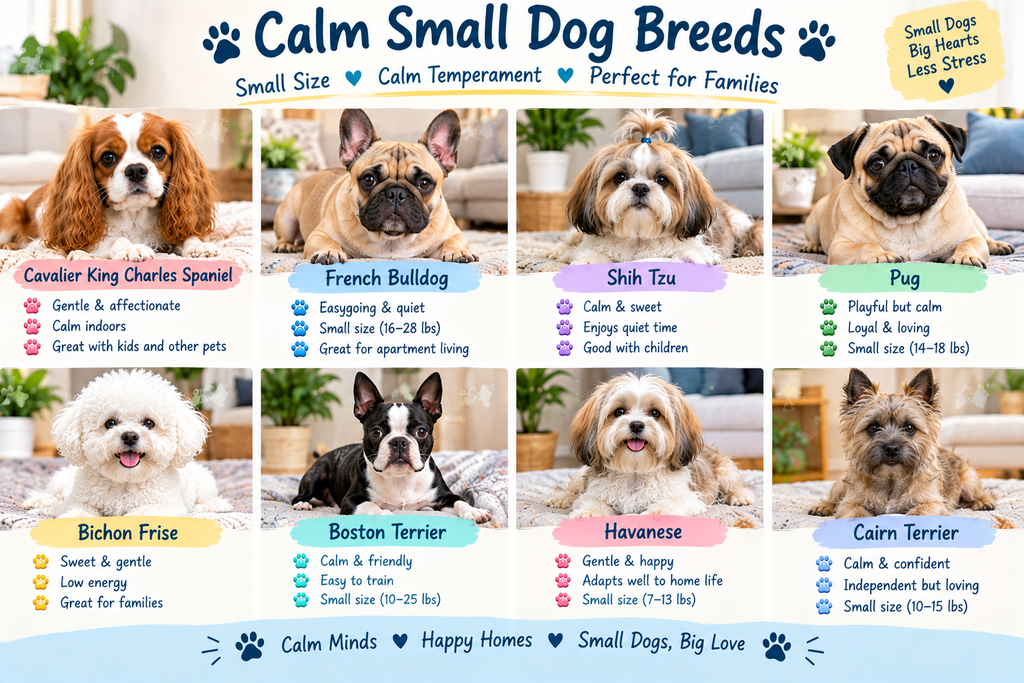
If your priority is a relaxed companion, breeds worth researching include: Calm Small Dog Breeds
- Cavalier King Charles Spaniel
- Shih Tzu
- Pug
- Japanese Chin
- English Toy Spaniel
- Havanese
- Bolognese
- Pekingese
The Cavalier is particularly notable because the AKC specifically includes it among breeds known for calm, easygoing temperaments.
However, breed tendencies are not guarantees. An individual dog’s age, upbringing, training, health, and environment can significantly affect behavior.
Are Calm Small Dogs Good for Apartments?
Many small dogs can adapt well to apartments, but size alone is not enough to determine apartment suitability.
The AKC notes that some small breeds have relatively low exercise needs, while other small dogs are energetic and need more opportunities to run and play. It also recommends considering barking and how a dog behaves around neighbors and shared spaces.
For apartment living, consider: Calm Small Dog Breeds
- Energy level
- Barking tendencies
- Exercise requirements
- Ability to settle indoors
- Neighbor interactions
- Time spent alone
- Access to safe outdoor exercise
A calm adult dog may be easier to manage in an apartment than a highly energetic puppy of the same breed.
Are Calm Small Dogs Good With Children?
Some calm small breeds can live happily with children, but supervision and appropriate handling are essential.
Very small dogs can be physically fragile. The AKC specifically cautions that some small breeds may be too delicate for households with very young, boisterous children and recommends considering the family’s lifestyle when choosing a dog.
Teach children to: Calm Small Dog Breeds
- Avoid pulling ears or tails
- Leave the dog alone while eating
- Never climb on the dog
- Respect the dog’s sleeping area
- Ask an adult before picking up a small dog
- Recognize when the dog wants space
Adults should supervise interactions, particularly with toddlers.
How Do You Help a Small Dog Become Calm?
Even a naturally easygoing breed benefits from a predictable routine.
Useful habits include: Calm Small Dog Breeds
- Provide age-appropriate exercise.
A dog that has no outlet for energy may become restless. - Use positive training.
Reward the behavior you want rather than relying on punishment. - Give the dog a quiet resting area.
Every dog should have somewhere it can retreat and relax. - Introduce new experiences gradually.
Controlled socialization can help puppies develop confidence. - Teach a settle behavior.
Rewarding quiet behavior can help dogs understand when it is time to relax. - Maintain a predictable schedule.
Consistent feeding, walking, training, and rest can make daily life easier for many dogs.
Calm Does Not Mean Lazy
One of the most common misconceptions about calm dogs is that they need almost no activity.
A healthy small dog still needs appropriate physical and mental stimulation. The exact amount depends on breed, age, health, and individual personality.
For example, a Cavalier may enjoy a relaxed evening on the sofa after a walk, while a Havanese may want an interactive game before settling down. A small dog’s ability to relax often improves when its normal needs have already been met.
A Simple Daily Routine for a Calm Small Dog
A basic routine might include: Calm Small Dog Breeds
- Morning bathroom break and walk
- Breakfast
- Rest
- Short training session
- Afternoon play or sniffing activity
- Evening walk
- Quiet family time
- Consistent bedtime
The exact schedule should be adjusted for the dog’s age, health, and individual needs.
Calm Small Dog Breeds vs. Low-Maintenance Dogs
These terms are sometimes confused.
Calm refers primarily to behavior and temperament.
Low-maintenance can refer to grooming, exercise, training, or general care.
A Shih Tzu, for example, can be a calm companion while still requiring substantial grooming. Conversely, a short-haired small dog may have simple coat care but a much more energetic personality.
That distinction is important when choosing a dog.
FAQ About Calm Small Dog Breeds
What is the most calm small dog breed?
There is no universal answer because individual temperament varies. Cavalier King Charles Spaniels are among the small breeds specifically described by the AKC as calm and easygoing.
What small dog is calm and cuddly?
Shih Tzus, Cavalier King Charles Spaniels, Pugs, and several other companion breeds can enjoy close contact with their owners. The Shih Tzu, in particular, is described by the AKC as affectionate, adaptable, and strongly companion-oriented.
What is a good calm small dog for an apartment?
Shih Tzu, Cavalier King Charles Spaniel, Pug, Japanese Chin, and some other small companion breeds can adapt to apartment living. However, barking, exercise, and time alone should be considered alongside size.
Are small dogs naturally calmer than big dogs?
No. Small dogs can be highly energetic, vocal, alert, or independent. The AKC specifically points out that small breeds differ significantly in personality and activity level.
What is the best calm small dog for seniors?
A senior’s ideal dog depends on mobility, daily routine, grooming preferences, experience, and the amount of exercise they can comfortably provide. Calm companion breeds such as the Cavalier King Charles Spaniel or Shih Tzu may be worth researching, but the individual dog’s temperament and care requirements should also be considered.
The Bottom Line
Calm small dog breeds can be wonderful companions for apartments, quiet households, families, and people who prefer a more relaxed canine lifestyle. Cavalier King Charles Spaniels, Shih Tzus, Pugs, Japanese Chins, Havanese, English Toy Spaniels, and Pekingese are useful breeds to research when temperament is a priority. Still, no breed guarantees a calm personality. The best match comes from considering the individual dog’s temperament alongside exercise, training, grooming, family needs, and living environment.
[…] A little dog can be a wonderful companion for people who want a smaller pet that fits comfortably into everyday life. Chihuahuas, Shih Tzus, Havanese, Pugs, Maltese, Italian Greyhounds, and other small breeds can suit apartments and smaller homes, but their personalities and care requirements vary. The best choice depends on your lifestyle, activity level, family situation, and the amount of grooming and training you can provide. For more insight here calm small dog breeds […]