
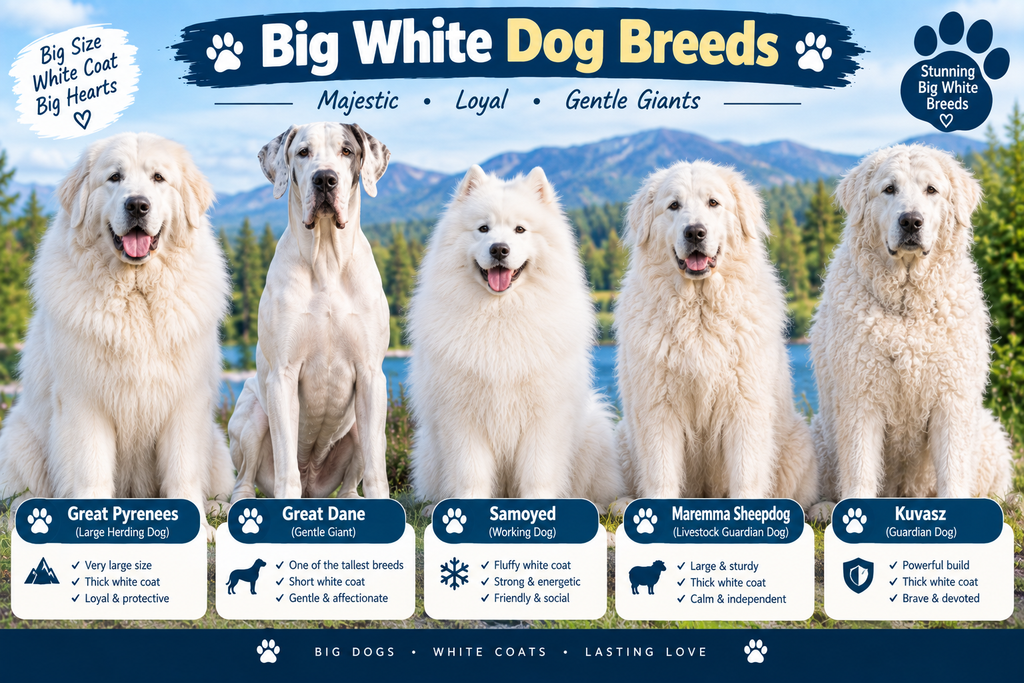
Big white dog breeds are hard to miss. From the gentle Great Pyrenees to the energetic Samoyed and independent Kuvasz, large white dogs come in different sizes, coat textures, and personalities. Some were bred to guard livestock, while others worked alongside people in cold climates or as versatile working companions.
A white coat can be beautiful, but appearance should only be one part of choosing a dog. Large breeds can have significant exercise, grooming, training, and space requirements, so the right match depends on your household and lifestyle. For more insight here big dogs don’t shed
What Counts as a Big White Dog?
There isn’t one official definition of a “big white dog.” The phrase usually describes medium-large to giant breeds that have predominantly white coats.
Some are almost completely white, while others can have cream, biscuit, gray, tan, or other markings depending on the breed standard. For example, the Kuvasz is white, while Great Pyrenees are principally white but can have some other coloration.
Common characteristics of these dogs include: Big White Dog Breeds
- Large or substantial body size
- White or predominantly white coats
- Working or guardian backgrounds in several breeds
- Moderate to high grooming needs in many breeds
- Exercise requirements that vary considerably
- Strong family bonds in many individual dogs
The important point is that white coat color does not tell you a dog’s temperament. Two large white breeds can have very different personalities.
1. Great Pyrenees
The Great Pyrenees is one of the classic big white dog breeds. Originally developed as a livestock guardian in the Pyrenees Mountains, this powerful breed was expected to protect sheep from predators. Today, Great Pyrenees can be calm family companions as well as vigilant guardians.
Their thick white coat gives them an enormous appearance, especially around the neck and chest.
Temperament
Great Pyrenees are often described as calm and gentle with their families, but their guardian instincts shouldn’t be overlooked.
They may: Big White Dog Breeds
- Watch the property at night
- Bark when they notice something unusual
- Be independent rather than constantly seeking instructions
- Form strong bonds with their family
- Need early socialization
One detail prospective owners sometimes underestimate is nighttime barking. A dog bred to notice potential threats independently may not wait for its owner to tell it that something is happening.
Grooming and exercise
Their thick coat needs regular care, particularly during periods of heavier shedding. They generally don’t require the same intense exercise as some athletic working breeds, but they still need daily activity and mental engagement.
2. Samoyed
The Samoyed is one of the most recognizable fluffy white dogs.
The breed has a thick double coat designed for cold conditions and is famous for its characteristic “Sammy smile.” The AKC describes the Samoyed as powerful, tireless, and functional despite its glamorous appearance.
Samoyeds are not giant dogs in the same way as Great Pyrenees, but their substantial coat makes them look considerably larger.
Personality
Samoyeds are generally social, alert, active, and people-oriented. They were historically used for tasks including herding and sled work.
They often enjoy: Big White Dog Breeds
- Long walks
- Hiking
- Interactive games
- Training
- Dog sports
- Spending time with their people
Grooming
This is where prospective owners should be realistic. A Samoyed’s beautiful coat requires significant maintenance. The Samoyed Club of America describes grooming the breed’s double coat as a substantial part of ownership.
If you want a white dog but dislike brushing and vacuuming, this probably isn’t the easiest choice.
3. Kuvasz
The Kuvasz is a large, snow-white Hungarian livestock guardian.
It can easily be confused with the Great Pyrenees because both are large white guardian breeds with thick coats. However, they are distinct breeds with different histories and characteristics.
Kuvaszok are known for being intelligent, confident, independent, and devoted to their families.
What owners should know
This isn’t necessarily a breed for someone who wants a dog that follows commands instantly.
A Kuvasz was developed to make decisions while guarding livestock, so independent thinking is part of its heritage.
Good ownership includes: Big White Dog Breeds
- Early socialization
- Consistent training
- Clear boundaries
- Plenty of daily activity
- Appropriate space
- Respect for the dog’s guardian instincts
PetMD also notes that Kuvaszok need regular brushing, daily exercise, and room to move.
4. Komondor
The Komondor is one of the most unusual big white dogs in the world.
Its long, naturally corded coat makes it look almost like a walking mop. But the appearance has a practical history: the breed was developed as a livestock guardian, and its coat helped it blend into flocks while providing protection from harsh conditions and predators.
The coat is the major commitment
Komondor grooming isn’t like brushing an ordinary long-haired dog.
The coat develops into cords that require appropriate maintenance. Owners need to understand how to keep the cords separated and clean.
The Komondor can be: Big White Dog Breeds
- Protective
- Independent
- Devoted
- Serious about its home and family
- Reserved around unfamiliar people
Because of its size and guardian background, early socialization and responsible training are essential.
5. Maremma Sheepdog
The Maremma Sheepdog is a large Italian livestock guardian known for its predominantly white coat.
It was developed to work with livestock, so it is fundamentally a working dog rather than simply a fluffy companion.
That history matters when considering one as a family pet.
A Maremma may be a good match for someone who: Big White Dog Breeds
- Has substantial outdoor space
- Understands livestock guardian behavior
- Enjoys an independent dog
- Can provide daily activity
- Is prepared for regular coat care
People sometimes see the fluffy white coat and assume these dogs are naturally easygoing pets. Their working instincts can be much stronger than their appearance suggests.
6. White Swiss Shepherd Dog
The White Swiss Shepherd Dog is another striking white-coated breed.
It has a shepherd-like appearance and is generally more athletic and responsive than the giant livestock guardians on this list.
These dogs can be devoted family companions when given sufficient physical and mental activity.
Their ideal routine may include: Big White Dog Breeds
- Daily walks
- Obedience training
- Interactive games
- Hiking
- Scent activities
- Structured socialization
They are not a good choice simply because you want a beautiful white dog. Their intelligence means they benefit from having something meaningful to do.
7. Newfoundland With a White-and-Black Coat
Not every large dog with a striking white coat is entirely white.
The Newfoundland can have a black-and-white pattern known as Landseer in some breed standards and regions. Newfoundlands are exceptionally large working dogs historically associated with water work and hauling.
Their size and coat create a powerful visual impression.
Newfoundlands are known for: Big White Dog Breeds
- Their substantial size
- Strong swimming ability
- Gentle dispositions in many individuals
- Thick coats
- A strong attachment to their families
Their coat also means owners should be prepared for shedding and regular grooming.
If your goal is specifically an all-white dog, this isn’t the right choice. But if you’re interested in large dogs with prominent white coloring, it belongs in the conversation.
8. White Siberian Husky
The Siberian Husky is another breed that can have a predominantly white coat.
Unlike the guardian breeds above, Huskies were developed for endurance and pulling sleds. They tend to have high energy and can be extremely active.
A white Husky may look peaceful in a photograph, but daily life can be very different.
Expect a dog that may enjoy: Big White Dog Breeds
- Running
- Hiking
- Long walks
- Play
- Training games
- Exploring
Their double coat can also shed heavily, especially during seasonal coat changes. PetMD notes that Husky owners should expect regular coat upkeep.
9. White or Predominantly White Leonberger
The Leonberger is an enormous German breed with a lush coat. It isn’t an all-white breed, but some individuals can have very light coloring with substantial cream or white areas.
The AKC describes the Leonberger as a lush-coated giant with a gentle and serene nature.
Because of its size, this breed requires owners who can comfortably manage a very large dog.
A Leonberger may suit a household looking for a giant companion with a softer family-oriented temperament, provided the family can handle the grooming, exercise, food, training, and general logistics of giant-breed ownership.
Big White Dog Breeds at a Glance
| Breed | Coat | Activity | Grooming | Typical Personality |
|---|---|---|---|---|
| Great Pyrenees | White, thick | Moderate | Moderate–High | Calm, protective |
| Samoyed | White/cream | High | High | Social, energetic |
| Kuvasz | White | Moderate–High | Moderate | Independent, loyal |
| Komondor | White, corded | Moderate | High | Protective, independent |
| Maremma Sheepdog | White | Moderate | Moderate–High | Watchful, independent |
| White Swiss Shepherd | White | High | Moderate | Intelligent, active |
| Newfoundland | Black/white or other patterns | Moderate | High | Gentle, strong |
| Siberian Husky | Can be predominantly white | High | High | Energetic, independent |
| Leonberger | Light colors possible | Moderate | High | Gentle, substantial |
These are broad breed-level descriptions. Individual dogs can differ considerably in temperament and activity needs.
Are Big White Dogs Good Family Dogs?
Some can be excellent family companions, but size and color don’t determine family suitability.
Great Pyrenees, for example, can be gentle with children, while their guardian instincts still require responsible socialization and management. AKC sources describe mature Great Pyrenees as relatively laid-back and note their potential as family companions.
Before choosing any large breed, consider: Big White Dog Breeds
- The ages of children in the household
- Other pets
- Available living space
- Exercise time
- Training experience
- Grooming budget
- Tolerance for barking
- Ability to physically manage a large adult dog
A 100-pound dog can be wonderful, but it also occupies a lot of physical space and requires appropriate handling.
Do Big White Dogs Shed a Lot?
Many do.
A common mistake is assuming that a fluffy coat means low shedding. In reality, many white-coated large breeds have dense double coats and can leave substantial amounts of hair around the home.
Samoyeds, Great Pyrenees, and Huskies, for example, have substantial coats designed for cold environments. The Samoyed’s double coat includes a dense undercoat, while Great Pyrenees are described by the AKC as thickly coated.
If reducing dog hair is your main priority, focus on coat type and shedding level, not simply color.
How Much Grooming Do Big White Dogs Need?
The answer depends heavily on the breed.
A typical grooming routine may involve: Big White Dog Breeds
- Brushing several times a week
- More frequent brushing during heavy shedding
- Bathing when appropriate
- Checking behind the ears and legs for mats
- Nail care
- Coat trimming when required
- Regular professional grooming for certain coat types
White coats can also show dirt more easily, particularly around the feet, face, and underside of the body.
The Komondor is a particularly specialized case because its corded coat requires different care from a conventional fluffy coat.
Great Pyrenees vs. Kuvasz: What’s the Difference?
These two breeds are frequently mistaken for each other.
Both are large white livestock guardians with thick coats. However, the Kuvasz comes from Hungary, while the Great Pyrenees originated in the Pyrenees Mountains between France and Spain.
There are also visible differences in their coats and heads. Great Pyrenees can have some gray, red, or tan markings, whereas the Kuvasz is white. Their temperaments also differ, although individual dogs naturally vary.
If you’re trying to identify a white dog you’ve seen, coat color alone isn’t enough. Body structure, coat texture, head shape, ears, size, and behavior can all provide clues.
Things to Consider Before Choosing a Big White Dog
A beautiful photograph can make any breed look easy to own. Living with one is different.
Ask yourself: Big White Dog Breeds
- Can I manage the adult size?
- Can I provide daily exercise?
- Am I prepared for shedding?
- Can I keep up with grooming?
- Do I understand guardian or working-dog behavior?
- Can I provide consistent training?
- Does the breed fit my household and other pets?
For large working breeds, training and socialization aren’t optional extras. They help dogs learn how to behave safely around people, animals, visitors, and everyday situations.
Frequently Asked Questions
What is the most popular big white dog breed?
The Great Pyrenees is one of the best-known large white breeds. It is a powerful livestock guardian that can also be a calm family companion.
What is the fluffiest big white dog?
The Samoyed is among the most recognizable fluffy white breeds, while the Great Pyrenees also has a thick, luxurious coat.
What is the biggest white dog breed?
There isn’t one universally accepted “biggest white dog,” because size varies among individuals and breeds. Great Pyrenees, Kuvasz, Komondor, and some other large guardian breeds can reach substantial sizes.
Are big white dogs hard to take care of?
Some are. Their size, grooming requirements, exercise needs, shedding, and working instincts can make them more demanding than smaller companion breeds.
Which big white dog is good for families?
Several can live successfully with families when appropriately trained and socialized. Great Pyrenees are particularly known for their gentle family-oriented nature, but each household should consider the breed’s size, guarding instincts, grooming, and exercise needs.
Do white dogs get dirty easily?
White coats can make dirt more visible, especially around the paws, face, and underside. Regular brushing and appropriate bathing can help keep the coat clean without overbathing.
The Bottom Line
Big white dog breeds range from calm livestock guardians to energetic northern working dogs, so choosing one should involve much more than picking the fluffiest face. Great Pyrenees, Samoyeds, Kuvasz, Komondors, and other large white-coated breeds each bring different grooming, exercise, training, and temperament needs. Research the breed’s original purpose as carefully as its appearance, and you’ll have a much clearer idea of whether that impressive white dog fits your everyday life.
[…] If you are searching for the best white fluffy dog breeds, this guide introduces some of the most popular and recognizable breeds and explains what potential owners should know before choosing one. For more insight here big white dog breeds […]