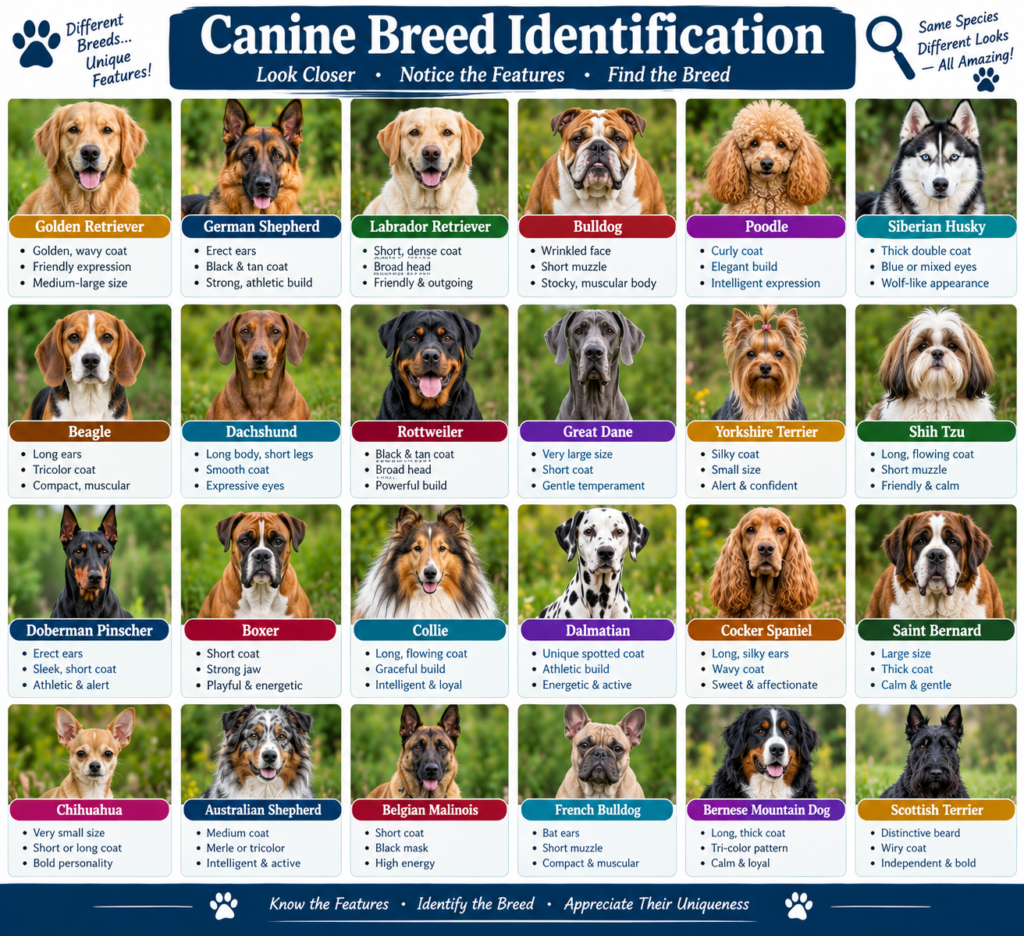
Canine breed identification is the process of determining what breed or combination of breeds a dog may belong to. For purebred dogs, identification can sometimes be relatively straightforward when the dog’s physical features closely match an established breed standard. For mixed-breed dogs, however, identification can be much more challenging.
A dog’s size, body shape, head structure, ears, tail, coat, color, movement, and behavior can provide useful clues. Pedigree records can provide documented ancestry, while some commercial DNA tests can estimate breed ancestry in mixed-breed dogs. It is important to understand that appearance alone does not always provide a definitive answer.
The American Kennel Club provides breed identification resources designed to help people recognize AKC-recognized breeds, including a Breed ID Guide covering more than 170 breeds. For more insight here dog with no hair
What Is Canine Breed Identification?
Canine breed identification means examining a dog’s characteristics to determine which breed it most closely resembles or, in the case of a mixed-breed dog, which breeds may be part of its ancestry.
Identification can involve several different sources of information: Canine Breed Identification
- Physical appearance
- Body size and proportions
- Coat type and color
- Head and ear shape
- Tail structure
- Behavior and temperament
- Movement and physical abilities
- Pedigree documentation
- DNA-based breed ancestry testing
No single characteristic should automatically determine a dog’s breed. Many unrelated breeds can share similar physical features.
Why Is Dog Breed Identification Important?
Knowing a dog’s breed or likely ancestry can be useful for several reasons.
Understanding Physical Needs
Different breeds were developed for different purposes. Herding dogs, sporting dogs, hounds, terriers, and working breeds can have very different exercise requirements.
Training
Breed background can provide clues about a dog’s natural tendencies. A herding breed may enjoy activities involving movement and problem-solving, while a scent hound may be particularly interested in following smells.
Grooming
Coat type can help owners understand how much grooming a dog may require.
Health Information
Breed ancestry can help veterinarians and owners consider health issues that may be more common in particular breeds. However, breed identification should never replace veterinary evaluation.
Choosing the Right Activities
Understanding likely breed background can help owners choose appropriate exercise, games, training, and enrichment.
How to Identify a Dog Breed by Appearance
Physical appearance is one of the most common starting points for canine breed identification.
However, visual identification should be treated as an educated estimate rather than absolute proof, particularly when identifying mixed-breed dogs.
1. Look at the Dog’s Size
Begin by estimating the dog’s adult size.
Consider: Canine Breed Identification
- Height at the shoulder
- Body length
- Weight
- Leg length
- Bone structure
- Overall proportions
For example, a very tall, narrow dog may suggest a sighthound background, while a compact, heavily built dog could resemble certain terrier, bulldog, or mastiff types.
Size alone is not enough because many breeds overlap in weight and height.
2. Examine the Head Shape
The head can provide useful breed clues.
Look at:
- Muzzle length
- Muzzle width
- Stop between the forehead and muzzle
- Skull shape
- Jaw structure
- Cheek shape
- Facial wrinkles
A long, narrow muzzle is common in several sighthounds, while shorter muzzles occur in brachycephalic breeds such as Bulldogs and Pugs.
3. Check the Ears
Dog ears vary dramatically between breeds.
They may be: Canine Breed Identification
- Upright
- Semi-erect
- Drop
- Button
- Rose-shaped
- Feathered
- Cropped in some dogs
Ear shape can narrow down possible breeds, but it should be considered alongside other characteristics.
4. Examine the Tail
The tail is another useful identification feature.
Consider whether it is: Canine Breed Identification
- Long
- Short
- Naturally bobbed
- Curled
- Plumed
- Feathered
- Thick at the base
- Carried high or low
Some breeds have distinctive naturally short or curled tails, while others have long feathered tails.
5. Study the Coat
Coat type is often one of the most obvious characteristics.
Dogs may have:
- Short coats
- Long coats
- Double coats
- Wiry coats
- Curly coats
- Corded coats
- Hairless coats
Coat texture can help distinguish breeds that otherwise have similar body shapes.
6. Consider Coat Color and Pattern
Color can provide additional clues.
Common patterns include: Canine Breed Identification
- Solid
- Brindle
- Merle
- Sable
- Spotted
- Parti-color
- Black and tan
- White markings
However, coat color should never be used alone because many breeds share similar colors and patterns.
Can Behavior Help Identify a Dog Breed?
Behavior can provide clues, but it is not a reliable standalone method of identification.
For example, a dog that loves chasing moving objects might have terrier or herding ancestry. A dog that spends a great deal of time following scents may have hound ancestry.
However, individual personality is influenced by genetics, early socialization, training, environment, and life experience.
Therefore, saying that a dog is a particular breed solely because of its behavior can be misleading.
Dog Breed Identification by Purpose
Another useful approach is to consider what type of work the dog’s physical characteristics and behavior suggest.
Herding Dogs
Herding breeds were developed to work with livestock. They often have high energy and strong responsiveness to movement.
Examples include: Canine Breed Identification
- Border Collie
- Australian Shepherd
- German Shepherd Dog
- Shetland Sheepdog
Sporting Dogs
Sporting breeds were developed for activities such as finding, flushing, or retrieving game.
Examples include:
- Labrador Retriever
- Golden Retriever
- English Springer Spaniel
- German Shorthaired Pointer
Hounds
Hounds include dogs developed primarily for hunting using sight or scent.
Examples include: Canine Breed Identification
- Greyhound
- Saluki
- Beagle
- Bloodhound
Terriers
Terriers were traditionally developed for controlling vermin and other forms of hunting.
Examples include:
- Jack Russell Terrier
- Scottish Terrier
- Airedale Terrier
- Miniature Schnauzer
Working Dogs
Working breeds have historically performed jobs such as guarding, pulling, rescue, and property protection.
Examples include: Canine Breed Identification
- Rottweiler
- Boxer
- Great Dane
- Newfoundland
These categories can provide useful clues but should not be treated as definitive identification methods.
Can You Identify a Mixed-Breed Dog?
Mixed-breed dogs can be particularly difficult to identify by appearance.
A dog may have physical characteristics resembling several breeds without actually being a direct cross between those breeds. Genetic inheritance is complex, and puppies from the same mixed-breed parents can sometimes look quite different from one another.
For this reason, visual breed identification should be presented as an estimate when the dog’s pedigree is unknown.
Common Signs of a Mixed-Breed Dog
Possible clues include: Canine Breed Identification
- A combination of different body types
- Unusual coat patterns
- Features associated with several breed groups
- Physical traits that do not closely match one breed standard
- Unknown ancestry
However, these characteristics do not prove that a dog is mixed-breed.
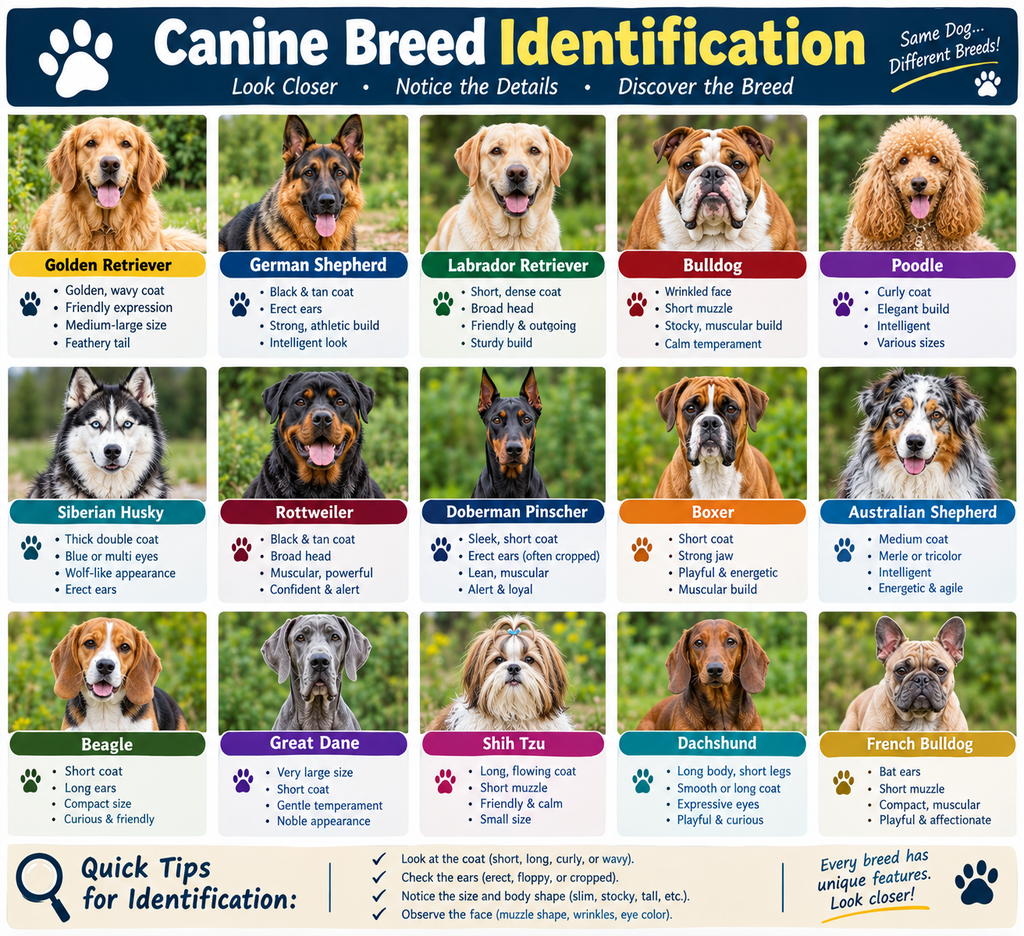
Can a DNA Test Identify a Dog Breed?
DNA testing can provide information about genetic ancestry, but it is important to understand what a particular test actually measures.
The AKC distinguishes its DNA profiling program from breed-ancestry testing. AKC DNA profiling is designed for genetic identification and parentage verification and does not determine a dog’s breed.
Some other commercial DNA tests are specifically designed to estimate breed ancestry in mixed-breed dogs. AKC has also discussed the use of DNA testing to investigate genetic makeup in mixed-breed dogs.
Results can depend on the company’s reference database and testing methodology, so DNA results should be interpreted in context rather than treated as an infallible description of a dog’s identity.
Pedigree Is Different From Breed Guessing
For a registered purebred dog, pedigree documentation provides a record of its ancestry.
An official pedigree can show generations of ancestors and may include registration information, titles, health clearances, and other details depending on the registry.
This is different from looking at a dog’s appearance and guessing its breed.
A dog can look like a particular breed without having documented pedigree ancestry from that breed.
Canine Breed Identification Checklist
When trying to identify an unfamiliar dog, work through this checklist:
Step 1: Estimate Size
Record approximate height and weight.
Step 2: Examine Body Shape
Look at the chest, back, legs, bone structure, and overall proportions.
Step 3: Study the Head
Examine the muzzle, skull, eyes, cheeks, and jaw.
Step 4: Check the Ears
Determine whether the ears are upright, floppy, folded, or another shape.
Step 5: Examine the Tail
Look at length, shape, thickness, and how the dog carries it.
Step 6: Study the Coat
Identify length, texture, density, and pattern.
Step 7: Observe Movement
Watch the dog walk or run if it is safe to do so. Gait can sometimes provide additional clues.
Step 8: Consider Behavior
Look at activity level, responsiveness, play style, and natural tendencies.
Step 9: Compare With Breed Standards
Compare the dog with reliable breed information rather than relying only on social-media photographs.
Step 10: Check Documentation
If available, review registration papers, pedigree information, adoption records, or breeder records.
Dog Breed Identification From a Photo
A photograph can be useful for making an initial breed estimate.
When examining a dog photo, try to use a clear image showing: Canine Breed Identification
- The entire body
- Head and face
- Ears
- Tail
- Legs and paws
- Coat texture
Multiple photographs from different angles are usually more informative than a single close-up.
Even with good photographs, visual identification may remain uncertain, particularly for mixed-breed dogs.
The AKC itself notes through its breed-identification resources that distinguishing breeds can sometimes be challenging, which is why dedicated identification guides and breed information are useful.
Common Mistakes in Dog Breed Identification
Several mistakes can lead to inaccurate breed identification.
Mistake 1: Identifying by Color Alone
A black dog is not necessarily a particular breed, just as a white dog does not automatically belong to one breed.
Mistake 2: Assuming Size Proves Breed
Many unrelated breeds can have similar adult sizes.
Mistake 3: Relying Only on Personality
Temperament varies between individual dogs.
Mistake 4: Confusing Breed With Breed Type
Terms such as “retriever,” “terrier,” “hound,” or “mastiff” may describe groups or historical functions rather than one specific breed.
Mistake 5: Treating a DNA Result as Absolute
Breed-ancestry results should be interpreted according to the test’s methodology and database.
Mistake 6: Ignoring the Dog’s Age
Puppies can change dramatically as they grow. Their adult proportions, coat, and facial features may not yet be fully developed.
Dog Breed Identification for Puppies
Identifying a puppy can be harder than identifying an adult dog.
Puppies may not yet have:
- Their adult coat
- Full body proportions
- Mature head shape
- Adult size
- Final ear carriage
A puppy that looks like one breed at eight weeks may look noticeably different several months later.
If the puppy comes from a responsible breeder, pedigree and parent information can be much more useful than visual guessing.
Why Breed Identification Matters for Dog Owners
Understanding a dog’s likely ancestry can help owners make more informed decisions about care.
It can provide clues about:
- Exercise requirements
- Grooming
- Training style
- Mental stimulation
- Potential breed-associated health concerns
- Adult size
- Suitable activities
However, breed identification should complement—not replace—observation of the individual dog’s actual needs.
A mixed-breed dog can be just as healthy, intelligent, trainable, and loving as a purebred dog.
Frequently Asked Questions
What is canine breed identification?
Canine breed identification is the process of determining a dog’s breed or likely breed ancestry using characteristics such as appearance, behavior, documentation, and, where appropriate, DNA-based testing.
Can you identify a dog breed by appearance?
Sometimes. Physical features can provide useful clues, but appearance alone cannot always definitively identify a breed, especially in mixed-breed dogs.
What features are most useful for identifying a dog?
Size, body proportions, head shape, ears, tail, coat type, coat pattern, and overall structure can all provide useful clues.
Can a DNA test tell me what breed my dog is?
Some commercial ancestry tests are designed to estimate breed ancestry, particularly for mixed-breed dogs. However, not every DNA test is a breed test. For example, AKC DNA profiling is designed for genetic identity and parentage verification and does not determine breed.
Is a pedigree more reliable than appearance?
For a registered purebred dog, a documented pedigree provides ancestry information rather than a visual estimate. Pedigrees record the dog’s direct ancestors and can contain registration and other information.
Can puppies be difficult to identify?
Yes. Puppies are still developing, so their adult size, coat, proportions, and facial features may not yet be obvious.
Can two different breeds look almost identical?
Yes. Different breeds can share similar colors, body shapes, ear types, and coats. This is one reason breed identification from photographs can be difficult.
Does breed identification determine a dog’s personality?
No. Breed can provide clues about typical tendencies, but individual temperament is influenced by genetics, socialization, training, environment, and life experience.
Conclusion
Canine breed identification is a useful way to learn more about a dog’s possible background, but it requires careful observation and realistic expectations. Size, body structure, head shape, ears, tail, coat, movement, and behavior can all provide valuable clues.
For purebred dogs, reliable pedigree documentation is stronger evidence of ancestry than visual appearance. For mixed-breed dogs, specialized DNA ancestry testing may provide additional information, depending on the test and its database.
The most effective approach is to combine multiple sources of information rather than relying on one physical feature. Whether you are identifying a puppy, researching a rescue dog, or simply curious about a dog you have seen, careful comparison with reliable breed resources can make the process more accurate and informative.
[…] The American Kennel Club also maintains an official breed identification guide and breed database that can help owners compare dogs with recognized breed characteristics. For more insight here canine breed identification […]