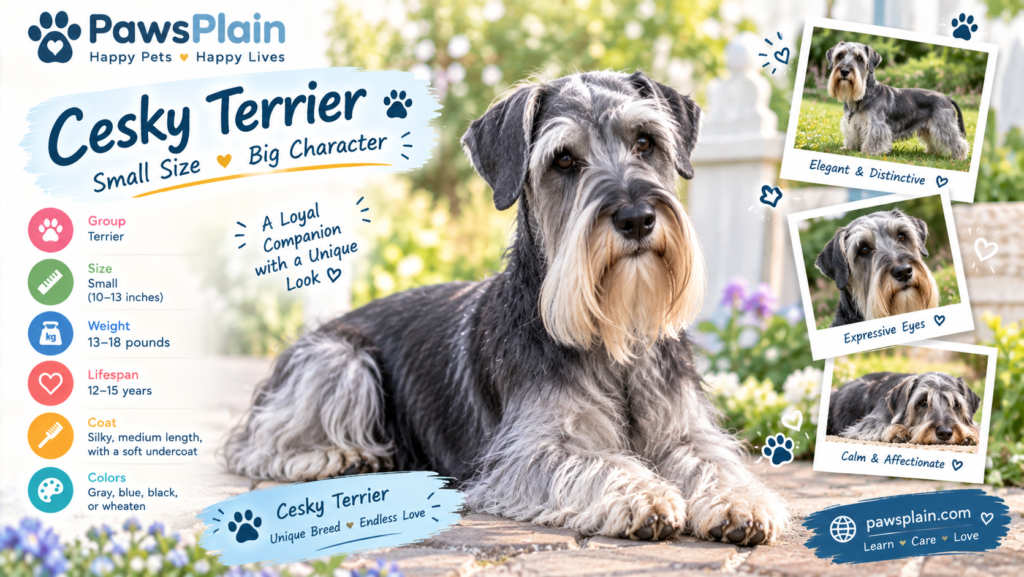
The Cesky Terrier, also known as the Czech Terrier or Bohemian Terrier, is a distinctive small terrier from the Czech Republic. With its long body, short legs, soft silky coat, natural drop ears, and characteristic beard and eyebrows, the Cesky Terrier has an appearance unlike most other terrier breeds.
Although small, the Cesky is an active and capable working dog. It was originally developed for hunting and was specifically designed to work in packs and move efficiently through burrows. Today, it is valued primarily as a loyal companion while retaining many of the intelligence, alertness, and determination of its terrier heritage.
The breed is relatively rare, particularly in the United States. The American Kennel Club describes the Cesky as a clever and adventurous companion that tends to be somewhat more laid-back and tractable than many other terriers. For more insigh here german spitz
Quick Facts
| Feature | Details |
|---|---|
| Breed Name | Cesky Terrier |
| Other Names | Czech Terrier, Bohemian Terrier |
| Country of Origin | Czech Republic |
| Breed Group | Terrier |
| FCI Group | Group 3 – Terriers |
| Height | About 10–13 inches |
| Weight | About 16–22 pounds |
| Coat | Soft, silky and clipped |
| Colors | Shades of gray; coffee is extremely rare |
| Temperament | Cheerful, loyal, calm and reserved with strangers |
| Energy Level | Moderate |
| Grooming | Regular |
| Shedding | Low |
| Main Historical Role | Hunting terrier |
| Best For | Families and active individuals |
The FCI officially recognizes the breed as the Czech Terrier (Cesky Terrier) and classifies it among the small-sized terriers. The breed received definitive FCI recognition in 1963.
History
The Cesky Terrier has a relatively recent and unusually well-documented history.
The breed was created in Czechoslovakia by František Horák, a Czech breeder and hunter, during the late 1940s. Horák wanted to develop a terrier that could hunt in packs and work effectively in the forests and burrows of his country.
He crossed the Scottish Terrier with the Sealyham Terrier. His goal was to combine useful qualities from both breeds while creating a dog with a narrower body and shorter stature that could move through underground hunting environments.
Horák also wanted the new breed to be suitable as a family companion. As a result, the Cesky was developed to combine hunting ability with a comparatively calm and cooperative temperament.
The breed eventually became known as the Cesky Terrier, with “Cesky” meaning Czech.
The breed was officially recognized by the FCI in 1963. It later reached the United States, and the American Kennel Club admitted it to the Terrier Group in 2011.
What Does a Look Like?
The Cesky Terrier has a distinctive body shape.
It is:
- Short-legged
- Longer than it is tall
- Muscular
- Well-pigmented
- Relatively narrow
- Long-bodied
- Naturally tailed
- Drop-eared
The official AKC standard describes the Cesky as a well-muscled, short-legged hunting terrier with natural drop ears and a natural tail. Its body is longer than its height, giving the breed its characteristic low-to-the-ground appearance.
Head and Face
The Cesky has a long head with a distinctive facial appearance.
Its eyebrows, mustache and beard are usually left longer, creating one of the breed’s most recognizable features.
The ears are naturally dropped rather than standing upright like those of many other terriers.
Size
The ideal height is approximately 10–13 inches, while the AKC standard gives an ideal weight range of approximately 13–22 pounds. The breed is small enough to be manageable but muscular enough to remain an active working terrier.
Coat and Colors
The Cesky Terrier has a soft, silky coat, which is unusual among terriers.
Unlike many traditional terriers, the Cesky’s coat is clipped rather than hand-stripped. This makes its grooming routine somewhat different from breeds such as the Scottish Terrier.
Cesky puppies are born black or black-and-tan, and their coat gradually lightens as they mature. The adult coat develops into shades of gray ranging from darker charcoal to lighter platinum. The correct mature gray coloration may not be fully established until the dog is several years old.
A very rare coffee-colored variety also exists.
Temperament
The Cesky Terrier is known for being a pleasant and cheerful companion.
The AKC’s breed temperament guide describes the Cesky as a pleasant, cheerful companion that is reserved toward strangers and has a calm, kind disposition. The breed should not be aggressive or excessively shy.
Common personality characteristics include:
- Loyal
- Cheerful
- Intelligent
- Calm
- Affectionate with family
- Alert
- Reserved with strangers
- Determined when working
- Playful
Compared with some terrier breeds, the Cesky is often considered more relaxed and tractable. The AKC describes it as somewhat more laid-back than the typical terrier.
Is the a Good Family Dog?
Yes, the Cesky Terrier can be an excellent family companion.
The breed was deliberately developed to combine working ability with a family-friendly temperament. Cesky Terriers tend to form strong bonds with their owners and enjoy participating in family activities.
However, children should always be taught how to interact respectfully with dogs. Young children should be supervised, especially because the Cesky remains a terrier with natural hunting instincts.
Strangers
Cesky Terriers can be reserved around unfamiliar people.
This does not necessarily mean they are unfriendly. Rather, they may prefer to observe a new person before becoming comfortable.
Early socialization is therefore important. The AKC specifically recommends socialization because the breed’s cautious nature around strangers can otherwise become problematic.
Exercise Needs
The Cesky Terrier is active but does not generally require the extreme amount of exercise associated with some high-energy terriers.
Daily activity can include:
- Walks
- Hiking
- Fetch
- Interactive games
- Obedience training
- Tracking activities
- Agility
- Earthdog activities
The breed’s hunting background means it enjoys activities that allow it to use both its body and brain.
The AKC notes that Cesky Terriers are energetic and can participate successfully in activities such as agility, tracking and earthdog work.
Training a Cesky Terrier
The Cesky Terrier is intelligent and can be highly trainable.
Its willingness to work with people is one of the characteristics that distinguishes it from some more independent terrier breeds.
Training should be:
- Positive
- Consistent
- Reward-based
- Short and engaging
- Appropriate for the dog’s age
Useful commands include:
- Sit
- Stay
- Come
- Down
- Leave it
- Wait
Because the Cesky is intelligent, repetitive training can become boring. Mixing obedience with games and new challenges can help maintain its attention.
Cesky Terrier Hunting Instincts
Although modern Ceskys are often family companions, their hunting heritage remains important.
The breed was developed to hunt animals such as hare, fox and other game. The AKC notes that Cesky Terriers are keen and alert when hunting and may chase things that catch their attention.
For this reason, owners should be cautious around:
- Small animals
- Unfenced areas
- Busy roads
- Unfamiliar wildlife
A secure yard and reliable leash habits are important.
Cesky Terrier Grooming
One of the advantages of the Cesky Terrier is that its coat is clipped rather than hand-stripped.
Pet Cesky Terriers generally need professional grooming approximately every 6–10 weeks, depending on coat growth, climate and lifestyle. Longer hair on the legs and underside should also be brushed regularly to prevent tangles.
A grooming routine should include:
- Regular brushing
- Professional clipping
- Combing longer furnishings
- Ear care
- Nail trimming
- Dental care
- Checking the skin and coat
The breed’s beard and facial furnishings can collect food and debris, so they may require additional cleaning.
Does the Cesky Terrier Shed?
The Cesky Terrier is generally considered a low-shedding breed.
Its coat is different from the harsh, wiry coat of many other terriers. However, low shedding does not mean zero maintenance.
Regular grooming is still necessary to keep the coat healthy and prevent tangles.

Cesky Terrier Health
Like every breed, the Cesky Terrier can experience health problems. Responsible breeding and appropriate veterinary care are important for maintaining the breed’s health.
The American Kennel Club’s current breed-health testing recommendations for the Cesky Terrier include:
- Patella evaluation
- Cardiac examination
- Ophthalmologist evaluation
- Dentition examination
Prospective owners should ask breeders about health testing and the medical history of the parents.
Regular veterinary examinations throughout the dog’s life are also important.
Dental Care
Dental care should be part of the Cesky Terrier’s regular routine.
Owners can help protect oral health through:
- Regular tooth brushing
- Veterinary-approved dental products
- Routine dental examinations
- Monitoring for tartar
- Professional dental cleaning when recommended
Small breeds can require particular attention to dental hygiene, so establishing a routine early is beneficial.
Feeding a Cesky Terrier
A Cesky Terrier should receive a nutritionally complete diet appropriate for its age, size and activity level.
Owners should monitor portions carefully because maintaining a healthy body condition is important for a short-legged breed.
A feeding plan should consider:
- Puppy or adult stage
- Body weight
- Activity level
- Body condition
- Individual health needs
- Veterinary recommendations
Treats should be limited and included as part of the dog’s overall daily calorie intake.
Fresh water should always be available.
Cesky Terrier Puppies
Cesky Terrier puppies are intelligent and curious, making early training especially important.
Puppy development should include:
- Safe socialization
- Basic obedience
- Gentle grooming practice
- Appropriate nutrition
- Veterinary care
- Controlled exercise
- Exposure to different environments
Because grooming is an important part of Cesky ownership, puppies should become comfortable with brushing, handling, nail care and having their ears examined.
Cesky Terrier With Other Pets
A Cesky Terrier may live successfully with other pets when properly socialized and introduced.
However, its historical hunting background means owners should not automatically assume that every Cesky will be safe with small animals.
Introductions should be gradual and supervised.
A secure environment is particularly important if the household includes rabbits, rodents or other small pets.
Is the Cesky Terrier Good for Apartment Living?
The Cesky Terrier can adapt well to apartment life if its exercise and mental stimulation needs are met.
Its relatively small size makes it practical for smaller homes, but owners should still provide daily walks and play.
The breed’s moderate activity level can make it easier to manage indoors than some highly energetic terriers.
Is the Cesky Terrier Good for First-Time Owners?
The Cesky Terrier can be a reasonable choice for a first-time owner who is willing to learn about terrier behavior and grooming.
Its trainability and relatively calm temperament can be advantages.
However, prospective owners should still be prepared for:
- Regular grooming
- Daily exercise
- Socialization
- Training
- Hunting instincts
- Caution around unfamiliar animals
Cesky Terrier Pros and Cons
Pros
- Loyal and affectionate
- Intelligent
- Relatively calm for a terrier
- Low shedding
- Compact size
- Trainable
- Good family companion
- Distinctive appearance
- Can enjoy many dog sports
Cons
- Relatively rare
- Needs regular professional grooming
- Can be reserved with strangers
- Retains hunting instincts
- Requires consistent socialization
- May be difficult to find from a responsible breeder
Frequently Asked Questions
What is a Cesky Terrier?
The Cesky Terrier is a small Czech terrier developed by František Horák for hunting and companionship. It is known for its long body, short legs, silky coat and loyal temperament.
Is the Cesky Terrier rare?
Yes. The breed remains relatively uncommon, particularly in the United States. The AKC has described it as a rare breed.
How big does a Cesky Terrier get?
The breed is approximately 10–13 inches tall and generally weighs around 16–22 pounds, although the AKC standard gives an ideal range of 13–22 pounds.
Does a Cesky Terrier shed?
It is considered a low-shedding breed, but regular grooming is still required to maintain its silky coat.
Is a Cesky Terrier easy to train?
Generally, yes. It is intelligent and was specifically developed to combine working ability with a cooperative family temperament.
Are Cesky Terriers good with children?
They can be good family dogs when properly socialized. Children should always be taught to interact with dogs respectfully and supervised when necessary.
How often does a Cesky Terrier need grooming?
Pet Cesky Terriers generally benefit from professional grooming approximately every 6–10 weeks, while longer areas of the coat should be brushed at least weekly to prevent tangles.
What colors are Cesky Terriers?
The main coat color is gray in various shades. Coffee-colored Cesky Terriers exist but are extremely rare. Puppies are typically born darker and lighten as they mature.
Conclusion
The Cesky Terrier is a unique combination of working terrier, loyal family companion and rare Czech breed. Created by František Horák with a specific goal of producing a capable hunting dog that could also live successfully with people, the Cesky has developed a reputation for being intelligent, affectionate and comparatively calm for a terrier.
Its long body, short legs, silky gray coat and distinctive beard make it instantly recognizable, while its loyal personality makes it appealing to families and individuals who want an active but manageable companion. However, owners should be prepared for regular grooming, early socialization and the breed’s natural hunting instincts.
For the right home, the Cesky Terrier can be a wonderful companion—smart, devoted, cheerful and full of character, while still retaining the working spirit that shaped its history.
Leave a Reply