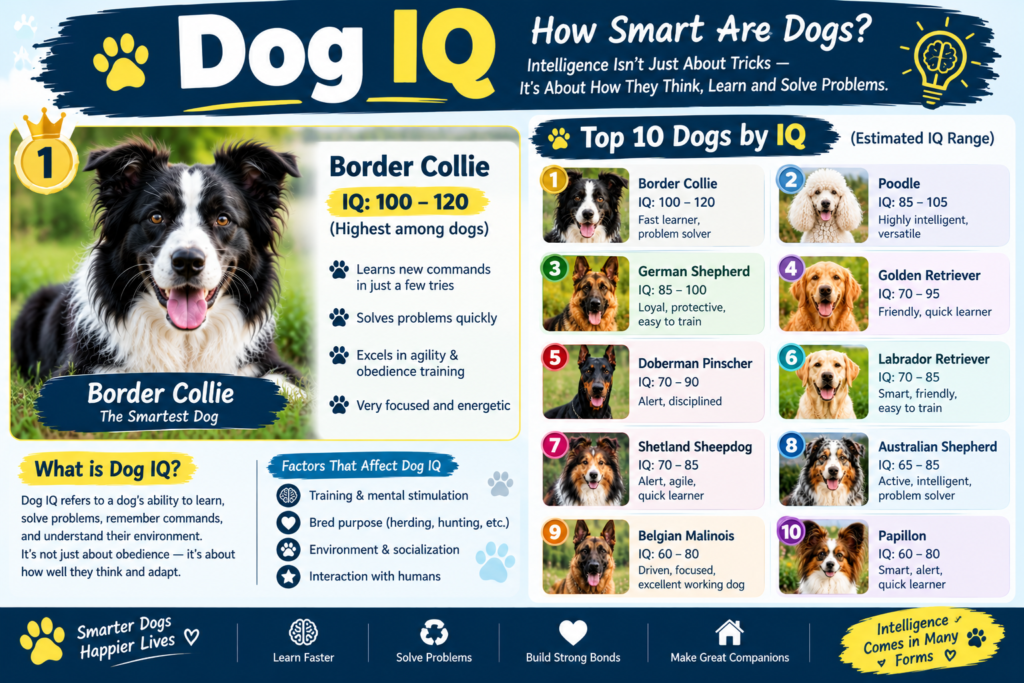
Dog IQ is a popular way to describe how smart a dog seems, but dogs do not have a single IQ score comparable to a human intelligence test. Canine intelligence is much broader and includes learning, memory, problem-solving, communication, impulse control, and the ability to understand people. Researchers now recognize that no single measure can capture every aspect of a dog’s cognitive abilities.
Some dogs learn commands extremely quickly, while others excel at solving problems, reading human gestures, remembering routines, or performing the jobs they were bred to do. Understanding these different forms of intelligence gives a much more useful picture of how a dog’s mind works. For more insight here what is the cleverest dog
What Does Dog IQ Actually Mean?
When people talk about a dog’s IQ, they are usually talking about canine intelligence rather than an actual numerical IQ score.
Human IQ tests are designed to measure particular cognitive abilities in people. Dogs have different sensory systems, motivations, communication methods, and natural behaviors, so researchers use specialized cognitive tests instead.
Dog cognition can involve: Dog IQ
- Learning new behaviors
- Remembering information
- Solving physical problems
- Understanding human gestures
- Controlling impulses
- Communicating with people
- Adapting to new situations
- Using breed-specific instincts
The American Kennel Club explains that canine intelligence can include instinctive ability, adaptive problem-solving, and working or obedience intelligence.
This is why saying that one dog has a higher “IQ” than another can be misleading.
How Is Dog Intelligence Measured?
Researchers can test dogs using controlled tasks designed to measure particular cognitive abilities.
For example, a dog might be asked to: Dog IQ
- Find food hidden behind an obstacle
- Follow a person’s pointing gesture
- Remember where something was placed
- Wait before taking a reward
- Solve a puzzle
- Navigate around a barrier
- Learn a new response
- Interact with an unfamiliar person
Different tests measure different skills.
A 2022 study involving 1,002 dogs from 13 breeds tested several cognitive traits and behaviors. Researchers found breed differences in social cognition, persistence, inhibitory control, and spatial problem-solving. However, short-term memory and logical reasoning did not show the same breed differences in that study.
That finding is important because it shows why there is no simple “smartest dog” measurement that explains everything.
The Three Common Types of Dog Intelligence
One of the most widely discussed frameworks for canine intelligence comes from psychologist Stanley Coren. His work describes three broad forms of intelligence.
1. Instinctive Intelligence
Instinctive intelligence refers to natural abilities a dog was bred to perform.
Examples include:
- Border Collies herding livestock
- Retrievers carrying objects
- Scent hounds following odors
- Guarding breeds monitoring their surroundings
- Terriers pursuing small prey
A dog does not need to be taught every part of these behaviors from scratch. Selective breeding has shaped many breed-specific tendencies.
2. Adaptive Intelligence
Adaptive intelligence describes how a dog learns from experience and solves problems.
A dog may discover how to: Dog IQ
- Open a simple container
- Get around an obstacle
- Find a hidden treat
- Recognize a household routine
- Change its behavior after something stops working
This type of intelligence can vary considerably from one individual dog to another.
3. Working and Obedience Intelligence
This involves learning from humans and responding to trained instructions.
Dogs that quickly learn commands often appear especially intelligent to their owners because their abilities are easy to observe.
The traditional Stanley Coren breed ranking focuses heavily on this type of intelligence. In that ranking, Border Collies are placed at the top, followed by Poodles and German Shepherd Dogs.
Is There a Real Dog IQ Test?
There is no single universally accepted test that produces a definitive IQ number for every dog.
Instead, researchers use different cognitive tests depending on what they want to study.
A test designed to measure memory may tell researchers something different from a test measuring impulse control or social understanding.
For example, a dog that immediately follows a person’s pointing gesture may demonstrate strong social cognition, while another dog that persists with a difficult physical puzzle may show strong problem-solving persistence.
Both behaviors can be described as intelligent, but they represent different abilities.
Can Dogs Really Be Very Smart?
Yes. Research into dog cognition has demonstrated a wide range of impressive abilities.
Dogs can learn associations between words, gestures, objects, people, places, and routines. They can also use information from humans when trying to solve certain problems.
The AKC notes that dogs have been studied for abilities involving words, arithmetic-like tasks, social understanding, and problem-solving.
Some individual dogs can become remarkably skilled at learning vocabulary or complex behaviors, but these exceptional examples should not be treated as representative of every dog.
Which Dog Has the Highest IQ?
There is no scientifically established numerical IQ ranking for dog breeds.
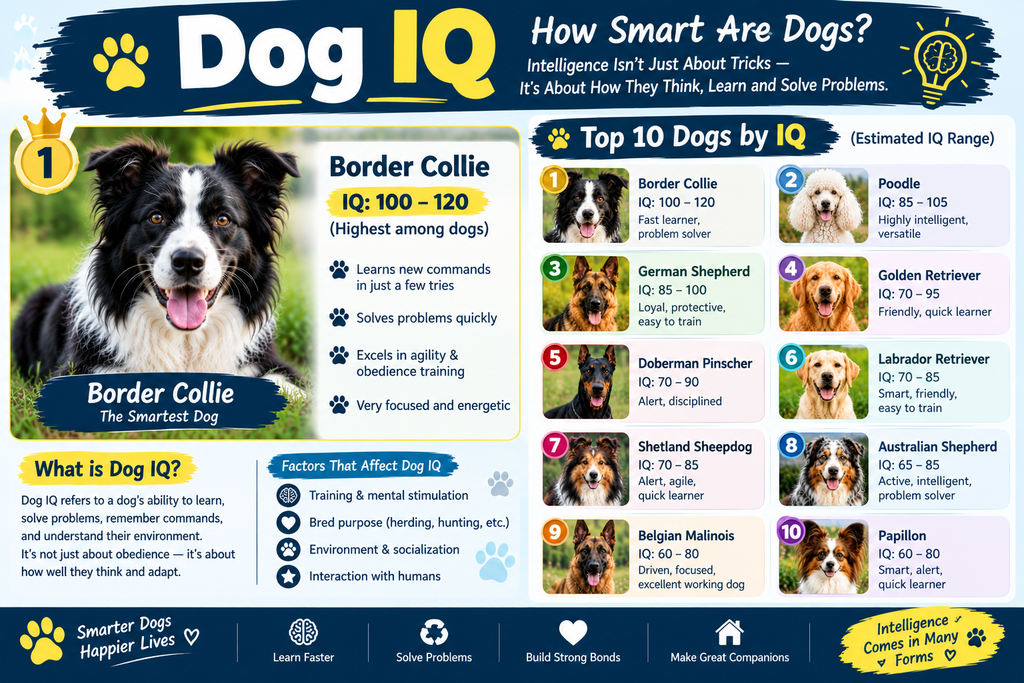
However, if “highest IQ” means exceptional performance in working and obedience intelligence, the Border Collie is traditionally placed at the top of Stanley Coren’s widely cited ranking.
Other breeds traditionally associated with strong working and obedience intelligence include: Dog IQ
- Poodle
- German Shepherd Dog
- Golden Retriever
- Doberman Pinscher
- Shetland Sheepdog
- Labrador Retriever
- Papillon
- Rottweiler
- Australian Cattle Dog
These rankings should be understood as measuring a particular type of performance rather than every form of intelligence.
Why Is the Border Collie Considered So Intelligent?
The Border Collie is famous for its ability to learn, concentrate, respond to a handler, and perform complex herding behaviors.
Its working history is a major part of the explanation.
Herding requires a dog to monitor livestock movement, respond to human direction, and control its own impulses while working around animals. Modern research has also found notable cognitive differences among breeds, including differences involving inhibitory control and human-directed behavior.
The Border Collie’s intelligence can appear in everyday life through: Dog IQ
- Fast learning
- Strong attention to its handler
- Ability to recognize patterns
- Excellent responsiveness
- Persistence with tasks
- Natural herding behavior
But that intelligence also means the breed usually needs substantial mental and physical stimulation.
Top Dog Breeds Known for Intelligence
Although there is no universal dog IQ ranking, several breeds are repeatedly recognized for trainability and cognitive abilities.
Border Collie
Border Collies are renowned for learning quickly and working closely with humans. They were developed for herding and generally thrive when given challenging activities.
Poodle
Poodles are highly trainable, curious, and versatile. They often enjoy obedience, tricks, agility, and other activities requiring concentration.
German Shepherd Dog
German Shepherds have a long history of demanding working roles. Their intelligence is often expressed through trainability, independence, and the ability to perform structured tasks.
Golden Retriever
Golden Retrievers are cooperative and eager to work with people. Their retrieving background and people-oriented nature make them highly trainable.
Doberman Pinscher
Dobermans are alert, responsive, and athletic. They can learn complex behaviors when training is consistent and appropriately structured.
Shetland Sheepdog
Shelties are smaller herding dogs known for their responsiveness and enthusiasm for training.
Labrador Retriever
Labradors combine strong retrieving instincts with a cooperative personality. They are commonly trained for a wide variety of tasks.
Papillon
The Papillon demonstrates that intelligence is not related simply to body size. This small breed can excel in obedience and agility.
Rottweiler
Rottweilers have strong working abilities and can respond well to consistent training and clear expectations.
Australian Cattle Dog
This energetic breed was developed for challenging livestock work. Its intelligence is closely connected with persistence, independence, and herding ability.
Does Breed Determine Dog IQ?
Breed can influence certain cognitive and behavioral tendencies, but it does not completely determine how intelligent an individual dog will be.
Research has found meaningful differences among breeds in specific cognitive traits. One study found differences in social cognition, persistence, inhibitory control, and spatial problem-solving.
At the same time, individual dogs within the same breed can behave very differently.
A Border Collie that loves training may learn a particular task faster than another Border Collie. Similarly, a mixed-breed dog may be an excellent problem-solver even though it does not appear on a traditional breed intelligence list.
Can Training Increase a Dog’s IQ?
Training cannot be described as simply increasing a dog’s IQ number because there is no universal dog IQ score.
However, training can absolutely improve a dog’s skills and cognitive performance on learned tasks.
Regular training gives a dog opportunities to: Dog IQ
- Learn new associations
- Practice memory
- Control impulses
- Follow human cues
- Solve problems
- Adapt to new situations
- Communicate with its owner
Research on puppies has also found that cognitive abilities develop during early life. Studies of puppies have identified perceptual discrimination, memory, social communication, flexible thinking, and self-control at young ages, with some abilities developing further as dogs mature.
How to Make Your Dog Smarter
You cannot turn every dog into a Border Collie, but you can give almost any dog opportunities to learn and solve problems.
Try Short Training Sessions
Five to ten minutes of focused training can be useful.
Practice familiar behaviors such as: Dog IQ
- Sit
- Stay
- Come
- Touch
- Leave it
- Place
Then gradually introduce new behaviors.
Use Puzzle Toys
Food puzzles encourage dogs to work out how to access a reward.
Start with an easy puzzle and increase difficulty gradually. A puzzle that is too difficult can cause frustration rather than productive learning.
Play Scent Games
Dogs have an extraordinary sense of smell, and scent-based activities give them an opportunity to use a natural ability.
You can hide a few pieces of food around an appropriate area and encourage your dog to find them.
Teach Tricks
Trick training can be a simple way to exercise a dog’s brain.
Examples include: Dog IQ
- Spin
- Shake
- Touch
- Put toys away
- Find a toy
- Go to a mat
- Walk backward
The goal is not simply the trick itself. The learning process provides mental engagement.
Does Age Affect Dog Intelligence?
Age can influence cognitive performance, but it does not mean an older dog suddenly stops being capable of learning.
Puppies are developing rapidly, while adult dogs have accumulated experience that can help them understand familiar situations. Older dogs may also continue learning new behaviors when training is appropriate for them.
Research on puppy cognition has found that some cognitive traits develop with age, including memory, impulse control, and social motivation.
For owners, the practical lesson is simple: learning opportunities can remain useful throughout a dog’s life.
Are Smart Dogs Easier to Train?
Not necessarily.
A highly intelligent dog may learn a desired behavior quickly, but it can also learn an unwanted behavior just as efficiently.
For example, imagine a dog discovers that barking causes someone to open a door. If the barking repeatedly produces that result, the dog may learn that barking is an effective strategy.
Smart dogs can also become bored when they do not have enough appropriate stimulation.
This is particularly relevant for working breeds that were developed to spend long periods performing demanding tasks.
Can a Small Dog Have a High Dog IQ?
Yes.
Body size does not determine cognitive ability.
The Papillon is a classic example. It is a small breed that has traditionally been placed among highly trainable dogs.
Small dogs can learn obedience, tricks, scent games, agility skills, and household routines just like larger dogs.
The important factor is the individual dog’s motivation, experience, temperament, and ability to learn—not simply its weight or height.
Can Mixed-Breed Dogs Be Highly Intelligent?
Absolutely.
Mixed-breed dogs can display excellent learning ability, problem-solving skills, memory, and social cognition.
Breed-based rankings are useful for describing general tendencies, but they should not be treated as a test of an individual dog’s potential.
A mixed-breed dog may excel at a cognitive task that a traditional breed ranking does not measure.
Common Misconception About Dog IQ
The biggest misconception is that there is one number that tells you exactly how intelligent a dog is.
There isn’t.
A dog might be exceptional at reading human gestures but less interested in obedience. Another might solve physical puzzles extremely well but become distracted during training. A third might have outstanding memory for words or routines.
These are different cognitive strengths.
The AKC Canine Health Foundation specifically notes that a single construct such as general intelligence does not adequately explain the variation in cognitive abilities seen in dogs.
What Does a Smart Dog Look Like in Everyday Life?
You may notice intelligence through ordinary behaviors rather than complicated scientific tests.
Your dog might: Dog IQ
- Remember where treats are stored
- Recognize the sound of its leash
- Understand household routines
- Learn a new command quickly
- Figure out how to reach a toy
- Read your body language
- Anticipate familiar activities
- Find a hidden object
- Change strategies when one approach fails
These everyday examples can tell you a lot about your dog’s individual cognitive style.
Frequently Asked Questions
What is a dog’s IQ?
Dogs do not have one universally accepted IQ score like humans do. Scientists measure specific cognitive abilities such as memory, problem-solving, communication, social cognition, and impulse control.
What is the smartest dog breed?
The Border Collie is traditionally ranked highest for working and obedience intelligence in Stanley Coren’s widely cited breed ranking.
Can dogs have different types of intelligence?
Yes. Dogs can differ in instinctive abilities, adaptive problem-solving, working and obedience skills, social cognition, memory, and other cognitive traits.
How can I test my dog’s intelligence at home?
You can try simple activities such as hiding a toy, using a beginner puzzle feeder, teaching a new behavior, or testing whether your dog follows a pointing gesture. These activities are fun observations, not standardized IQ tests.
Does training make dogs smarter?
Training helps dogs learn skills, build associations, practice self-control, and respond to human cues. It can improve performance on learned tasks, although it is not accurate to describe this as simply increasing a numerical IQ.
Are puppies intelligent?
Yes. Research shows that puppies demonstrate abilities involving perception, memory, social communication, flexible thinking, and self-control early in development, with several cognitive abilities changing as they mature.
The Bottom Line
Dog IQ is best understood as a popular term for a much broader subject: canine cognition. There is no single number that completely describes how smart a dog is. Instead, dogs can show intelligence through learning, memory, problem-solving, communication, impulse control, social understanding, and natural abilities.
The Border Collie is traditionally considered the leading breed for working and obedience intelligence, but that does not mean every Border Collie will outperform every other dog at every cognitive task. Modern research shows that different breeds and individual dogs can have different cognitive strengths.
For dog owners, the most useful approach is not trying to discover one perfect IQ number. Instead, give your dog regular opportunities to learn, explore, solve problems, use its natural abilities, and interact positively with people. A mentally engaged dog is more likely to have a rich and rewarding daily life.
[…] That distinction can be confusing because “tallest dog breed” and “tallest dog ever” are not exactly the same thing. The Irish Wolfhound has the greatest standard height among AKC-recognized breeds, while individual Great Danes have achieved some of the most remarkable height records ever measured. For more insight here dog iq […]