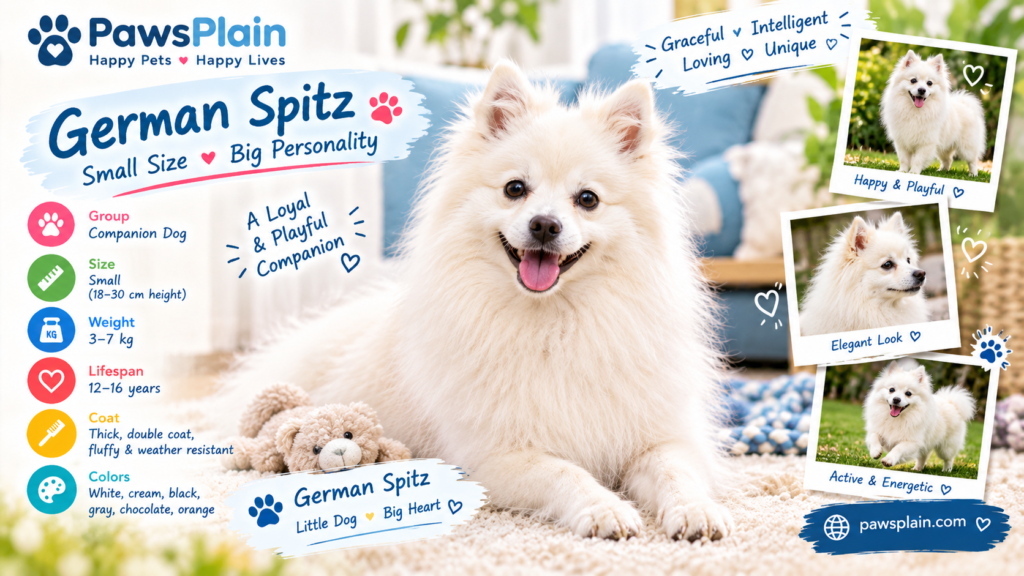
The German Spitz is an intelligent, lively and highly devoted dog breed with a distinctive fluffy coat, pointed ears, curled tail and fox-like expression. Originating in Germany, the breed has a long history as a watchdog, farm dog and companion.
One of the most interesting things about the German Spitz is that it is not limited to one size. The Fédération Cynologique Internationale (FCI) recognizes several varieties under the German Spitz breed, including the Wolfspitz (Keeshond), Giant Spitz, Medium Spitz, Miniature Spitz and Pomeranian.
German Spitz dogs are known for being alert, intelligent and strongly attached to their owners. They can make excellent companions for active families and individuals, but their natural watchdog instincts also mean that barking and early socialization need to be managed properly. For more insigh here english toy spaniel
Quick Facts
| Feature | Details |
|---|---|
| Breed Name | German Spitz |
| Origin | Germany |
| FCI Group | Group 5 – Spitz and Primitive Types |
| Section | European Spitz |
| Main Roles | Companion, watchdog and farm dog |
| Coat | Thick double coat |
| Temperament | Intelligent, lively, devoted and alert |
| Energy Level | Moderate to high |
| Grooming | Regular |
| Shedding | Yes |
| Training | Intelligent and generally responsive |
| Watchdog Ability | Excellent |
| Family Suitability | Good with proper socialization |
The FCI lists Germany as the country of origin and gives the German Spitz definitive breed recognition dating to 1957. The current official standard was published in September 2024.
History
The German Spitz has a very old history in Central Europe. The FCI describes German Spitz dogs as descendants of ancient Peat Dogs and later Lake Dwelling Spitz dogs, making the breed one of the oldest dog types in Central Europe.
Historically, Spitz-type dogs were valued for their ability to alert people to unfamiliar activity and protect farms and homes. They were also used around livestock, vineyards and agricultural properties.
The American Kennel Club notes that German Spitz dogs were used as watchdogs, vermin controllers and livestock guardians during medieval times. Their alert nature and willingness to vocalize made them useful working dogs.
Over time, different sizes and types developed. Some became larger working dogs, while smaller varieties became increasingly popular as household companions.
Today, the German Spitz continues to retain many of the qualities that made it useful historically: intelligence, alertness, confidence and devotion to its owner.
Varieties
The German Spitz is unusual because the FCI recognizes multiple varieties under the same breed.
These include:
1. Wolfspitz / Keeshond
The Wolfspitz is the largest traditional type associated with the German Spitz family and has a characteristic wolf-gray coloration.
2. Giant Spitz
The Giant Spitz is a larger German Spitz variety. Recognized colors include white, brown and black.
3. Medium Spitz
The Medium Spitz is a middle-sized variety and can appear in several colors, including white, black, brown, orange, shaded gray and other recognized colors.
4. Miniature Spitz
The Miniature Spitz is smaller than the Medium Spitz and is available in several recognized colors.
5. Pomeranian
The FCI includes the Pomeranian as the smallest variety within the German Spitz breed classification.
This classification can be confusing for dog lovers because kennel organizations in different countries may treat these varieties differently. Therefore, when researching a German Spitz, it is useful to specify the particular variety being discussed.
Appearance
The German Spitz has the classic appearance associated with Spitz breeds.
Typical characteristics include:
- Pointed, upright ears
- Fox-like facial expression
- Almond-shaped or expressive eyes
- Thick double coat
- Strong neck
- Pronounced ruff around the neck
- Bushy tail carried over the back
- Compact and well-balanced body
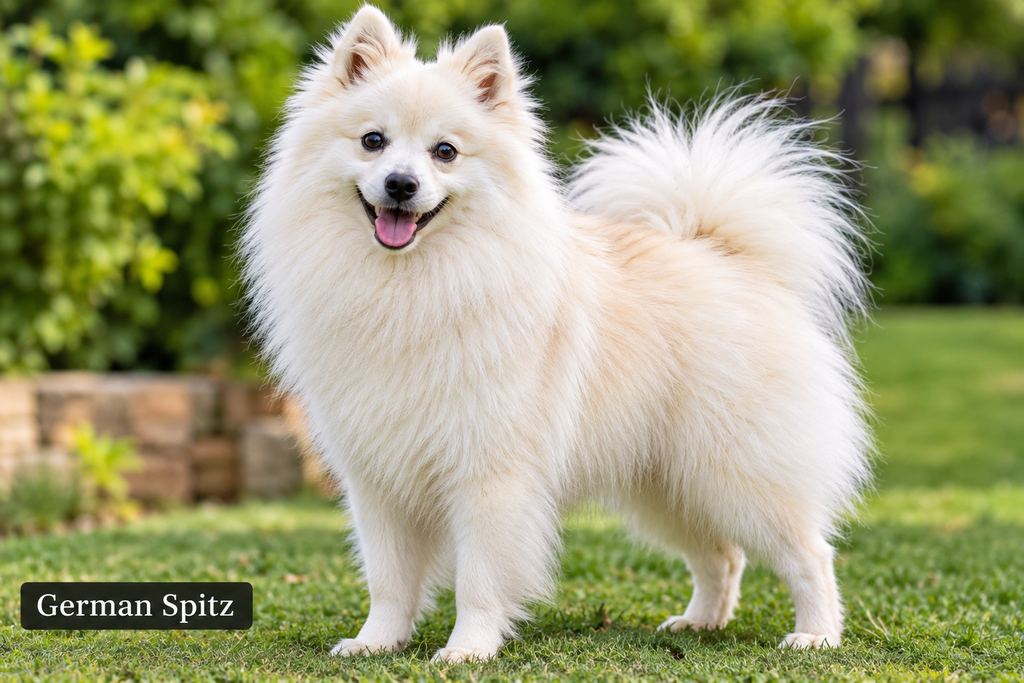
The FCI standard emphasizes the breed’s abundant undercoat, prominent neck ruff and bushy tail carried boldly over the back.
The coat gives the German Spitz a larger appearance than its actual body size.
Coat
The German Spitz has a thick double coat consisting of a protective outer coat and dense undercoat.
This coat helped the breed cope with colder weather and outdoor work. The American Kennel Club notes that the German Spitz was bred for colder climates and that its thick coat provides insulation.
The coat is one of the breed’s most attractive features, but it also means owners must be prepared for regular grooming.
Colors
Depending on the variety, German Spitz dogs can occur in several colors.
Recognized colors across the different varieties include:
- White
- Black
- Brown
- Orange
- Gray shaded
- Other recognized colors depending on variety
The exact colors permitted depend on which German Spitz variety is being considered.
Temperament
The German Spitz is known for its lively and attentive personality.
The AKC describes the breed as always attentive, lively and exceptionally devoted to its owner. It also notes that the breed is very teachable and easy to train.
Common personality traits include:
- Intelligent
- Alert
- Devoted
- Lively
- Confident
- Affectionate with family
- Watchful
- Independent at times
Because German Spitz dogs have strong watchdog instincts, they can be suspicious or cautious around unfamiliar people.
Early socialization is therefore especially important.
Is the a Good Family Dog?
A well-socialized German Spitz can be a wonderful family companion.
The breed tends to form strong relationships with its owners and enjoys being involved in family activities. The AKC also notes that German Spitz dogs can be good with older children and other pets when properly socialized.
However, families should understand that this is an alert breed rather than a completely quiet one.
Children should be taught to respect the dog’s space, food and resting areas. Younger children should always be supervised when interacting with any dog.
Exercise Needs
German Spitz dogs are energetic and intelligent, so they need both physical exercise and mental stimulation.
Good activities include:
- Daily walks
- Fetch
- Ball games
- Trick training
- Obedience exercises
- Interactive toys
- Puzzle feeders
- Supervised outdoor play
The AKC specifically notes that the German Spitz needs physical and mental stimulation and can become more likely to bark excessively or behave destructively when its energy is not given an appropriate outlet.
Exercise needs vary considerably between the different size varieties, so the dog’s individual size, age, health and fitness should always be considered.
Spitz
Training is one of the German Spitz’s strengths.
The breed is intelligent, learns quickly and is generally eager to work with its owner.
However, intelligence does not mean the dog will automatically obey every command.
A German Spitz can sometimes be independent and may decide that it has a better idea.
Best Training Methods
Use:
- Positive reinforcement
- Short training sessions
- Consistent commands
- Praise
- Appropriate treats
- Interactive games
Avoid harsh or confusing training methods.
Early training can also help control excessive barking and teach the dog when alert behavior is appropriate.
Barking
One of the most important characteristics potential owners should understand is the breed’s tendency to bark.
German Spitz dogs were historically valued as watchdogs, so alert barking is part of their natural behavior.
The AKC describes the breed as naturally vocal and notes that it can react by barking at unfamiliar sights and sounds.
This does not mean every German Spitz will bark constantly. Proper socialization, training and sufficient exercise can help manage unnecessary barking.
Owners living in apartments should pay particular attention to this trait.
Grooming
The German Spitz’s thick coat needs regular maintenance.
The AKC recommends brushing every few days and more thorough grooming approximately once a week.
A good grooming routine can include:
- Brushing several times a week
- More thorough weekly grooming
- Checking behind the ears
- Checking the legs and tail for tangles
- Nail trimming
- Ear cleaning when needed
- Regular dental care
The dense undercoat can become tangled if grooming is neglected.
Does the Shed?
Yes. The German Spitz is a shedding breed.
Because it has a dense double coat, owners should expect loose hair around the home, especially during heavier seasonal shedding periods.
Regular brushing can remove loose hair before it ends up on furniture and floors.
The breed is not considered hypoallergenic.
Bathing
German Spitz dogs generally do not need extremely frequent baths if their coat is brushed regularly.
Their thick coat can naturally resist dirt to some extent. Over-bathing may also remove natural oils from the skin and coat.
When bathing is necessary, use a dog-specific shampoo and make sure the dense coat is thoroughly dried afterward.
Health
Like all breeds, German Spitz dogs can experience health problems. Good breeding practices, appropriate nutrition, exercise and regular veterinary care can help support long-term health.
Potential owners should look for responsible breeders who prioritize healthy dogs and provide appropriate veterinary information.
Routine veterinary care should include:
- Vaccinations
- Parasite prevention
- Dental checks
- Weight monitoring
- General physical examinations
- Breed-appropriate health screening
Health needs can vary between individual dogs and the different German Spitz varieties.
Dental Care
Dental care should not be ignored, particularly in smaller varieties.
Owners can help maintain good oral health through:
- Regular tooth brushing
- Veterinary-approved dental products
- Routine dental examinations
- Monitoring for bad breath
- Checking the gums and teeth
Starting dental care while the dog is young can make the process easier.
Feeding
A German Spitz should receive a balanced diet appropriate for its size, age and activity level.
Because German Spitz varieties vary significantly in size, feeding amounts should not be based on the breed name alone.
Consider:
- Age
- Body weight
- Activity
- Body condition
- Food type
- Individual health needs
Treats should be given in moderation to help prevent unnecessary weight gain.
Fresh water should always be available.
Puppies
puppies are intelligent and active from an early age.
The first months are an important period for establishing good habits.
Puppy care should include:
- Appropriate nutrition
- Veterinary examinations
- Safe socialization
- Basic obedience
- Gentle grooming
- Safe exercise
- Puppy-proofing the home
Early exposure to different sounds, people and environments can help develop a confident adult dog.
Other Pets
dogs can potentially live successfully with other pets when introduced properly.
Their lack of a strong hunting instinct is one trait noted by the AKC, although individual behavior always varies.
Introductions should be gradual and supervised.
Early socialization can make it easier for a German Spitz to understand that other household animals are part of the family.
Is Good for Apartment Living?
A German Spitz can live in an apartment, but there is one major consideration: barking.
Its small size makes some varieties physically suitable for apartments, but the breed’s alert and vocal nature can create problems with neighbors if it is not properly trained.
Apartment owners should provide:
- Daily walks
- Indoor play
- Mental stimulation
- Training
- Barking management
A sufficiently exercised and mentally stimulated German Spitz is generally easier to live with than one that is bored.
Is Good for First-Time Owners?
Spitz can be suitable for first-time owners who are prepared to provide consistent training and grooming.
Its intelligence makes learning easier, but its independent nature and watchdog instincts require an owner who can establish clear boundaries.
It may not be the best choice for someone who wants a completely quiet or very low-maintenance dog.
Hot Weather
The German Spitz has a dense double coat designed to provide insulation, especially in colder conditions.
In hot climates, owners should take extra care to prevent overheating.
Helpful practices include:
- Exercising during cooler parts of the day
- Providing shade
- Keeping fresh water available
- Avoiding strenuous activity during extreme heat
- Watching for signs of heat stress
The coat should not simply be shaved off as a solution to hot weather. A veterinarian or professional groomer can provide appropriate advice for the individual dog.
Pros and Cons
Pros
- Highly intelligent
- Very devoted to owners
- Attractive fluffy appearance
- Excellent watchdog instincts
- Generally responsive to training
- Energetic and playful
- Can adapt to different homes
- Strong family bond
Cons
- Can be vocal
- Needs regular grooming
- Sheds
- May be wary of strangers
- Needs mental stimulation
- Can become bored without enough activity
- Independent personality can sometimes make training challenging
Frequently Asked Questions
What is a German Spitz?
The German Spitz is a German breed of Spitz-type dog known for its thick double coat, pointed ears, bushy tail, intelligence and strong devotion to its owner.
Where did the German Spitz originate?
The German Spitz originated in Germany and has a very old Central European history.
How many types of German Spitz are there?
The FCI recognizes five varieties: Wolfspitz, Giant Spitz, Medium Spitz, Miniature Spitz and Pomeranian.
Is a German Spitz easy to train?
Generally, yes. The breed is intelligent, teachable and devoted to its owner, although consistency is important because individual dogs can also be independent.
Does German Spitz bark a lot?
The breed has strong watchdog instincts and can be naturally vocal. Proper training, socialization, exercise and mental stimulation can help reduce unnecessary barking.
Does German Spitz shed?
Yes. Its thick double coat sheds and requires regular brushing.
Is German Spitz good with children?
It can be a good family dog, particularly with older children and when properly socialized. Young children should always be supervised around dogs.
Is German Spitz good for apartments?
Some German Spitz varieties can adapt to apartment living, but owners must be prepared for the breed’s energy and tendency to bark.
Is German Spitz a good watchdog?
Yes. Watchfulness is one of the breed’s strongest natural characteristics. Historically, German Spitz dogs were used as watchdogs and guardians.
Conclusion
The German Spitz is an intelligent, lively and devoted breed with a fascinating history that stretches deep into Central Europe. Its beautiful double coat, pointed ears, bushy tail and alert expression give it the classic appearance of a Spitz dog, while its strong bond with people makes it a rewarding companion.
The breed is particularly well suited to owners who appreciate an active, intelligent and watchful dog. However, prospective owners should be prepared for regular grooming, shedding, daily activity and potentially frequent barking. Early socialization and consistent positive training are especially important.
With proper care, exercise, training and companionship, the German Spitz can be a loyal and entertaining member of the household. Its combination of intelligence, beauty and devotion makes it a distinctive breed for dog lovers looking for something more than an ordinary companion.
Leave a Reply