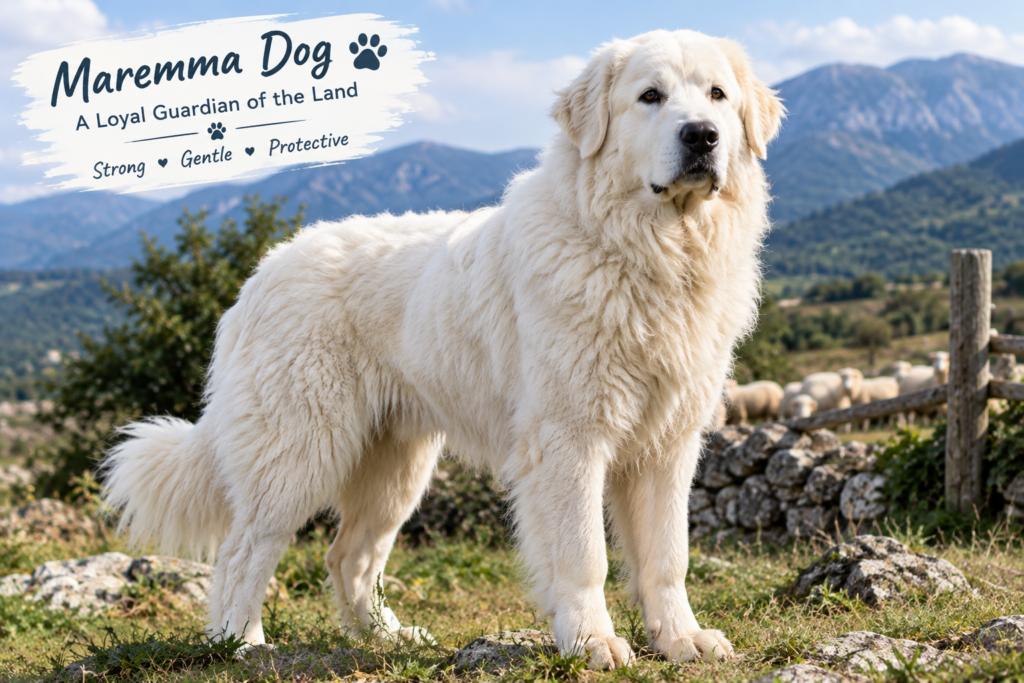
The Maremma Dog, more commonly called the Maremma Sheepdog, is a large white livestock guardian from Italy. Bred to protect sheep and other animals, this intelligent and independent dog is naturally alert, courageous, and devoted to its territory and family. It can make a wonderful working companion, but it is not a typical easygoing house dog.
The breed developed from ancient shepherd dogs associated with Italy’s Abruzzo region and the Maremma area. Historical sources describe the two regional types being crossed over time, particularly from around the 19th century, eventually forming the Maremma Sheepdog known today. For more insigh here basenji bark
Maremma Dog at a Glance
| Trait | Maremma Sheepdog |
|---|---|
| Origin | Italy |
| Main role | Livestock guardian |
| Size | Large |
| Coat | Long, dense, harsh-textured |
| Typical color | White |
| Temperament | Intelligent, independent, courageous, alert |
| Exercise | Daily exercise and outdoor activity |
| Grooming | Regular brushing |
| Best suited to | Rural homes, farms, large properties |
| Apartment living | Generally a poor fit |
The breed standard describes the Maremma as majestic, large, strongly built, and suited to outdoor work. Ideal height is about 65–73 cm for males and 60–68 cm for females, with typical ideal weights of approximately 35–45 kg for males and 30–40 kg for females.
What Is a Maremma Dog?
The Maremma Sheepdog is a traditional livestock guardian rather than a dog developed primarily for obedience or companionship.
Its job was to remain with livestock, notice potential threats, and respond independently. That background explains several traits modern owners may notice:
- Strong territorial awareness
- Independence
- Natural protective behavior
- Alertness to unfamiliar people and animals
- Loyalty toward its family or flock
- Ability to make decisions without constant human direction
This independence is one of the most important things to understand before choosing the breed. A Maremma may not behave like a Golden Retriever that is eager to follow every command simply because its owner asks.
Maremma Dog Appearance
A mature Maremma has a powerful but athletic appearance. The breed is large and strongly built, with a body that is slightly longer than its height.
Its most recognizable features include:
- A large, broad head
- Small, high-set triangular ears
- Dark, almond-shaped eyes
- A strong muzzle
- Thick white coat
- Heavy seasonal undercoat
- Large feet
- A heavily coated tail
The Kennel Club describes the expression as one of “aloof awareness,” reflecting the breed’s naturally watchful character.
Maremma Coat and Color
The coat is one of the breed’s defining features. It is long, abundant, and fairly harsh rather than soft and silky. Slight waviness is acceptable, but a curly coat is not considered typical under the breed standard.
The coat is predominantly white. Limited ivory, pale orange, or lemon shading may be permitted depending on the breed standard being followed.
The thick winter undercoat is particularly useful for a dog historically expected to work outdoors in changing weather.
Maremma Dog Temperament
A well-bred Maremma is generally intelligent, courageous, alert, and devoted. The breed standard emphasizes that courage should not become unnecessary aggression.
The Maremma’s temperament is strongly connected to its original job.
Rather than waiting for a person to tell it that something unusual is happening, a livestock guardian is expected to notice changes in its surroundings independently.
This can make the breed:
- Calm and observant around familiar surroundings
- Reserved with strangers
- Protective of its property or animals
- Independent during training
- Strongly bonded to its family
- Naturally suspicious of unusual activity
A Common Mistake Owners Make
One of the biggest mistakes is treating a Maremma like a large companion dog.
Its size may attract attention, but its working instincts are much more important than its fluffy appearance. A Maremma that has nothing meaningful to do may find its own ways to stay occupied, including patrolling, barking, digging, or monitoring everything happening around the property.
Understanding the breed’s purpose is therefore essential.
Is the Maremma Dog Good With Families?
A Maremma can become a loyal family dog when properly socialized and raised in an environment that suits its temperament.
However, families should understand that the breed’s guardian instincts do not disappear simply because it lives as a pet.
Young children should always be supervised around any large dog. Children also need to learn how to respect the dog’s space, food, resting areas, and boundaries.
A good household for a Maremma is one that:
- Understands independent guardian breeds
- Can provide sufficient space
- Is comfortable with a protective dog
- Has time for socialization and training
- Can manage a large, powerful animal
- Doesn’t expect constant obedience or attention
Is a Maremma Dog Good for Apartment Living?
Usually, no.
The problem isn’t simply that the Maremma is large. Its working instincts and need for appropriate outdoor activity make a typical apartment environment challenging.
Dogs New Zealand notes that the breed needs space and describes it as unsuitable for apartment living. It also reports that the breed benefits from daily exercise and access to a yard.
A rural property, farm, or large secure outdoor area is generally much more compatible with what this breed was developed to do.
That does not mean every Maremma must live on a farm, but owners should have a realistic plan for exercise, enrichment, territory, and socialization.
Maremma Dog Exercise Needs
Maremmas need regular physical activity, but exercise should be considered together with mental stimulation and their natural guardian behavior.
Useful activities can include:
- Long walks in safe areas
- Exploring secure outdoor spaces
- Supervised farm or property work
- Basic obedience training
- Scent and environmental enrichment
- Calm socialization experiences
- Appropriate play
Dogs New Zealand recommends daily exercise and notes that the breed enjoys long walks or running in a safe area.
The goal isn’t simply to exhaust the dog. A Maremma benefits from having a suitable environment in which its natural abilities can be expressed appropriately.
Maremma Dog Training
Training a Maremma can be different from training a highly biddable companion breed.
The dog is intelligent, but intelligence does not automatically mean a desire to repeat commands for its owner. Its working history encouraged independent decision-making.
A Practical Training Approach
Start early and keep training consistent.
1. Begin socialization early
Introduce the puppy carefully to different people, environments, surfaces, sounds, and situations.
2. Teach basic cues
Focus on practical commands such as recall, walking politely, staying, and settling.
3. Use reward-based training
Clear rewards and calm repetition can help build cooperation without creating unnecessary conflict.
4. Keep expectations realistic
A livestock guardian may not respond with the same enthusiasm as a retriever. Consistency matters more than forcing repeated commands.
5. Practice around distractions
Gradually teach the dog that listening to its handler still matters when people, animals, noises, or unfamiliar situations are present.
Training is an ongoing process rather than something completed after puppyhood.
Maremma Dog Grooming
That beautiful white coat requires regular care.
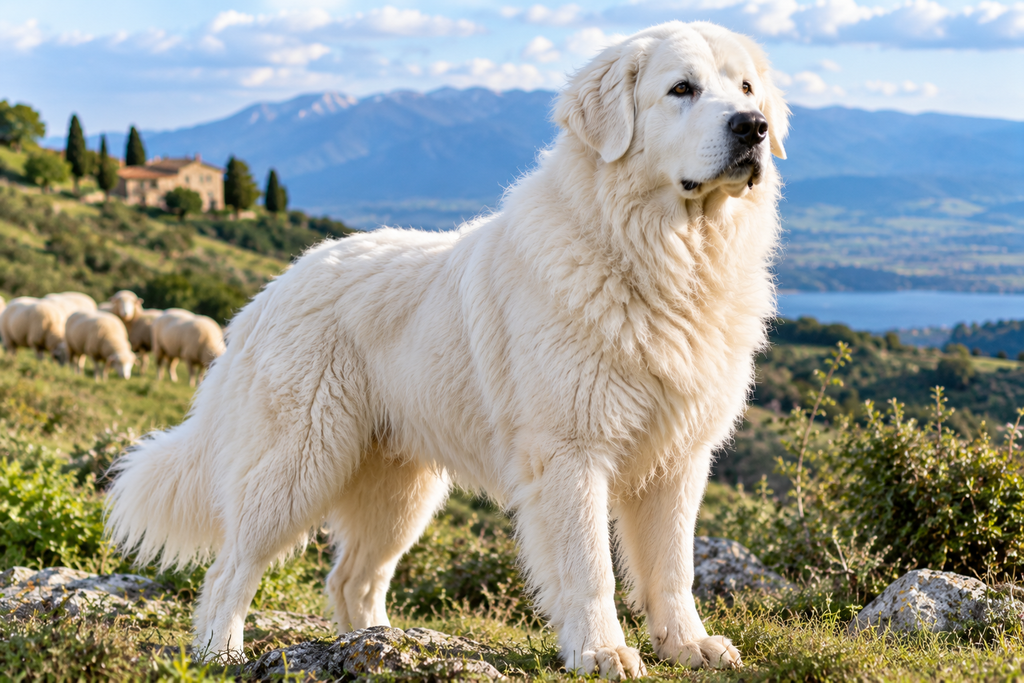
The breed’s coat is long and dense, with a substantial seasonal undercoat. Dogs New Zealand recommends brushing once or twice a week, with more frequent brushing during heavy shedding periods.
A useful grooming routine includes:
- Regular brushing to remove loose hair
- More frequent brushing during seasonal shedding
- Checking behind the ears and around areas where tangles can form
- Regular nail care
- Routine ear checks
- Keeping the coat clean and dry when necessary
The coat should not be treated as merely decorative. It developed as functional protection for a working outdoor dog.
Does a Maremma Shed?
Yes. Expect noticeable shedding, particularly when the seasonal undercoat is being replaced.
Owners who want a large white dog with minimal loose hair should probably consider another breed. The Maremma’s coat is a major part of its appeal, but it also creates a significant grooming commitment.
Maremma Dog Health
Like all dogs, Maremmas can experience health problems, and individual risk varies with genetics, breeding, environment, nutrition, and general care.
The Royal Kennel Club currently lists hip testing for hip dysplasia within its health-testing guidance for the breed.
Responsible owners should focus on:
- Maintaining a healthy body condition
- Providing appropriate nutrition
- Keeping up with routine veterinary examinations
- Monitoring mobility as the dog ages
- Discussing appropriate screening with a veterinarian
- Choosing responsible breeding practices when obtaining a puppy
Health information should never be used to diagnose an individual dog. If your Maremma develops persistent changes in appetite, mobility, behavior, or general condition, speak with your veterinarian.
Maremma Dog Size
The Maremma is a genuinely large breed.
According to the Royal Kennel Club standard:
- Male height: 65–73 cm
- Female height: 60–68 cm
- Male weight: 35–45 kg
- Female weight: 30–40 kg
These are breed-standard measurements rather than a guarantee of the adult size of every individual dog.
Because the Maremma is large and powerful, owners should think ahead about everything from transportation to sleeping space and safe fencing.
Maremma Dog and Other Animals
This is where the breed’s history becomes especially relevant.
Maremmas were developed as livestock guardians, and modern examples can still be used to protect animals. Their natural role involves observing livestock and responding to potential threats. Breed information from Dogs New Zealand notes Maremmas being used to protect animals including sheep, goats, alpacas, pigs, chickens, and donkeys.
However, living successfully with other animals isn’t automatic. Early socialization, appropriate introductions, supervision, and the individual dog’s temperament all matter.
A Maremma should never simply be placed with unfamiliar animals and expected to understand the situation immediately.
Maremma Dog Barking
Barking can be an important consideration for prospective owners.
A guardian dog needs to communicate when it detects something unusual. A Maremma may therefore be much more vocal than someone expects from its calm appearance.
This can become a problem in a close neighborhood where barking carries easily.
On a suitably managed rural property, however, alert barking can be part of the dog’s natural working role.
Owners should focus on understanding why the dog is barking rather than attempting to eliminate every bark. A guardian dog that never alerts may not be behaving as expected.
Maremma Dog in Hot Weather
The Maremma’s dense coat is adapted to outdoor life, including seasonal changes, but owners still need to take heat seriously.
During hot weather:
- Provide constant access to fresh water.
- Make sure shade is available.
- Avoid strenuous exercise during the hottest part of the day.
- Provide a cool resting area.
- Watch for signs of heat-related distress.
Do not assume that shaving a double-coated dog is automatically the best solution for summer. Coat management should be discussed with a veterinarian or professional groomer familiar with double-coated breeds.
Is a Maremma Dog Right for You?
The Maremma can be an excellent match for the right owner and a difficult match for the wrong one.
A Maremma may suit you if:
- You have a secure outdoor property.
- You appreciate independent working dogs.
- You understand livestock guardian behavior.
- You can provide daily activity and enrichment.
- You are comfortable with a large protective breed.
- You don’t mind regular grooming and seasonal shedding.
- You have the patience for consistent training.
Another breed may suit you better if:
- You live in a small apartment.
- You want a dog that eagerly follows commands all day.
- You dislike barking.
- You want very low grooming requirements.
- You cannot provide enough outdoor activity.
- You are uncomfortable managing a large protective dog.
Frequently Asked Questions
Is a Maremma Dog a good house dog?
A Maremma can live with a family, but it is not an ideal choice for every household. Its guardian instincts, large size, independence, and need for space make it better suited to homes that can accommodate its working-dog characteristics.
Are Maremma Dogs aggressive?
The breed standard describes the Maremma as courageous but not aggressive. However, it is naturally protective and can be reserved around unfamiliar people. Early socialization and responsible management are important.
How big does a Maremma Dog get?
Males are ideally 65–73 cm at the shoulder and 35–45 kg, while females are ideally 60–68 cm and 30–40 kg under the Royal Kennel Club standard.
Do Maremma Dogs need a lot of grooming?
Yes. Their long, abundant coat and thick seasonal undercoat require regular brushing. Grooming needs increase during heavy shedding periods.
Are Maremma Dogs good livestock guardians?
Yes. Livestock protection is the breed’s traditional purpose. Their alertness, independence, courage, and protective instincts are closely connected to this working role.
Can a Maremma Dog live in an apartment?
It is generally a poor fit. The breed needs appropriate exercise, outdoor activity, and enough space to express its natural behavior. Dogs New Zealand specifically describes the breed as not suitable for apartment living.
The Bottom Line
The Maremma Sheepdog is much more than a beautiful white dog. It is an intelligent, independent livestock guardian whose behavior makes the most sense when you understand the work it was developed to perform. For owners with suitable space, patience, and an appreciation for working dogs, a Maremma can be a remarkably loyal and capable companion. For apartment dwellers or anyone looking for an effortless, highly obedient pet, another breed may be a better fit.
Conclusion
The Maremma Dog is a loyal, intelligent, and naturally protective breed with a strong history as a livestock guardian. Its independent personality, large size, thick coat, and need for space make it best suited to owners who can provide proper training, regular grooming, and an appropriate living environment. With the right care and socialization, the Maremma Dog can be a dependable, devoted, and hardworking companion.
[…] The Beauceron dog is a powerful, intelligent French herding breed known for its confidence, loyalty, endurance, and protective nature. Originally developed to work with large flocks of sheep, the Beauceron combines athletic ability with a strong desire to work alongside its owner. It can be a devoted family companion, but its size, energy, intelligence, and independence require an experienced and committed owner. For more insigh here maremma dog […]