
The Australian Terrier is a small, energetic, intelligent, and confident dog with a big personality. Originally developed in Australia as a working terrier, this compact breed was used to control rodents and snakes and also served as a watchdog and family companion. Today, the Australian Terrier is appreciated as a loyal household dog that combines a courageous working nature with an affectionate personality. For more insigth read heare dog breeds a to z photos
Although small in size, the Australian Terrier is not a passive lapdog. It is alert, curious, active, and naturally interested in its surroundings. The American Kennel Club describes the breed as plucky, spirited, smart, and self-assured.
For the right owner, this little Australian terrier can be an entertaining, devoted, and highly adaptable companion.
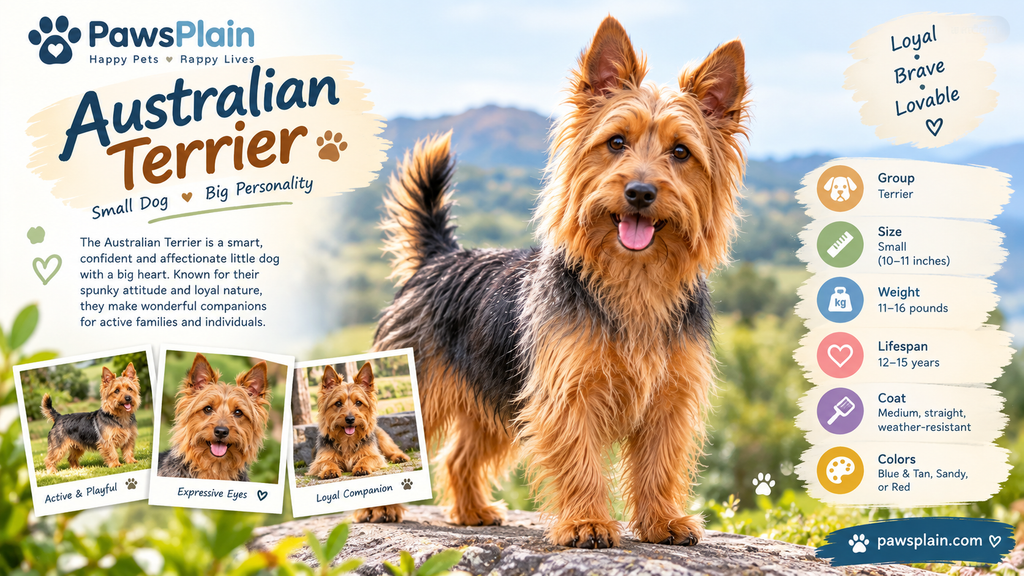
Quick Facts
| Feature | Details |
|---|---|
| Breed Name | Australian Terrier |
| Origin | Australia |
| Breed Group | Terrier |
| Height | 10–11 inches |
| Average Weight | About 15–20 pounds |
| Lifespan | Around 11–15 years |
| Coat | Harsh, textured outer coat with undercoat |
| Common Colors | Blue and tan, sandy, red |
| Personality | Spirited, confident, affectionate, courageous |
| Energy Level | Moderate to high |
| Best For | Active families and owners who enjoy training and companionship |
The official AKC breed standard places the Australian Terrier at approximately 10–11 inches at the withers. PetMD gives an average adult weight of about 15–20 pounds and reports a typical lifespan of 11–15 years.
History
The Australian Terrier has a strong working history. The breed was developed in Australia to help people deal with rodents and snakes around farms, sheep and cattle stations, and waterfront areas.
These dogs were valued for more than hunting. They could alert their owners to unfamiliar activity, help around properties, and live as companions with families. Their versatility helped shape the confident and energetic personality seen in Australian Terriers today.
The breed originated around Melbourne, Australia, and the American Kennel Club first recognized the Australian Terrier in 1960.
Its history is important for modern owners because many of the breed’s natural behaviors come directly from its working background. An Australian Terrier may enjoy chasing, digging, investigating, and alerting its family when something unusual catches its attention.
What Does an Aussie Terrier Look Like?
The Aussie Terrier is a small but sturdy dog. Its body is somewhat longer than it is tall, giving the breed a distinctive rectangular appearance.
The breed has small upright ears, a strong head, dark eyes, and an alert expression. Its outer coat is harsh and textured, while the breed has a softer undercoat. A distinctive ruff, apron, and topknot contribute to its characteristic appearance.
Aussie Terrier are commonly seen in:
- Blue and tan
- Solid sandy
- Solid red
Their compact size can make them look delicate to people unfamiliar with the breed, but their structure reflects their history as working terriers.
Aussie Terrier Personality and Temperament
One of the biggest attractions of the Australian Terrier is its personality.
The AKC’s current temperament guide describes the breed as spirited, courageous, confident, friendly, and affectionate. The breed standard also emphasizes a self-assured and intelligent character.
Australian Terriers often enjoy being involved in family life. They can form strong relationships with their owners and are usually happiest when they have regular interaction and activities.
However, their terrier instincts should not be overlooked. They were bred to hunt vermin, so they can have a strong prey drive and may be interested in chasing small animals.
They can also be alert barkers. PetMD notes that Australian Terriers may bark at unfamiliar sights and noises, which is something prospective owners should consider.
Are Aussie Terrier Good Family Dogs?
Aussie Terrier can make excellent family companions when they receive appropriate training and socialization.
Their small size makes them relatively easy to manage, while their active personality can make them fun companions for families who enjoy walking and playing with their dogs.
However, children should always be taught how to interact safely with a dog. Young children should also be supervised around any dog.
Australian Terriers may not be ideal for households with very small pets because their history as vermin hunters can contribute to chasing behavior.
Australian Terrier Exercise Needs
Do not let the Australian Terrier’s small size fool you. This is an active breed that needs regular physical and mental stimulation.
Daily walks, play sessions, training exercises, and interactive games can help keep an Australian Terrier healthy and satisfied.
Suitable activities include:
- Walking
- Fetch
- Obedience training
- Agility
- Scent games
- Interactive toys
- Supervised outdoor play
- Earthdog activities
PetMD notes that the breed can adapt to apartment living, but only when its exercise, companionship, training, and mental-stimulation needs are properly met.
Without enough activity, an Australian Terrier can become bored and may find its own entertainment.
Training an Aussie Terrier
Australian Terriers are intelligent dogs, but they also have the independent nature commonly associated with terriers.
Early training can help owners establish good habits before unwanted behaviors become difficult to manage.
Positive reinforcement is a useful approach. Rewarding good behavior with treats, praise, toys, or play can make training more enjoyable.
Important training areas include:
Australian Terrier Basic Obedience
Teach commands such as sit, stay, come, leave it, and down.
Recall
A reliable recall is especially important because Australian Terriers may chase interesting animals or objects.
Leash Training
Teaching polite leash behavior can make daily walks much easier.
Socialization
Introduce puppies gradually to different people, environments, sounds, and suitable dogs.
Barking Control
Because the breed can be alert and vocal, owners should teach appropriate responses to unfamiliar sounds and visitors.
Grooming
The Australian Terrier has a distinctive harsh outer coat and softer undercoat. Fortunately, its grooming requirements are relatively manageable compared with many long-coated breeds.
Regular brushing helps remove loose hair, debris, and tangles. PetMD recommends weekly brushing to maintain the coat and help prevent matting in the undercoat.
Owners should also check:
- Ears
- Eyes
- Teeth
- Nails
- Skin
- Coat
Frequent unnecessary bathing is generally not recommended because it can contribute to dry skin. PetMD suggests bathing only when needed and following veterinary advice for individual dogs.
For owners interested in maintaining a traditional show-style coat, professional terrier grooming techniques may be useful.
Australian Terrier Do Australian Terriers Shed?
Australian Terriers generally do not shed heavily.
Their coat is relatively low-maintenance compared with some other breeds, but no dog is completely non-shedding.
Regular brushing can help remove loose hair and keep the coat clean and healthy.
People with allergies should remember that low shedding does not mean hypoallergenic. Anyone with significant allergies should spend time around an Australian Terrier before bringing one home.
Health
Australian Terriers are generally considered sturdy dogs, but they can still develop health problems.
PetMD identifies several conditions that may affect the breed, including luxating patella and Legg-Calvé-Perthes disease.
Luxating Patella
Luxating patella occurs when the kneecap moves out of its normal position. Signs can include limping or an unusual gait.
Veterinary treatment depends on the severity of the condition.
Legg-Calvé-Perthes Disease
Legg-Calvé-Perthes disease affects the hip joint and can cause pain and difficulty using the affected leg. PetMD notes that it commonly develops when affected Australian Terrier puppies are less than one year old.
Responsible breeding and appropriate veterinary screening can help owners make better-informed decisions when selecting a puppy.
Regular veterinary examinations are also important throughout the dog’s life.
Australian Terrier Lifespan
The Australian Terrier generally has a lifespan of around 11–15 years.
A dog’s actual lifespan depends on many factors, including genetics, nutrition, exercise, preventive veterinary care, dental health, weight, and overall lifestyle.
Owners can support their dog’s health by providing:
- A complete and balanced diet
- Regular exercise
- Routine veterinary examinations
- Dental care
- Parasite prevention
- Appropriate vaccinations
- Healthy weight management
- Mental stimulation
Feeding an Australian Terrier
Aussie Terrier need a complete and balanced diet appropriate for their age, size, activity level, and health.
Puppies generally have different nutritional requirements from adult and senior dogs. Active dogs may also need different feeding plans than less active individuals.
Portion control is important because excessive weight can place additional stress on joints.
Treats should be given in moderation and included as part of the dog’s overall daily calorie intake.
Fresh, clean water should always be available.
Puppies
Australian Terrier puppies are curious, energetic, and intelligent. Their early development is an important period for establishing good habits.
Puppy owners should focus on:
- Early socialization
- Basic obedience
- Safe exploration
- Appropriate chewing toys
- Grooming practice
- Gentle handling
- Veterinary care
- Positive experiences with different environments
It is particularly helpful to teach a puppy to tolerate brushing, nail trimming, ear checks, and dental care from an early age.
This can make routine grooming and veterinary visits easier as the dog grows.
Aussie Terrier and Apartment Living
An Australian Terrier can live in an apartment or smaller home.
Its compact size is helpful, but space alone is not the most important factor. The owner must provide sufficient exercise, mental stimulation, companionship, and training.
A small home with an active owner can be a better environment for an Australian Terrier than a large home where the dog receives little attention.
PetMD specifically notes that the breed can adapt to apartment living when its exercise and mental-stimulation needs are met.
With Other Pets
This is an area where owners should use caution.
Because Australian Terriers were developed to hunt rodents and other vermin, they can have strong chasing instincts.
Some individuals may live successfully with other dogs when properly socialized, but interactions with cats, rodents, rabbits, or other small animals should be managed carefully.
A secure yard and appropriate supervision are particularly important.
Australian Terrier Pros and Cons
Pros
- Small and sturdy
- Intelligent
- Confident
- Affectionate
- Energetic
- Loyal to family
- Relatively manageable grooming needs
- Adaptable to different homes
- Fun for active owners
Cons
- Can be independent
- May bark at unfamiliar sights and sounds
- Strong prey drive
- Needs regular exercise
- Requires consistent training
- May chase small animals
- Does not thrive with prolonged isolation
Australian Terrier Who Should Get an Australian Terrier?
The Australian Terrier can be a great choice for someone looking for a small dog with a lively personality.
It may be particularly suitable for owners who enjoy:
- Daily walks
- Training
- Outdoor activities
- Interactive play
- Companionable dogs
- Small working breeds
It may not be the best choice for someone who wants a completely quiet, low-energy dog that can spend most of the day alone.
The breed needs companionship and engagement. PetMD specifically cautions that Australian Terriers do not do well with a solitary lifestyle and should not be left alone for extended periods.
Frequently Asked Questions About Australian Terriers
How big does an Australian Terrier get?
An adult Australian Terrier generally stands around 10–11 inches tall at the withers. Average weight is approximately 15–20 pounds.
How long does an Aussie Terrier live?
Australian Terriers typically live around 11–15 years.
Are Aussie Terrier good pets?
Yes. They can be affectionate, loyal, intelligent, and entertaining pets when their exercise, training, companionship, and socialization needs are met.
Are Australian Terriers aggressive?
The AKC temperament guide describes the breed as spirited, courageous, confident, friendly, and affectionate, and says it should not be shy or aggressive. Individual behavior can still vary based on genetics, socialization, training, and environment.
Do Australian Terriers bark a lot?
They can be alert and vocal, particularly when they notice unfamiliar sights or sounds. Consistent training can help manage excessive barking.
Are Aussie Terrier easy to train?
They are intelligent and capable of learning quickly, but their independent terrier personality means that consistency, patience, and positive reinforcement are important.
Do Aussie Terrier shed?
They generally shed relatively little compared with many breeds, but they still require regular brushing and coat care.
Can Australian Terriers live in apartments?
Yes. Their small size makes apartment living possible, provided they receive enough daily exercise, mental stimulation, training, and companionship.
Final Thoughts
The Australian Terrier is a small dog with the confidence and determination of a much larger working breed. Its history as a vermin hunter, watchdog, and companion has created a dog that is alert, intelligent, courageous, and affectionate.
For the right owner, the Australian Terrier can be an excellent companion. It does not need a huge home, but it does need an involved owner who can provide exercise, training, mental stimulation, grooming, and plenty of companionship.
If you are looking for a small dog with a big personality, working-dog instincts, and a loyal nature, the Australian Terrier is certainly a breed worth considering.
Conclusion
Australian Terriers are small, intelligent, energetic, and loyal dogs. Their brave nature and playful personality make them great companions for active families. With proper training, exercise, and care, the Australian Terrier can be a wonderful lifelong pet.
[…] Today, the Kooikerhondje remains relatively uncommon outside its homeland, making it an interesting choice for dog lovers looking for a less common breed with a fascinating history. For more insight here australian terrier […]
[…] The American Kennel Club currently recognizes 200 dog breeds, while many more breeds are recognized by kennel organizations around the world. That means there is no single universal list of every dog breed. This guide uses the AKC’s current breed directory as its main reference and focuses on the characteristics that actually matter to owners. For more insight heare australian terrier […]