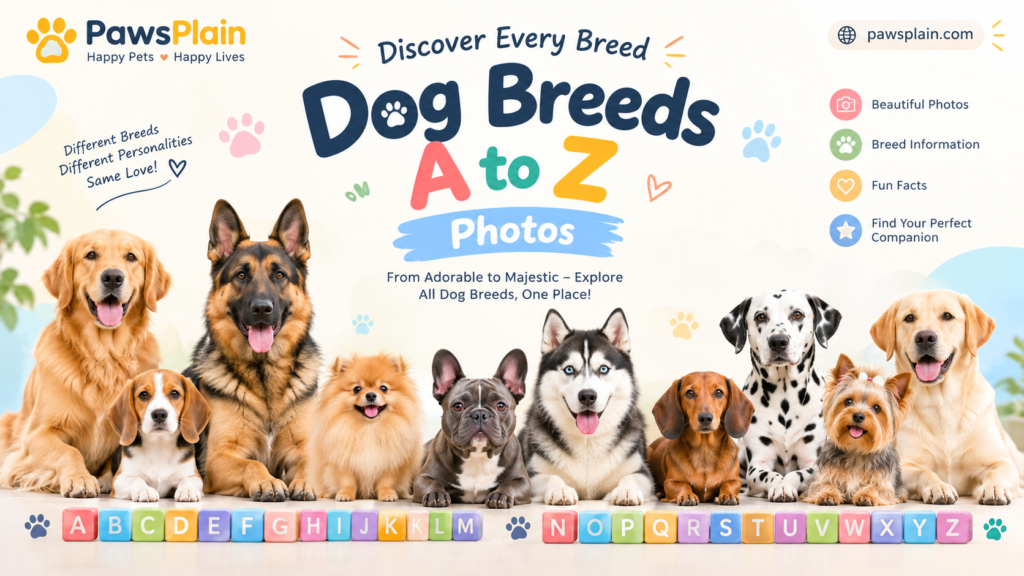
Dog Breeds A to Z Photos Looking for dog breeds A to Z with photos? This guide gives you an alphabetical tour of the breeds recognized by the American Kennel Club, along with practical information about temperament, size, activity, grooming, and everyday care. Whether you’re researching a future companion or simply love dogs, the A–Z format makes it easier to compare breeds without getting lost in a huge list.
The American Kennel Club currently recognizes 200 dog breeds, while many more breeds are recognized by kennel organizations around the world. That means there is no single universal list of every dog breed. This guide uses the AKC’s current breed directory as its main reference and focuses on the characteristics that actually matter to owners. For more insight heare australian terrier
about Small Dog Breeds How to Use This Dog Breed A–Z Guide
A photo can tell you what a dog looks like, but appearance is only the beginning. Two dogs that look similarly fluffy may have completely different exercise, training, and grooming needs.
When comparing breeds, pay attention to:
- Energy level: Some dogs need substantial daily physical and mental activity, while others are happier with moderate exercise.
- Size: A small dog is not automatically easier to care for, and a large dog is not necessarily unsuitable for an apartment.
- Grooming: Long, curly, double, or corded coats can require significantly more maintenance than short coats.
- Temperament: Breed tendencies can provide useful clues, but individual personality still varies.
- Original purpose: Many modern companion dogs were originally developed for hunting, herding, guarding, retrieving, or other jobs.
- Lifestyle fit: Your schedule, home, family, other pets, and willingness to train all matter.
The AKC explains that breeds developed around particular physical and mental traits for specific jobs. Each recognized breed also has a written breed standard describing its expected characteristics.
Fluffy Dog Breeds Dog Breeds A to Z
Below is the current AKC alphabetical directory used for this guide. For a photo-based PawNook page, each breed name can be paired with a clear, properly licensed photo and a link to its individual breed guide.
Dog Breeds A to Z Photos A
- Affenpinscher
- Afghan Hound
- Airedale Terrier
- Akita
- Alaskan Klee Kai
- Alaskan Malamute
- American Bulldog
- American English Coonhound
- American Eskimo Dog
- American Foxhound
- American Hairless Terrier
- American Leopard Hound
- American Staffordshire Terrier
- American Water Spaniel
- Anatolian Shepherd Dog
- Appenzeller Sennenhund
- Australian Cattle Dog
- Australian Kelpie
- Australian Shepherd
- Australian Stumpy Tail Cattle Dog
- Australian Terrier
- Azawakh
The A group ranges from tiny companion dogs to powerful working breeds. An Affenpinscher, for example, has very different exercise and grooming needs from an Alaskan Malamute. Australian Cattle Dogs and Australian Kelpies also reflect how strongly working history can influence a breed’s activity level.
Dog Breeds A to Z Photos B
- Barbado da Terceira
- Barbet
- Basenji
- Basset Fauve de Bretagne
- Basset Hound
- Bavarian Mountain Scent Hound
- Beagle
- Bearded Collie
- Beauceron
- Bedlington Terrier
- Belgian Laekenois
- Belgian Malinois
- Belgian Sheepdog
- Belgian Tervuren
- Bergamasco Sheepdog
- Berger Picard
- Bernese Mountain Dog
- Bichon Frise
- Biewer Terrier
- Black and Tan Coonhound
- Black Russian Terrier
- Bloodhound
- Blue Picardy Spaniel
- Bluetick Coonhound
- Boerboel
- Bohemian Shepherd
- Bolognese
- Border Collie
- Border Terrier
- Borzoi
- Boston Terrier
- Bouvier des Ardennes
- Bouvier des Flandres
- Boxer
- Boykin Spaniel
- Bracco Italiano
- Braque du Bourbonnais
- Braque Francais Pyrenean
- Braque Saint-Germain
- Brazilian Terrier
- Briard
- Brittany
- Broholmer
- Brussels Griffon
- Bull Terrier
- Bulldog
- Bullmastiff
The B section contains some of the most recognizable dogs in the world. Border Collies are famous for their working intelligence, while Bernese Mountain Dogs are known for their large size and striking tri-color coats. A Beagle may look compact and easygoing, but its scent-hound background means its nose can be a major part of its behavior.
Dog Breeds A to Z Photos C
- Cairn Terrier
- Calupoh
- Canaan Dog
- Canadian Eskimo Dog
- Cane Corso
- Cardigan Welsh Corgi
- Carolina Dog
- Catahoula Leopard Dog
- Caucasian Shepherd Dog
- Cavalier King Charles Spaniel
- Central Asian Shepherd Dog
- Cesky Terrier
- Chesapeake Bay Retriever
- Chihuahua
- Chinese Crested
- Chinese Shar-Pei
- Chinook
- Chow Chow
- Cirneco dell’Etna
- Clumber Spaniel
- Cocker Spaniel
- Collie
- Coton de Tulear
- Croatian Sheepdog
- Curly-Coated Retriever
- Czechoslovakian Vlciak
C includes everything from the tiny Chihuahua to large guardian breeds. The Cavalier King Charles Spaniel and Coton de Tulear are very different from working dogs such as the Cane Corso or Central Asian Shepherd Dog. Breed size alone therefore doesn’t tell the full story.
Dog Breeds A to Z Photos D
- Dachshund
- Dalmatian
- Dandie Dinmont Terrier
- Danish-Swedish Farmdog
- Deutscher Wachtelhund
- Doberman Pinscher
- Dogo Argentino
- Dogue de Bordeaux
- Drentsche Patrijshond
- Drever
- Dutch Shepherd
The Dachshund is one of the clearest examples of form following function: its long body and short legs were developed for work involving burrowing. The Dalmatian, meanwhile, is instantly recognizable by its spotted coat and has historically been associated with coaching and carriage work.
Dog Breeds A to Z Photos E
- English Cocker Spaniel
- English Foxhound
- English Setter
- English Springer Spaniel
- English Toy Spaniel
- Entlebucher Mountain Dog
- Estrela Mountain Dog
- Eurasier
English breeds range from compact companion dogs to athletic sporting and working dogs. English Springer Spaniels and English Cocker Spaniels generally need more activity than their relaxed appearance might suggest.
Dog Breeds A to Z Photos F
- Field Spaniel
- Finnish Lapphund
- Finnish Spitz
- Flat-Coated Retriever
- French Bulldog
- French Spaniel
French Bulldogs are compact companion dogs, while Flat-Coated Retrievers and Field Spaniels were developed with much more active sporting roles in mind. This is a useful reminder that breed history can explain a dog’s modern behavior better than its appearance alone.
Dog Breeds A to Z Photos G
- German Longhaired Pointer
- German Pinscher
- German Shepherd Dog
- German Shorthaired Pointer
- German Spitz
- German Wirehaired Pointer
- Giant Schnauzer
- Glen of Imaal Terrier
- Golden Retriever
- Gordon Setter
- Grand Basset Griffon Vendéen
- Great Dane
- Great Pyrenees
- Greater Swiss Mountain Dog
- Greyhound
The G group includes several highly active breeds as well as calmer giants. German Shepherd Dogs were developed as versatile working dogs, while Golden Retrievers were developed as sporting dogs. Great Danes and Great Pyrenees are much larger, so owners need to consider space, food, equipment, and veterinary care as well as exercise.
Dog Breeds A to Z Photos H
- Hamiltonstovare
- Hanoverian Scenthound
- Harrier
- Havanese
- Hokkaido
- Hovawart
The H breeds show the range of canine jobs particularly well. Hounds were developed around scent or pursuit, while the Havanese is a much smaller companion breed.
Dog Breeds A to Z Photos I
- Ibizan Hound
- Icelandic Sheepdog
- Irish Red and White Setter
- Irish Setter
- Irish Terrier
- Irish Water Spaniel
- Irish Wolfhound
- Italian Greyhound
The Irish Wolfhound is famous for its impressive size, whereas the Italian Greyhound is one of the smaller sighthounds. Their shared broad category does not mean their daily care requirements are interchangeable.
Dog Breeds A to Z Photos J
- Jagdterrier
- Japanese Akitainu
- Japanese Chin
- Japanese Spitz
- Japanese Terrier
Japanese breeds range from the small companion-oriented Japanese Chin to larger, more independent breeds such as the Japanese Akitainu.
Dog Breeds A to Z Photos K
- Kai Ken
- Karelian Bear Dog
- Keeshond
- Kerry Blue Terrier
- Kishu Ken
- Komondor
- Korean Jindo Dog
- Kromfohrlander
- Kuvasz
Several K breeds have strong working or hunting histories. The Komondor’s distinctive corded coat is particularly memorable, but that coat also creates specific grooming responsibilities that prospective owners should understand before choosing the breed.
Dog Breeds A to Z Photos L
- Labrador Retriever
- Lagotto Romagnolo
- Lakeland Terrier
- Lancashire Heeler
- Lapponian Herder
- Large Munsterlander
- Leonberger
- Lhasa Apso
- Löwchen
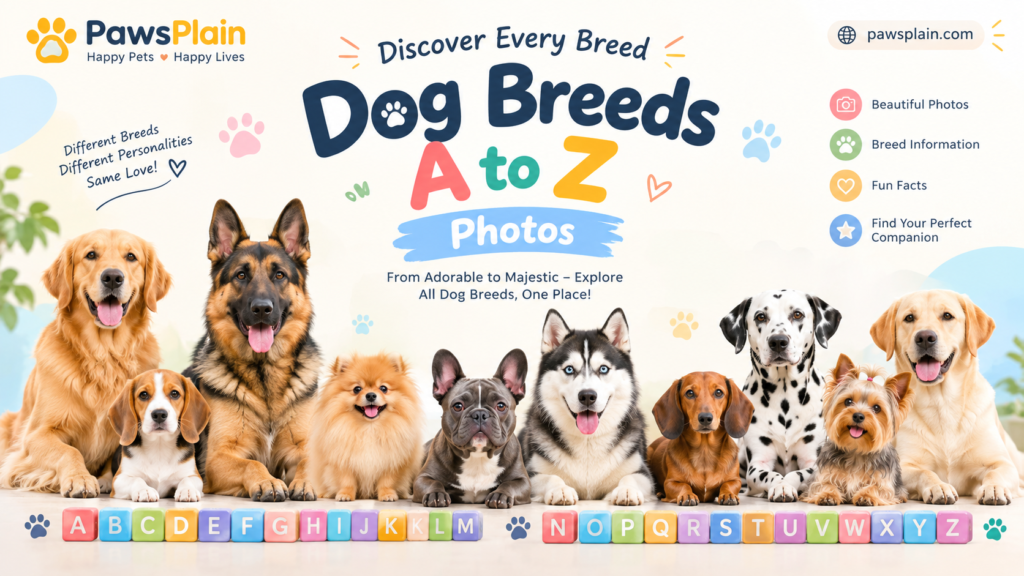
The Labrador Retriever is one of the most familiar family and sporting dogs, but its popularity should not be confused with low-maintenance ownership. Labradors still need exercise, training, enrichment, and appropriate weight management.
Dog Breeds A to Z Photos M
- Maltese
- Manchester Terrier (Standard)
- Manchester Terrier (Toy)
- Mastiff
- Miniature American Shepherd
- Miniature Bull Terrier
- Miniature Pinscher
- Miniature Schnauzer
- Mountain Cur
- Mudi
Mastiffs and Miniature Pinschers sit at opposite ends of the size spectrum. The Miniature American Shepherd and Mudi are examples of smaller dogs with strong working backgrounds and can need considerably more activity than someone might expect from their size.
Dog Breeds A to Z Photos N
- Neapolitan Mastiff
- Nederlandse Kooikerhondje
- Newfoundland
- Norfolk Terrier
- Norrbottenspets
- Norwegian Buhund
- Norwegian Elkhound
- Norwegian Lundehund
- Norwich Terrier
- Nova Scotia Duck Tolling Retriever
The Newfoundland is a large working breed with a long history around water, while the Norwegian Lundehund is an unusual breed with distinctive physical adaptations. A photo guide is especially useful for this section because some of these breeds are uncommon and easily confused with similar-looking dogs.
Dog Breeds A to Z Photos O
- Old English Sheepdog
- Otterhound
Both O breeds have distinctive appearances, but their coats require different grooming approaches. The Otterhound’s shaggy look is part of its working heritage rather than simply a decorative feature.
Dog Breeds A to Z Photos P
- Papillon
- Parson Russell Terrier
- Pekingese
- Pembroke Welsh Corgi
- Peruvian Inca Orchid
- Petit Basset Griffon Vendéen
- Pharaoh Hound
- Plott Hound
- Pointer
- Polish Lowland Sheepdog
- Pomeranian
- Pont-Audemer Spaniel
- Poodle (Miniature)
- Poodle (Standard)
- Poodle (Toy)
- Porcelaine
- Portuguese Podengo
- Portuguese Podengo Pequeno
- Portuguese Pointer
- Portuguese Sheepdog
- Portuguese Water Dog
- Presa Canario
- Pudelpointer
- Pug
- Puli
- Pumi
- Pyrenean Mastiff
- Pyrenean Shepherd
P may be one of the most visually diverse sections. Pomeranians, Pugs, Poodles, and Pembroke Welsh Corgis are familiar companion breeds, while breeds such as the Pudelpointer, Pointer, and Portuguese Water Dog reflect specialized working histories.
Dog Breeds A to Z Photos R
- Rafeiro do Alentejo
- Rat Terrier
- Redbone Coonhound
- Rhodesian Ridgeback
- Romanian Carpathian Shepherd
- Romanian Mioritic Shepherd Dog
- Rottweiler
- Russell Terrier
- Russian Toy
- Russian Tsvetnaya Bolonka
The R section includes small companion breeds alongside substantial working and hunting dogs. Rottweilers and Rhodesian Ridgebacks, in particular, should be evaluated for training needs and lifestyle fit rather than chosen simply because of their appearance.
Dog Breeds A to Z Photos S
- Saint Bernard
- Saluki
- Samoyed
- Schapendoes
- Schipperke
- Scottish Deerhound
- Scottish Terrier
- Sealyham Terrier
- Segugio Italiano
- Shetland Sheepdog
- Shiba Inu
- Shih Tzu
- Shikoku Ken
- Siberian Husky
- Silky Terrier
- Skye Terrier
- Sloughi
- Slovakian Wirehaired Pointer
- Slovensky Cuvac
- Slovensky Kopov
- Small Munsterlander
- Smooth Fox Terrier
- Soft Coated Wheaten Terrier
- Spanish Mastiff
- Spanish Water Dog
- Spinone Italiano
- Stabyhoun
- Staffordshire Bull Terrier
- Standard Schnauzer
- Sussex Spaniel
- Swedish Lapphund
- Swedish Vallhund
S contains some of the world’s best-known dogs, including the Siberian Husky, Shiba Inu, Saint Bernard, Samoyed, and Shih Tzu. Their needs vary dramatically. A Siberian Husky’s exercise and enrichment requirements should not be assumed to be similar to those of a Shih Tzu simply because both are popular household dogs.
Dog Breeds A to Z Photos T
- Taiwan Dog
- Teddy Roosevelt Terrier
- Thai Bangkaew
- Thai Ridgeback
- Tibetan Mastiff
- Tibetan Spaniel
- Tibetan Terrier
- Tornjak
- Tosa
- Toy Fox Terrier
- Transylvanian Hound
- Treeing Tennessee Brindle
- Treeing Walker Coonhound
Some T breeds are uncommon outside their regions of origin. The Tibetan Mastiff, for example, is a powerful guardian breed, while the Toy Fox Terrier is a much smaller companion and hunting-terrier type.
Dog Breeds A to Z Photos U
The AKC directory does not currently list a recognized breed beginning with U.
Dog Breeds A to Z Photos V
- Vizsla
- Volpino Italiano
The Vizsla is an athletic sporting breed known for its close relationship with its people. The Volpino Italiano is much smaller and belongs to the Spitz-type family.
Dog Breeds A to Z Photos W
- Weimaraner
- Welsh Springer Spaniel
- Welsh Terrier
- West Highland White Terrier
- Wetterhoun
- Whippet
- Wire Fox Terrier
- Wirehaired Pointing Griffon
- Wirehaired Vizsla
- Working Kelpie
The Whippet is a useful example of why exercise assumptions can be misleading. Sighthounds can be extremely athletic but may also spend substantial time relaxing at home. Working breeds such as the Working Kelpie have very different daily requirements.
Dog Breeds A to Z Photos X
- Xoloitzcuintli
The Xoloitzcuintli is an ancient Mexican breed found in hairless and coated varieties. Its appearance is unusual enough that a high-quality photo can be especially helpful when readers are learning to identify it.
Dog Breeds A to Z Photos Y
- Yakutian Laika
- Yorkshire Terrier
The Yorkshire Terrier is a tiny companion breed with a long, silky coat, while the Yakutian Laika is a northern working breed with a very different build and coat.
Dog Breeds A to Z Photos Z
The current AKC directory does not list a recognized breed beginning with Z.
What Should You Look at Besides a Dog’s Photo?
A good breed photo is useful for identification, but it should never be the deciding factor when choosing a dog. A common mistake is falling in love with a particular appearance and only afterward discovering that the breed needs significantly more exercise, grooming, training, or companionship than the household can provide.
Before choosing a breed, ask:
- How much daily exercise can I realistically provide?
- How much grooming am I prepared to do or pay for?
- Will the dog spend long periods alone?
- Are there children or other animals in the home?
- Can I manage the dog’s adult size?
- Am I prepared for training and mental enrichment?
- Does the breed’s typical temperament fit my household?
- Can I afford routine and unexpected veterinary care?
For example, a person living in a small apartment may assume that a tiny dog is automatically the easiest choice. That isn’t always true. Some small terriers and herding-type dogs can be energetic and vocal, while some larger dogs may be relatively calm indoors. The better question is whether the dog’s needs match the owner’s routine.
Small, Medium, and Large Dog Breeds
Size is useful, but it should be treated as a starting point rather than a complete lifestyle guide.
Small breeds
Small dogs can include breeds such as:
- Chihuahua
- Maltese
- Pomeranian
- Papillon
- Yorkshire Terrier
- Shih Tzu
- Toy Poodle
- Japanese Chin
Many small dogs are easier to physically accommodate in smaller homes, but they still need training, exercise, socialization, and appropriate veterinary care.
Dog Breeds A to Z Photos Medium breeds
Medium-sized options include:
- Beagle
- Border Collie
- Australian Cattle Dog
- Cocker Spaniel
- Corgi
- Shiba Inu
- Whippet
- Vizsla
This category covers a particularly wide range of temperaments and energy levels.
Dog Breeds A to Z Photos Large and giant breeds
Examples include: Dog Breeds A to Z Photos
- Great Dane
- Great Pyrenees
- Newfoundland
- Saint Bernard
- Irish Wolfhound
- Mastiff
- Leonberger
- Bernese Mountain Dog
With larger breeds, owners should consider more than floor space. Food costs, transportation, beds, crates, collars, grooming equipment, and veterinary expenses can all be affected by adult size.
Dog Breeds A to Z Photos Which Dog Breeds Are Good for Families?
There isn’t one breed that is automatically perfect for every family. A dog’s individual temperament, early socialization, training, age, and the family’s ability to supervise interactions all matter.
Popular family-oriented choices often include breeds such as Labrador Retrievers, Golden Retrievers, Cavalier King Charles Spaniels, and some Poodles. But popularity alone should never be treated as a guarantee of compatibility.
A better approach is to match the dog’s characteristics with the household. An energetic family that enjoys outdoor activities may have a very different ideal breed from a household that prefers quiet evenings and short walks.
Dog Breeds A to Z Photos Do All Dog Breeds Need a Lot of Exercise?
No. Exercise needs vary substantially between breeds and individuals.
A high-drive working or sporting breed may require regular physical activity plus mental challenges. Other dogs may be content with moderate walks and household interaction.
Even lower-energy breeds still benefit from movement, play, training, and enrichment. “Low energy” does not mean “no exercise.”
One practical mistake owners make is measuring exercise only in minutes of walking. Mental work matters too. Short training sessions, scent games, food puzzles, and appropriate play can give a dog useful mental stimulation.
Dog Breeds A to Z Photos Do All Dog Breeds Shed?
No two breeds have exactly the same coat characteristics, and “doesn’t shed” should be treated carefully.
Some dogs shed heavily or seasonally. Others shed less visibly but need regular brushing and professional grooming. Poodles, for example, have a coat that requires consistent maintenance even though they are often associated with reduced shedding.
There is also no dog breed that can be guaranteed to be completely allergy-free. Anyone with significant allergies should spend time around the breed before making a long-term commitment.
Dog Breeds A to Z Photos Frequently Asked Questions
How many dog breeds are there?
There is no single worldwide number because kennel organizations recognize different breeds. The AKC currently recognizes 200 breeds, while its breed information notes that more than 340 dog breeds are known worldwide. The FCI maintains its own international nomenclature and also recognizes breeds on definitive and provisional bases.
What is the easiest dog breed for a first-time owner?
There is no universally easiest breed. A first-time owner should consider trainability, energy, grooming, size, temperament, and the amount of time available for the dog. A breed that is manageable for one owner may be a poor fit for another.
What dog breed is best for an apartment?
Apartment suitability depends on more than size. Exercise requirements, barking, adaptability, and individual temperament all matter. Some medium or large dogs can adapt well to apartment life when their exercise and enrichment needs are met, while some small high-energy dogs may be more challenging.
Which dog breeds require the most grooming?
Long, curly, corded, or heavily coated breeds often require more grooming than short-coated breeds. Grooming can include brushing, bathing, coat trimming, nail care, and regular professional appointments depending on the breed.
Are mixed-breed dogs included in the AKC A–Z list?
This A–Z directory follows the AKC’s recognized-breed list. Mixed-breed dogs are not simply another breed category in that directory. They can nevertheless make excellent companions, and the same lifestyle considerations—energy, size, temperament, training, and grooming—still matter.
Dog Breeds A to Z Photos The Bottom Line
A dog breed photo can help you recognize a dog, but it cannot tell you whether that dog will fit your life. Use the A–Z list as a starting point, then look beyond appearance at exercise, temperament, grooming, training, adult size, and the dog’s original purpose. For individual health or care questions, confirm breed-specific recommendations with a veterinarian or another qualified professional. The best match is not necessarily the most popular or cutest breed—it is the dog whose needs you can consistently meet.
[…] The Australian Terrier is a small, energetic, intelligent, and confident dog with a big personality. Originally developed in Australia as a working terrier, this compact breed was used to control rodents and snakes and also served as a watchdog and family companion. Today, the Australian Terrier is appreciated as a loyal household dog that combines a courageous working nature with an affectionate personality. For more insigth read heare dog breeds a to z photos […]