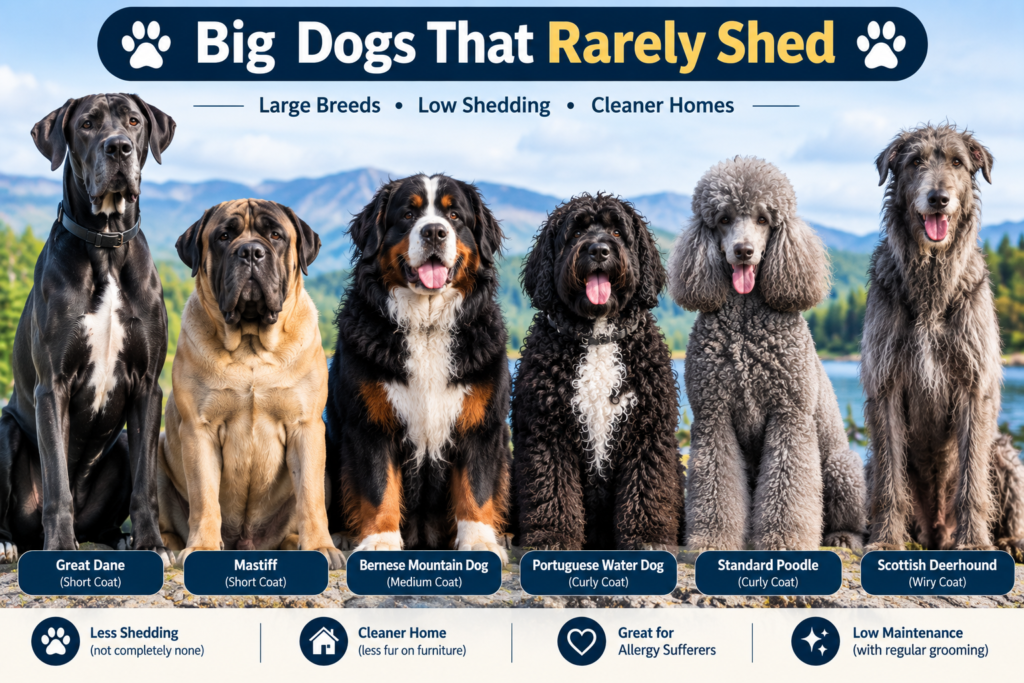
If you love large dogs but want to avoid a home covered in loose fur, several breeds shed much less than the typical heavy-shedding dog. Big dogs that rarely shed include the Standard Poodle, Giant Schnauzer, Portuguese Water Dog, Irish Water Spaniel, and several other breeds with curly, wiry, or continuously growing coats.
However, rarely shedding does not mean completely hair-free. Many low-shedding dogs need more grooming, because loose hairs can remain trapped in the coat instead of falling onto your furniture and floors. For more insight here big dogs that dont malt
What Does “Rarely Shed” Mean in Dogs?
Every dog loses some hair. Shedding is a normal part of maintaining a healthy coat, but the amount varies greatly between breeds.
Some dogs have thick double coats that release large amounts of hair, particularly during seasonal coat changes. Others have coats that grow continuously or hold loose hairs within curls and furnishings.
For owners, the difference can be noticeable.
A low-shedding large dog may leave: Big Dogs That Rarely Shed
- Less hair on furniture
- Fewer loose hairs on clothing
- Less visible fur on floors
- Less hair collecting in corners
- More grooming requirements instead
The last point is easy to overlook. A low-shedding coat still needs regular brushing and, in many cases, trimming.
1. Standard Poodle
The Standard Poodle is one of the most recognizable large low-shedding breeds. Its dense, curly coat tends to retain loose hairs rather than dropping them around the home.
Despite its elegant appearance, this is not a delicate or inactive dog. Standard Poodles are intelligent, athletic, and often enjoy activities that challenge both their bodies and minds.
Grooming needs
The coat needs consistent brushing to reduce tangling and matting. Many owners also use professional grooming to maintain a manageable coat length.
Best suited to
- Active families
- Owners who enjoy training
- People comfortable with regular grooming
- Homes that can provide mental stimulation
Common mistake: Assuming a Poodle’s low shedding means low maintenance. Its coat can require considerable work.
2. Giant Schnauzer
The Giant Schnauzer combines a large, powerful body with a wiry coat that generally sheds relatively little.
This is a working breed with plenty of energy and a strong personality. It can be protective and requires thoughtful training and socialization.
Why consider a Giant Schnauzer?
- Large and athletic
- Low-shedding coat
- Intelligent
- Strong working instincts
- Enjoys structured activities
This breed is usually a better match for experienced owners who can provide daily physical activity and consistent training.
3. Portuguese Water Dog
The Portuguese Water Dog is an athletic, medium-to-large breed known for its curly or wavy coat and relatively low shedding.
These dogs were developed for work around water, so they tend to enjoy active lifestyles. Swimming, retrieving, hiking, and interactive games can all provide useful outlets.
Coat care
The coat still requires regular brushing and trimming. Curly coats can tangle when neglected, so owners need a consistent grooming routine.
Good fit: Active families who want a trainable dog and enjoy outdoor activities.
4. Irish Water Spaniel
The Irish Water Spaniel is one of the less common choices for people searching for a large dog that rarely sheds.
Its curly coat gives it a distinctive appearance, while its athletic background makes it well suited to active households.
These dogs generally benefit from: Big Dogs That Rarely Shed
- Daily exercise
- Training games
- Outdoor activities
- Regular coat maintenance
- Plenty of interaction with their owners
Their unusual appearance and water-loving heritage make them an interesting alternative to more familiar breeds.
5. Afghan Hound
The Afghan Hound is famous for its long, flowing coat, which might make it seem like an obvious heavy shedder. In reality, it is considered a relatively low-shedding breed.
The major tradeoff is grooming.
That long coat needs regular attention to prevent tangles and keep it healthy-looking. Owners who choose an Afghan Hound primarily because it sheds less should understand that grooming can be a significant commitment.
Afghan Hound personality
Afghan Hounds are often independent and dignified. They may not have the eager-to-please style that some highly trainable working breeds display.
Best for: Owners who appreciate an elegant breed and are prepared for substantial coat care.
6. Bouvier des Flandres
The Bouvier des Flandres is a large, sturdy working breed with a rough-textured coat that generally produces less loose hair than many double-coated large dogs.
Its substantial build means that owners need to consider exercise, training, space, and grooming together.
A Bouvier may suit you if you want: Big Dogs That Rarely Shed
- A powerful large dog
- A working-dog personality
- A textured low-shedding coat
- An active companion
- A dog with a distinctive appearance
The coat can become tangled if brushing is neglected, so low shedding should never be confused with low maintenance.
7. Black Russian Terrier
The Black Russian Terrier is a large, imposing breed with a dense coat that tends to shed relatively little.
Because of its size and strength, this breed needs an owner who is prepared to provide structured training and appropriate socialization.
Its coat also requires maintenance, particularly when kept in the breed’s characteristic trimmed style.
This can be an appealing option for someone looking for a large, powerful dog without the heavy loose-fur problem associated with some other giant breeds.
8. Standard Schnauzer
Although the Standard Schnauzer isn’t as large as a Giant Schnauzer, it is still a sturdy medium-sized working dog and can be worth considering when low shedding is a priority.
Its wiry coat generally produces relatively little loose hair, but the beard, eyebrows, and leg furnishings need regular care.
Standard Schnauzers tend to be active and intelligent, so they are better suited to households that can provide daily exercise and engagement.
9. Barbet
The Barbet is a French water dog with a dense, curly coat that is known for relatively low shedding.
This breed can make a lively companion for people who enjoy an active dog and are willing to maintain its coat.
Its curls can hold loose hairs, which helps explain why owners may see less loose fur around the home. At the same time, those curls need regular brushing to prevent knots.
Big Dogs That Rarely Shed at a Glance
| Breed | Shedding | Grooming | Activity |
|---|---|---|---|
| Standard Poodle | Very low | High | High |
| Giant Schnauzer | Low | High | High |
| Portuguese Water Dog | Low | High | High |
| Irish Water Spaniel | Low | Moderate–High | High |
| Afghan Hound | Low | High | Moderate |
| Bouvier des Flandres | Low | High | Moderate–High |
| Black Russian Terrier | Low | High | Moderate–High |
| Standard Schnauzer | Low | Moderate–High | High |
| Barbet | Low | High | Moderate–High |
The exact amount of shedding can vary between individual dogs, and grooming practices can also affect how much loose hair you notice.
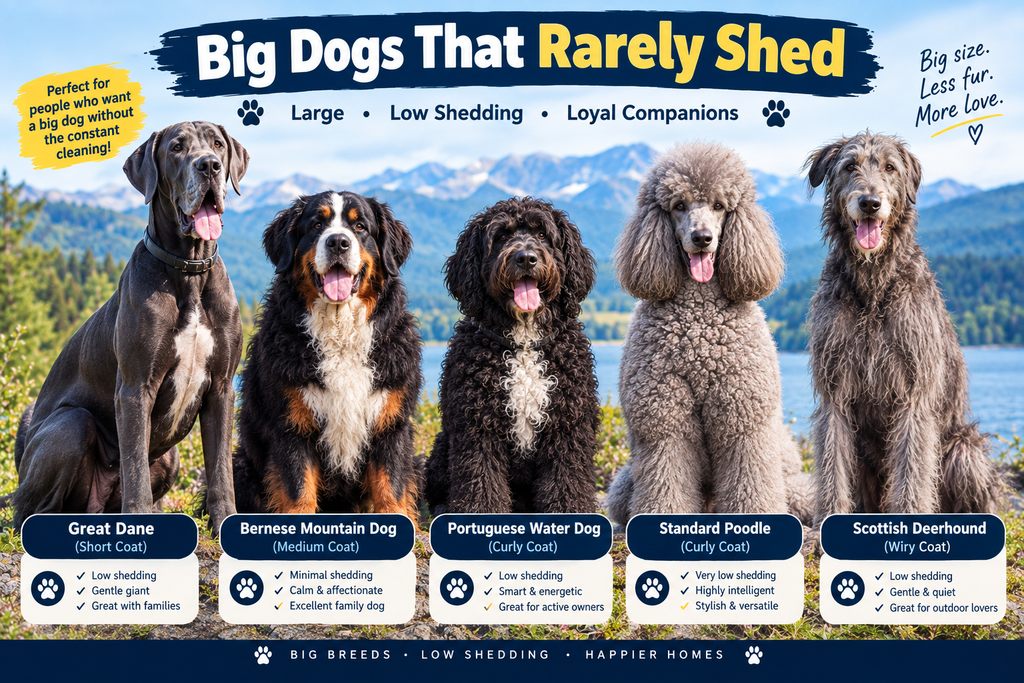
Why Do Low-Shedding Dogs Still Need So Much Grooming?
This is one of the biggest misconceptions about low-shedding breeds.
A dog that drops less hair around your home can actually require more coat maintenance than a dog that sheds heavily.
With many curly or wiry coats, loose hairs become caught within the surrounding coat. If they are not brushed out, they can contribute to tangles and mats.
A typical grooming routine may involve: Big Dogs That Rarely Shed
- Regular brushing
- Combing through dense areas
- Trimming
- Bathing when appropriate
- Checking behind the ears
- Checking around the legs and collar
- Professional grooming when needed
For example, a Standard Poodle may leave relatively little loose hair on your sofa, but its coat cannot simply be ignored for weeks.
Are Big Low-Shedding Dogs Good for Families?
Some are excellent family companions, but breed choice should be based on more than shedding.
A large dog needs enough space, exercise, training, and appropriate socialization. The dog’s individual temperament also matters.
For a family with young children, for example, a calm temperament and appropriate supervision may matter more than whether the dog leaves a small amount of hair behind.
Consider these questions before choosing a breed: Big Dogs That Rarely Shed
- How much exercise can your family provide?
- How much grooming can you manage?
- Are there young children in the home?
- Does the breed have strong working or protective instincts?
- How much training experience does the household have?
- Can everyone safely manage a large dog?
Are Low-Shedding Dogs Hypoallergenic?
No dog is completely hypoallergenic.
People with dog allergies may react to proteins associated with dander, saliva, and other biological material rather than simply reacting to loose hair. A low-shedding breed may work better for some individuals, but there is no guarantee.
If allergies are a serious concern, spending time with the specific breed or individual dog before bringing one home can provide useful information. A medical professional can also help you manage significant allergies.
How to Keep a Low-Shedding Dog’s Coat Healthy
A simple grooming routine can make a major difference.
1. Brush consistently
Don’t wait until you see obvious tangles. Regular brushing helps remove loose hair and keeps the coat easier to manage.
2. Check problem areas
Pay special attention to: Big Dogs That Rarely Shed
- Behind the ears
- Under the collar
- Around the legs
- The chest
- Areas where the coat rubs against itself
3. Keep grooming appointments
Breeds with continuously growing or heavily textured coats may benefit from professional grooming.
4. Don’t shave automatically
Coat length and trimming requirements vary by breed. Ask a qualified groomer or veterinarian about the appropriate approach for your dog’s coat rather than assuming shaving is always helpful.
5. Watch for unusual hair loss
Normal shedding varies by breed, but sudden or unusual hair loss, bald patches, significant itching, or skin changes should be discussed with a veterinarian.
Low-Shedding Does Not Mean Low-Energy
Another common mistake is choosing a low-shedding breed because it looks easy to care for.
Many of these dogs are active working or sporting breeds.
A Portuguese Water Dog, Giant Schnauzer, Standard Poodle, or Irish Water Spaniel may need considerably more exercise and mental stimulation than someone expecting a relaxed companion realizes.
For example, a dog that receives only a short walk when it needs substantially more activity may become bored and look for its own entertainment.
A better approach is to match the breed to your lifestyle before focusing on coat type.
What Is the Best Large Dog That Rarely Sheds?
There isn’t one universally best breed because the right choice depends on what you want from your dog.
A Standard Poodle may appeal to someone who wants intelligence and trainability. A Giant Schnauzer may suit someone interested in a powerful working breed. A Portuguese Water Dog can be a strong option for an active household that enjoys outdoor activities.
The most useful comparison is therefore: Big Dogs That Rarely Shed
- Want an intelligent, versatile companion? Look at the Standard Poodle.
- Want a strong working dog? Research the Giant Schnauzer.
- Love water and outdoor activities? Consider the Portuguese Water Dog.
- Want a distinctive, elegant appearance? Explore the Afghan Hound.
- Prefer a rugged working breed? Research the Bouvier des Flandres.
Frequently Asked Questions
What large dog sheds the least?
The Standard Poodle is one of the best-known large low-shedding breeds. Giant Schnauzers and Portuguese Water Dogs are also commonly considered when owners want a large dog that produces relatively little loose hair.
Are there any big dogs that never shed?
No dog should be considered completely non-shedding. Some breeds shed very little, but all dogs can lose some hair as part of normal coat growth and maintenance.
What big dogs are good for people who dislike dog hair?
Standard Poodles, Giant Schnauzers, Portuguese Water Dogs, Irish Water Spaniels, and other low-shedding breeds may be worth researching. Remember that their grooming requirements can be substantial.
Do low-shedding dogs require professional grooming?
Some do. Dogs with curly, long, or heavily textured coats can be difficult to maintain without regular trimming or professional grooming. The exact schedule depends on the breed and the coat style.
Are low-shedding dogs easier for allergy sufferers?
Not necessarily, although some people find low-shedding breeds easier to live with. Dog allergies involve more than loose hair, so individual reactions vary.
The Bottom Line
If you want a large companion without dealing with heavy amounts of loose fur, there are several big dogs that rarely shed. Standard Poodles, Giant Schnauzers, Portuguese Water Dogs, Irish Water Spaniels, and similar breeds can greatly reduce visible shedding, but they often replace it with a higher grooming commitment. Before choosing one, consider the complete package—size, exercise, temperament, training, grooming, and your household’s daily routine—not just the amount of hair it leaves behind.
[…] In this guide, you’ll discover 10 large dogs that shed very little, learn about their characteristics, and find out which breed may suit your lifestyle best. For more insight here big dogs that rarely shed […]